


Modern Sliding Wardrobe Door Design Ideas for 2026
Table of Contents
- What Makes a Sliding Wardrobe Door Look Modern in 2026
- Sliding Wardrobe Door Finishes: Mirror, Glass, Woodgrain and Lustre
- Panel Layouts: Full Panel, Split Panel and Mixed-Media Designs
- Bespoke Sliding Wardrobe Interiors That Fit Awkward Spaces
- Hardware Longevity: Soft-Close Mechanisms and Sliding Track Quality
- Lighting Integration and Sustainable Materials for Modern Wardrobes
- DIY or Professional Installation: What to Expect
- Frequently Asked Questions
Last Updated: September 23, 2026
What Makes a Sliding Wardrobe Door Look Modern in 2026
Modern sliding wardrobe door design ideas in 2026 lean on three things: slim frames, wide panels, and finishes that reflect light rather than absorb it. This guide from DoorsDirect covers the finishes, layouts, hardware and installation choices that keep a wardrobe looking current for years.
Slimline Aluminium Profiles and Handleless Fronts
A slimline aluminium profile keeps the visible border around each panel to a minimum, so a mirror or glass door looks like one continuous surface rather than a framed picture. DoorsDirect uses aluminium for both profile and track, not steel, which matters for how the system holds up over years of daily use.
Sliding Wardrobe Door Finishes: Mirror, Glass, Woodgrain and Lustre
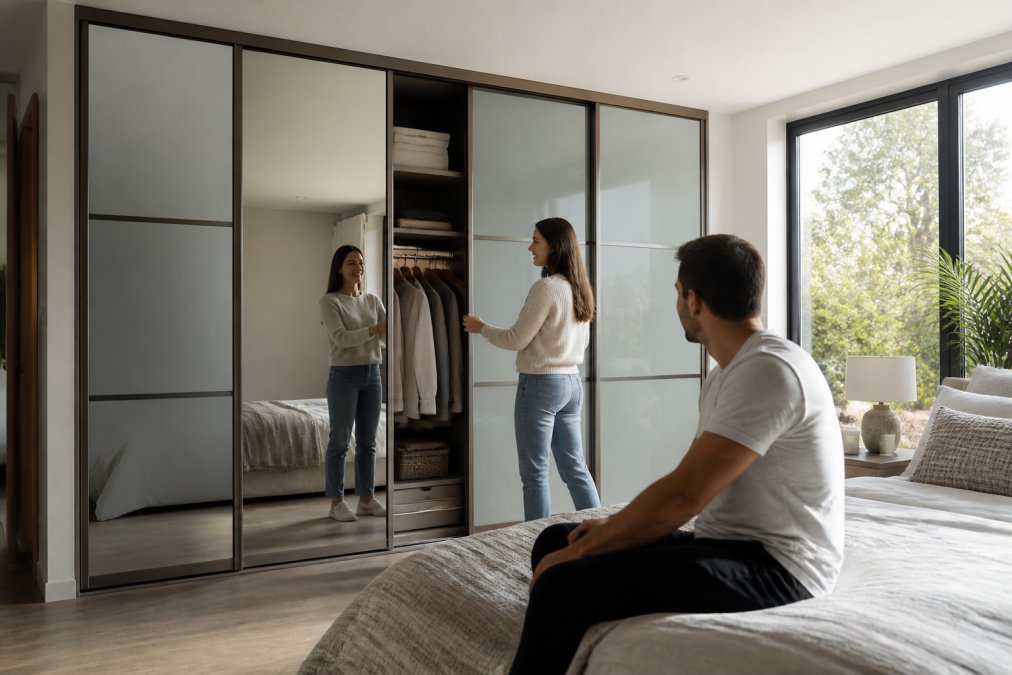
Finish choice is the biggest decision in sliding wardrobe door finishes, because it controls how much light the room gets back, how large the wardrobe feels, and how much maintenance the doors demand. Mirror reflects and expands; frosted glass softens and hides; woodgrain and melamine warm the space and suit period properties; lustre finishes catch light without a full reflection.
Frosted Glass, Reflective Surfaces and Colour Palettes
Frosted glass gives you the reflective quality of glass without turning the bedroom into a mirror hall, and hides the wardrobe contents behind a soft blur. Reflective surfaces work best as the only high-shine element in the room.
Glass Specification: What to Check Before You Order
Not all glass doors are equal, and the differences rarely show in a showroom. Three specifications matter:
- Toughened safety glass. Bedroom wardrobe doors should use toughened glass to BS EN 12150, which breaks into blunt fragments rather than sharp shards. A supplier who can't quote the standard is usually using annealed glass.
- Glass thickness. Most sliding wardrobe doors use 4mm or 5mm glass. Thinner panels flex and rattle in wide doors; thicker panels add weight the running gear must carry.
- Backing and coating. Mirror panels are usually glass with a silvered backing. Cheaper mirrors use a thinner backing that can develop 'black edge' corrosion where moisture reaches the cut edge. Sealed edges last longer in bathrooms and en-suites.
Material Durability and Maintenance by Finish
| Finish | Best For | Light Effect | Maintenance Reality |
|---|---|---|---|
| Full mirror | Small or dark bedrooms | Strong reflection, expands space | Daily wipe; shows every smudge and fingerprint |
| Frosted glass | Bedrooms needing privacy | Soft, diffused light | Low; hides marks well |
| Clear glass | Display-style storage | High reflection | Frequent cleaning; shows dust on both faces |
| Woodgrain / melamine | Period homes, warm schemes | Absorbs light, adds texture | Dust and wipe; textured grains trap dust in the profile |
| Lustre panel | Contemporary, understated rooms | Subtle sheen | Low to moderate; fingerprints show under direct light |
Sustainable and Eco-Friendly Finish Options
The panel substrate, profile metal and glass all have an end-of-life story worth asking about:
- FSC-certified timber substrates. If the door uses a timber or veneer core, ask whether it carries FSC or PEFC certification, a chain-of-custody claim, not a marketing label, and a supplier should show the certificate number.
- Recycled aluminium profiles. Aluminium is highly recyclable, and recycled-content extrusion carries a fraction of the embodied carbon of primary aluminium. Ask what proportion of recycled content the profile contains.
- Recycled or reclaimed glass. Some suppliers offer glass panels with recycled content. It performs identically to virgin glass; the only trade-off is availability and lead time.
- Low-VOC finishes and adhesives. Melamine-faced panels and their bonding adhesives vary in formaldehyde emission class. E1 or E0 rated boards are the lower-emission options worth specifying for bedrooms.
Panel Layouts: Full Panel, Split Panel and Mixed-Media Designs
Panel layout decides the character of the door. A full panel gives one uninterrupted sheet of glass, mirror or melamine per door, suiting minimalist and contemporary rooms. A split panel breaks the door into sections, usually three per door, adding structure without clutter.
Bespoke Sliding Wardrobe Interiors That Fit Awkward Spaces
Bespoke sliding wardrobe interiors solve the rooms standard units can't: alcoves, chimney breasts, dormer walls and uneven openings. Made-to-measure doors are cut to your actual dimensions rather than trimmed from a stock size, which is why they close flush and stay on track.
Wardrobe Internals: Track Systems and Interior Configuration
The carcass and internals are separate decisions from the doors. A well-planned interior typically splits the space into a full-height hanging section, a double-hang section for shirts and trousers, and drawers or shelving for folded items and shoes.
Track Systems: Top-Hung vs Bottom-Rolling
Sliding wardrobe doors run on one of two track systems, and the choice affects how the door feels, how much weight it carries, and how the floor is finished:
- Top-hung systems. The door hangs from a top track, with a small bottom guide for alignment. The floor stays clear, which suits rooms where you don't want a visible track across carpet or tile. Top-hung doors need a solid fixing into a lintel or reinforced head rail, because the whole weight hangs from that line.
- Bottom-rolling systems. The door's weight sits on rollers in a bottom track, with a top guide for alignment. These carry heavier doors more comfortably and are more forgiving on older ceilings, but the bottom track is visible and collects dust unless recessed.
Weight-Bearing Capacity and Door Sizing
Door weight decides which hardware you need. A full-height mirror door in a slimline aluminium frame is substantially heavier than the same size in melamine, and the running gear must be rated for the load:
- Wider doors carry more weight and flex more. A three-door set distributes load across three leaves, but each leaf still needs its own rated roller set.
- Soft-close mechanisms add resistance and should be matched to the door weight, not fitted as a generic add-on.
Soft-Close and Running Gear Longevity
A soft-close mechanism controls the last few centimetres of travel so the door settles rather than slams, protecting the frame and track.
Hardware Longevity: Soft-Close Mechanisms and Sliding Track Quality
Track quality matters just as much. Aluminium tracks resist the wear and distortion that steel tracks develop, and the brush pile edging along the door edge keeps dust out of the running gear. DoorsDirect supplies aluminium profile and track across its ranges and backs them with a ten-year guarantee.
Lighting Integration and Sustainable Materials for Modern Wardrobes
Two things the standard design gallery never shows you: how the wardrobe is lit, and what it's made from.
DIY or Professional Installation: What to Expect
Sliding wardrobe doors can be a competent DIY job if the opening is square and the floor and ceiling are level. The doors hang from a top track and run on a bottom track, so the critical work is fixing those two lines parallel and true. Get that right and the rest is straightforward.
| Situation | Recommended Route | Why |
|---|---|---|
| New build, square opening | DIY is realistic | Level surfaces, straightforward fixing |
| Older property, uneven ceiling | Professional fit | Track needs packing to a true line |
| Very wide opening, three doors | Professional fit | Weight and alignment tolerance |
| Trade project, multiple units | Trade support | Consistent spec across plots |
Frequently Asked Questions
How do I modernise sliding wardrobe doors without replacing them?
You can update the look by changing the panel finish rather than the whole carcass. Swapping dated wood veneer for mirror, frosted glass or a matt melamine panel instantly shifts the style. New slimline aluminium profiles and a soft-close mechanism also make older doors feel current. If the track system is worn, replacing the sliding track is often the single biggest upgrade for smooth, quiet movement. Made-to-measure replacement doors let you keep the opening you already have while changing the entire aesthetic.
What are the latest trends in sliding wardrobe door design?
Handleless fronts, slimline aluminium profiles and mixed-media panels dominate current designs. Full mirror doors remain popular for reflecting light and making small bedrooms feel larger, while frosted glass and lustre finishes add texture without losing brightness. Two-tone and mixed-media combinations, pairing woodgrain with mirror or coloured glass, give a bespoke look. Floor-to-ceiling doors that run the full height of the wall create a seamless, minimalist result that hides clutter completely.
Are sliding wardrobe doors still in style?
Yes. Sliding wardrobe doors suit modern and contemporary interiors because they need no clearance space to open, which makes them ideal for small bedrooms, alcoves and loft rooms. The current focus on handleless, minimalist fronts and slimline aluminium tracks keeps them firmly in fashion. With finishes ranging from mirror and frosted glass to woodgrain veneer, they work across colour palettes and room dimensions. A ten-year guarantee on quality components also makes them a long-term choice rather than a short-lived trend.
What is the best design for a sliding wardrobe in a small bedroom?
Full mirror or frosted glass panels on a slimline aluminium frame work best in small bedrooms because reflective surfaces bounce light around and reduce visual bulk. Floor-to-ceiling doors remove the horizontal break above the wardrobe, making the ceiling feel higher. Inside, bespoke sliding wardrobe interiors with a well-planned interior configuration maximise every centimetre. Soft-close mechanisms and a quality sliding track keep daily use quiet, which matters when space is tight.
Getting the finishes, layout and hardware right at the planning stage is what keeps a sliding wardrobe looking current long after installation. DoorsDirect makes every door to measure, offers mirror, glass, woodgrain and lustre finishes across its ranges, and backs each set with a ten-year guarantee and a three-stage quality check. Get started with DoorsDirect and order yours today.
Leave a comment