


Bespoke Wardrobe Interiors for Small Bedrooms: 2026 Guide
Table of Contents
- Why Bespoke Wardrobe Interiors Beat Off-the-Shelf Storage in Small Rooms
- Fitted Wardrobe Internal Layout Ideas That Work in Tight Spaces
- Sliding Doors vs Hinged Doors: Which Saves More Floor Space
- Space-Saving Wardrobe Accessories That Earn Their Place
- Making Awkward Corners and Alcoves Work Harder
- Materials, Finishes and Lighting: Choices That Change How Small a Room Feels
- DIY Kits vs Professional Bespoke: What Suits Your Budget and Skills
- Frequently Asked Questions
Last Updated: September 17, 2026
Why Bespoke Wardrobe Interiors Beat Off-the-Shelf Storage in Small Rooms
A standard 600mm-deep freestanding wardrobe can eat up to a fifth of the usable floor area in a compact bedroom, and still leaves dead zones above the frame and beside the wall. Bespoke wardrobe interiors solve that because every panel, rail and shelf is cut to your actual room dimensions rather than a factory average. At DoorsDirect, we build made-to-measure interiors and sliding doors for awkward alcoves, tight floor plans, and rooms where a few centimetres decide whether the door opens or scrapes.

UK government guidance on permitted development for home improvements
Fitted Wardrobe Internal Layout Ideas That Work in Tight Spaces
A workable fitted wardrobe internal layout divides the carcass into three vertical zones: hanging, shelving and drawers, each sized to what you actually own. Get those proportions right and a 2100mm opening holds more than a wider wardrobe with a single rail.
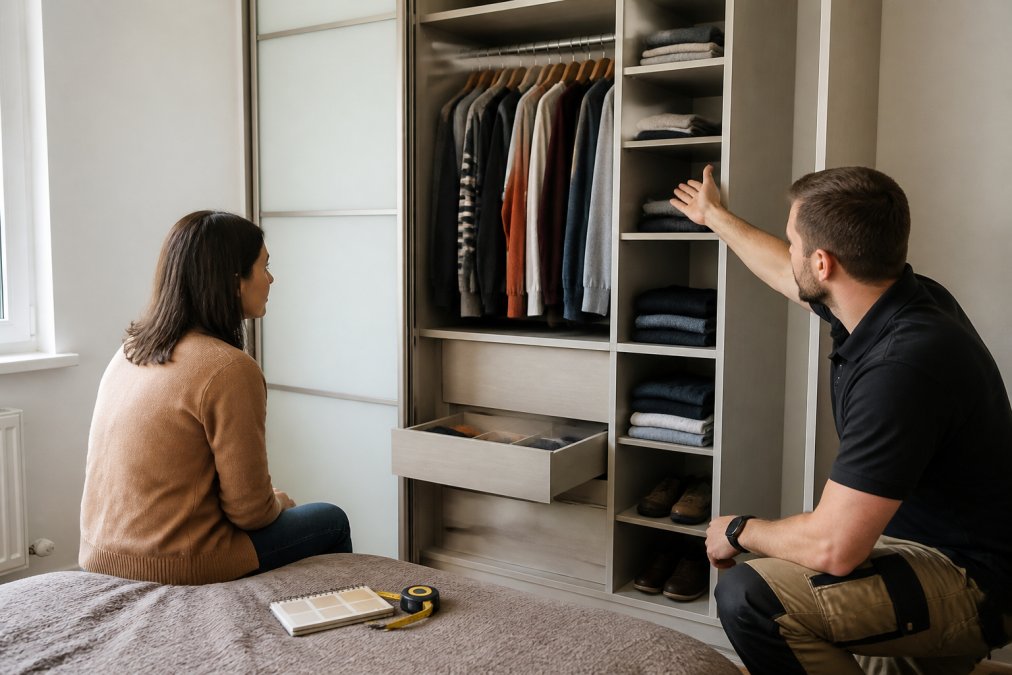
Hanging, Shelving and Drawer Zones by Room Dimensions
The zone split depends on your ceiling height and opening width, not a fixed template.
| Zone | Typical Allocation | Best For |
|---|---|---|
| Full-height hanging | 40-50% of width | Coats, dresses, long garments |
| Double hanging | 30% of width | Shirts, trousers, folded tops |
| Shelving stack | 20-30% of width | Folded items, bags, boxes |
| Drawer bank | 2-4 drawers | Accessories, underwear, small items |
Sliding Doors vs Hinged Doors: Which Saves More Floor Space
Sliding doors save more floor space, and it is not close. A hinged door needs a clear arc of roughly its own width to open, often the exact patch of floor you need for a bed or bedside table. Sliding panels travel along the track instead, so nothing swings into the room. The trade-off is depth: sliding systems need a slightly deeper frame to house the track, so you lose a few centimetres front to back, a better deal than losing a metre of walking space.
- Hinged doors: cheaper per panel, full access to the whole interior at once, needs clearance to swing
- Sliding doors: no swing clearance, better for narrow rooms, panels overlap so access is one half at a time
Space-Saving Wardrobe Accessories That Earn Their Place
Space-saving wardrobe accessories are worth buying only when they replace floor area or reach. The test: does the accessory let you store something you currently keep on the floor, the bed or a chair? If not, it is wasted depth in a small room.
The accessories that consistently pull their weight:
- Full-extension drawer inserts, so you can see the back of the drawer without emptying it.
- Pull-down or angled rails for high sections you cannot reach standing.
- Internal mirror panels on a door, removing the need for a separate dressing mirror and freeing a wall.
- Shoe racks fitted to the base, using the dead space under the hanging zone, usually the bottom 150-200mm of a full-height run.
- A slim pull-out trouser rack, which holds more than a folded stack in the same footprint and keeps creases out.
Ergonomic internal dimensions that make accessories work
Accessories only earn their place if the carcass around them is dimensioned for a human body, not a catalogue. Fitters commonly work to these figures:
| Element | Sensible internal dimension | Why it matters in a small room |
|---|---|---|
| Full-height hanging drop | 1500-1700mm clear below the rail | Fits long coats and dresses without crushing shoulders |
| Double hanging drop | 900-1000mm per rail | Two rails in the height of one, roughly doubling shirt and trouser capacity |
| Shelf spacing | 300-350mm apart | Fits folded knitwear and standard storage boxes without wasted air |
| Drawer internal depth | 400-500mm front to back | Deep enough for folded items, shallow enough to see the back |
| Drawer internal height | 150-200mm | Stops contents sliding over the sides when the drawer is pulled out |
| Rail clearance from back panel | 50-60mm minimum | Lets hangers sit flat instead of jamming against the back |
Smart additions that suit a compact interior
Smart-home integration is one of the cheapest ways to make a small interior feel considered rather than cramped:
Making Awkward Corners and Alcoves Work Harder
Awkward corners and alcoves are usually the best storage in the room, because nothing else fits there. A chimney breast, a recess beside a door, or a stepped wall all create depth a freestanding unit cannot use.
Royal Institution of Chartered Surveyors guidance on home improvements
Materials, Finishes and Lighting: Choices That Change How Small a Room Feels
Materials and finishes change how small a room feels more than the wardrobe's footprint does. A dark, heavy finish absorbs light and closes the space in; a pale or reflective surface bounces light back. What most guides skip is the specification behind the finish, the board, the edging and the sourcing, which decides whether a fitted interior lasts.
Board, edging and what to ask for
Most made-to-measure interiors in the UK market are built from 18mm furniture-grade particleboard or MDF, finished with a melamine or veneer face and edged with 2mm PVC or ABS banding. The details that matter:
- Board thickness. 18mm is the standard for carcass panels and shelves. Thinner board sags under stacked knitwear; thicker board adds weight without adding stiffness.
- Edging thickness. 2mm PVC or ABS edging protects the cut edge far better than the 0.4mm foil used on flat-pack units. It is the single most common point of failure on cheap interiors.
- Moisture resistance. In a bedroom with an en-suite or poor ventilation, ask whether the board is moisture-resistant (often marked MR or green-core). It prevents edge swell.
- Formaldehyde rating.
- Finish type. Melamine is hard-wearing and easy to wipe; veneer looks warmer but needs more care; high-gloss acrylic reflects light but shows fingerprints.
Sustainability and sourcing
Longevity is the most sustainable choice in a fitted wardrobe, because the greenest interior is the one you do not replace.
Lighting that makes a small interior work
Lighting matters as much as finish.
For smart home integration, an internal sensor strip that switches on when the door opens is a straightforward addition on most fitted builds, and can be paired with a phone app.
DIY Kits vs Professional Bespoke: What Suits Your Budget and Skills
- Choose a DIY kit if your opening is square, you have a second pair of hands, and you are comfortable cutting panels to size. The Economy Contract Interior is a self-assembly shelf stack with five shelves and three hanging rails, and the rails can be cut to your opening width.
- Choose professional bespoke if the room has an alcove, a stepped wall, or anything that needs a panel cut to a non-standard profile. Made-to-measure interiors arrive cut to your dimensions, and DoorsDirect offers guidance from measurement through to final fit.
If you want to see how a fitted interior would work in your room, browse the DoorsDirect interior range and send us your sizes for a quote.


Frequently Asked Questions
What are the best internal configurations for bespoke wardrobe interiors in a small bedroom?
Start with the mix of clothes you actually own. A typical compact layout pairs a full-height hanging rail on one side with a shelf stack and drawer inserts on the other, so long garments and folded items do not compete for the same space. Measure the opening width first, then plan rails at heights that clear the floor. DoorsDirect interior sets such as Interior 2 Door A (2 end panels, 1 divider, 1 floor panel, 1 ceiling panel, 1 shelf and 3 hanging rails) and Interior 2 Door B (6 shelves and 1 hanging rail) fit openings up to 2100mm and can be cut to size.
How do sliding doors improve storage efficiency in small bedrooms?
Hinged doors need clearance to swing open, which rules out placing a bed or bedside table close to the wardrobe. Sliding doors travel along their own track, so the full floor area in front of the wardrobe stays usable. That makes them a practical choice for narrow rooms where every centimetre of floor space counts. Made-to-measure sliding doors also remove the gap that standard sizes leave at the sides, so the whole opening becomes usable storage rather than wasted wall.
Are bespoke wardrobe interiors worth the investment for small rooms?
In a small room, the cost of a poor fit is higher than in a large one. A wardrobe that is 100mm too shallow wastes hanging depth, and one that is too wide leaves an unusable gap. Bespoke interiors are cut to your opening, so every shelf and rail sits where it is useful. DoorsDirect interiors are made from 18mm Furniture Grade Board (Egger) with matching 2mm PVC edging, and the range starts at £478 for Interior 2 Door A, with the Economy Contract Interior at £72 for a shelf stack and hanging rails.
Can bespoke interiors organise a small bedroom more effectively than freestanding furniture?
Freestanding wardrobes come in fixed sizes, so they rarely use a wall completely and often leave awkward gaps at the sides or above. A fitted interior runs from floor to ceiling where the room allows, turning that dead space above head height into shelving for suitcases, bedding or out-of-season clothes. Adding space-saving wardrobe accessories such as extra rails, drawer inserts and shelf dividers keeps categories separate, which is usually what makes a small bedroom feel organised rather than just full.
Small bedrooms punish guesswork. Measure the opening, decide your zone split, and pick doors that do not need swing clearance, and a cramped room becomes a functional one. DoorsDirect builds made-to-measure sliding wardrobe doors and bespoke interiors with a three-stage quality check, a ten-year guarantee and nationwide delivery, plus trade pricing and support for joiners and developers. Order yours today and get an interior cut to your room, not to an average.
Leave a comment