


Best Sliding Wardrobe Track Systems for 2026
Table of Contents
- Sliding Wardrobe Track Systems Compared: Key Specs at a Glance
- Top-Hung vs Bottom-Rolling Wardrobe Tracks: Which Suits Your Doors?
- Monaco Profile and Track Supreme: Best for Standard Fit-Outs
- New-York Profile and Track Supreme: Built for Heavier Doors
- Beijing Profile and Track Supreme: The Budget-Conscious Choice
- Soft-Close Sliding Door Mechanisms: Are They Worth the Upgrade?
- How to Fix Sliding Wardrobe Door Tracks: Common Issues and Repairs
- How We Evaluated These Sliding Wardrobe Track Systems
- Frequently Asked Questions
Last Updated: September 9, 2026
Choosing the best sliding wardrobe track systems comes down to one calculation most buyers overlook: the weight of your doors versus the load-bearing capacity of the track. Get that ratio wrong and even premium hardware will bind, sag, or derail within a year of installation. At DoorsDirect, we supply made-to-measure sliding wardrobe doors and the track systems that carry them, so we see the consequences of mismatched components every week.
Sliding Wardrobe Track Systems Compared: Key Specs at a Glance
A sliding wardrobe track is the metal rail and runner assembly that suspends and guides your doors, and its specification determines everything from door weight capacity to how quietly the doors operate. Most domestic systems fall into two families: top-hung, where the door hangs from an overhead track, and bottom-rolling, where the weight sits on floor-mounted tracks. The table below summarises the three profile families we evaluate, all paired with our Track Supreme runner system.
| Track Profile | Door Weight Capacity | Best Door Thickness | Typical Use Case | Starting Price |
|---|---|---|---|---|
| Monaco 2D-5D | Standard fit-outs | 18-25mm MDF | Bedrooms, standard openings | £36.00 |
| New-York 2D-5D | Heavier doors | 25-40mm glass/wood | Large panels, glass fronts | £60.00 |
| Beijing 2D | Budget-friendly | 18-22mm MDF | Cost-conscious projects | £60.00 |
The door weight capacity and track length are the two numbers that matter most. Every profile family uses concealed rollers and anti-jump clips, but the runner design differs where it counts: load distribution.
Top-Hung vs Bottom-Rolling Wardrobe Tracks: Which Suits Your Doors?
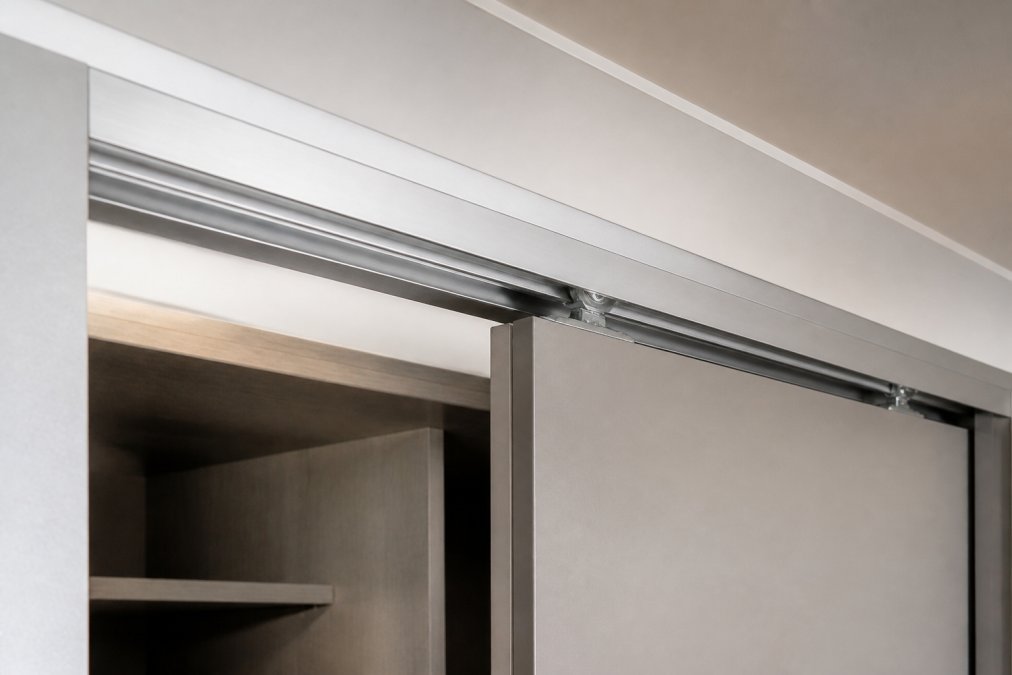
Top-hung systems suspend the entire door weight from an overhead track using concealed rollers, keeping the floor clear. Bottom-rolling systems carry the weight on floor-mounted tracks with guide rails at the top for alignment, suiting very heavy doors but requiring a clean, level floor channel.
For most UK bedrooms with MDF doors up to around 25mm thick, top-hung is the better choice: runners glide with less resistance, you need no floor channel to cut, and it suits existing openings where the floor is carpeted or uneven.
Bottom-rolling earns its place with oversized or glass doors where the weight exceeds what an overhead track can comfortably hold. The tradeoff is a visible floor track that collects dust and needs a perfectly level floor.
Weight Capacity and Door Thickness Limits
Standard MDF wardrobe doors in the 18-25mm range sit comfortably on the Monaco profile, while thicker panels or glass demand the New-York profile's reinforced track profiles. If your door panel exceeds roughly 40kg or you are fitting glass, step up to the New-York range.
Monaco Profile and Track Supreme: Best for Standard Fit-Outs
The Monaco profile is our default recommendation for standard wardrobe fit-outs using MDF doors up to 25mm thick, delivering the smoothest glide per pound spent. Available in 2D through 5D variants, the range starts at £36.00 for the Monaco 2D and rises to £90.00 for the 5D, which accommodates wider track lengths and additional door panels. The concealed rollers run silently, and the anti-jump clips prevent the doors from lifting off the track, a common failure point on cheaper systems.
For a typical two-door wardrobe with a track length under 3 metres, the Monaco 3D at £54.00 hits the sweet spot. If you are fitting three or more doors, move to the 4D or 5D for the extra track framework rigidity.
New-York Profile and Track Supreme: Built for Heavier Doors
When your doors step up in weight, the New-York profile is the upgrade path, engineered for thicker panels, glass fronts, and wider door panel widths. Pricing starts at £60.00 for the New-York 2D and tops out at £150.00 for the 5D variant, reflecting the reinforced aluminium extrusion and higher load-bearing capacity. The New-York range uses a deeper section that resists flexing under load, which matters when a 2.6m glass door panel swings on its runners. A common mistake is fitting a standard profile to a glass door because the visible hardware looks similar, the flex under weight is invisible at first, then the door starts dragging on the floor and the runners wear unevenly.
Beijing Profile and Track Supreme: The Budget-Conscious Choice
The Beijing profile delivers the essential sliding mechanism at a friendlier price point, making it the sensible pick for rental properties, guest rooms, or projects where the doors are lightweight and the budget is fixed. The Beijing 2D 3P starts at £60.00, with the 2D 4P variant at £72.00 for wider openings. It handles standard 18-22mm MDF doors comfortably, but you should not push it toward the upper limits of door thickness.
The honest tradeoff is this: Beijing saves you money on the hardware, but it will not forgive an overweight door. If there is any chance the doors get upgraded later, spend the extra on Monaco now and avoid a second fitting.
Soft-Close Sliding Door Mechanisms: Are They Worth the Upgrade?
A soft-close mechanism is a hydraulic or friction-based damper that engages in the final 50-100mm of door travel, decelerating the panel from roughly 0.5 m/s to a near-zero velocity before contact (peer-reviewed research). It eliminates the kinetic shock that otherwise transfers through the door stile into the rollers and track extrusion.
How the Mechanism Works
Two dominant designs exist in the UK market:
- Hydraulic dampers: A piston forces oil through a calibrated orifice as the door approaches the closed position. The resistance builds progressively, which is why the final few centimetres feel 'cushioned' rather than abrupt. These are the most common in mid-to-premium track systems and typically rated for 30,000-50,000 cycles before seal wear becomes noticeable.
- Friction or spring-based catches: A spring-loaded arm or magnetic catch pulls the door the last 10-15mm and a rubber bumper absorbs the residual energy. These are cheaper but do not provide true deceleration, they simply reduce the slam. They are best suited to lightweight MDF doors under 20kg.
Acoustic Performance: The Metric Most Buyers Ignore
Noise in sliding wardrobe systems comes from three sources: roller bearing chatter, track resonance, and the final door-to-frame impact. Soft-close addresses only the third. Consider the full acoustic chain: nylon or polyurethane-coated rollers with sealed ball bearings run quieter than bare steel; some premium extrusions (including the New-York profile) feature a polymer strip that absorbs vibration; and self-adhesive felt or rubber strips along the meeting stiles prevent metal-to-metal contact, costing under £5 per door. A soft-close damper alone reduces closing noise by roughly 60-70%, but a door that still rattles on its rollers will not feel 'silent'.
When Soft-Close Is Not Worth the Cost
Soft-close adds £20-£40 per door to the hardware cost and introduces a moving part that can fail. Skip it in utility rooms or garage storage where doors are opened rarely, for very lightweight doors (under 15kg) that carry too little momentum to slam hard, and for bottom-rolling systems with heavy glass where the floor track already absorbs much of the lateral energy.
Retrofitting Soft-Close to Existing Tracks
If you already have a sliding wardrobe without soft-close, retrofitting is possible but not always straightforward. Surface-mounted dampers are available for most aluminium profiles, but they require a minimum 15mm clearance between the door edge and the track end, a solid fixing point on the door stile (hollow-core doors may need a reinforcing block), and compatibility with your track's extrusion shape.
The Verdict on Soft-Close
For a standard bedroom wardrobe with doors over 20kg, soft-close is worth the upgrade, not for the luxury feel, but for the protection it offers the rollers and track mounting over years of use. For lightweight doors or utility installations, the cost and complexity outweigh the benefit.
How to Fix Sliding Wardrobe Door Tracks: Common Issues and Repairs
Most sliding wardrobe track problems trace back to three causes: misaligned track mounting, worn door runners, or doors that exceed the system's weight capacity. If the door keeps coming off the track, check the anti-jump clips first. If it drags on the floor, check the screws in the ceiling header, then inspect the concealed rollers for flat spots. If doors are hard to slide, clean the track profiles and roller wheels, a vacuum and a dry cloth resolve most cases.
How We Evaluated These Sliding Wardrobe Track Systems
We evaluated these sliding wardrobe track systems against four criteria: door weight capacity, hardware durability, ease of installation, and acoustic behaviour during operation. Each profile family was assessed across its full size range rather than on the entry-level variant alone.
Durability: What Cycle Testing Tells You
Most manufacturers do not publish cycle-test data for domestic track systems. The failure point in most domestic installations is the roller bearings and the anti-jump clip mechanism, not the track extrusion.
Weight-to-Track Ratio: A Simple Calculation
Rather than relying on a single 'maximum door weight' figure, use the runner-count method. Weigh your actual door panel (a 2.4m x 0.6m x 25mm MDF door weighs approximately 28-32kg; a similar-sized 10mm glass panel weighs roughly 36-40kg). Count the number of runners that will support the door, a standard 2-door system uses two runners per door. Divide the total door weight by the number of runners, then compare against the track's per-runner rating, keeping the per-runner load below 70% of the manufacturer's stated maximum. For example, a 30kg MDF door on two runners gives 15kg per runner. If the track is rated at 25kg per runner, you are at 60% of capacity, a comfortable margin.
The Flex Test: What Static Weight Ratings Miss
A static weight rating tells you how much load a track can hold without immediate failure, not how much the extrusion will flex during movement, and flex is what causes doors to bind, drag, or derail over time. A simple field test: mount the track, hang the door, and push it to the midpoint of its travel. If the track deflects more than 3mm at the centre under a static push, the extrusion is too light for the door weight.
Acoustic Assessment
We assessed noise by listening for three distinct failure sounds: roller chatter, track resonance, and door slap. The Monaco profile with its standard nylon rollers performs well on roller chatter but transmits more resonance than the New-York profile, which includes a polymer damping strip in the track channel.
What We Did Not Test
We did not perform independent laboratory cycle testing to a published British or European standard (such as BS EN 15706) (bsigroup.com). The weight figures and durability observations are based on field experience, manufacturer specifications, and feedback from the joiners and carpenters who fit these systems on site.
| Profile | Per-Runner Rating (approx.) | Flex Resistance | Acoustic Performance | Verdict |
|---|---|---|---|---|
| Monaco 2D-5D | 20-25kg | Moderate | Good with nylon rollers | Best all-round value |
| New-York 2D-5D | 30-40kg | High (deeper extrusion) | Excellent with damping strip | Required for big panels |
| Beijing 2D | 15-18kg | Low | Acceptable for light doors | Fine for guest rooms |
The right choice comes down to weighing your doors, counting your runners, and being honest about how the doors will be used. Every DoorsDirect system ships with a ten-year guarantee and passes our three-stage quality check, so the hardware is covered if you select the correct profile for your door weight.
Frequently Asked Questions
Which sliding wardrobe track system offers the smoothest glide?
Track systems with concealed ball-bearing rollers and anodised aluminium profiles deliver the smoothest glide. The New-York 5D system from DoorsDirect includes five independent wheels per hanger, which distributes door weight evenly and reduces friction. For the quietest operation, pair any track with a soft-close mechanism. Always match the track's load-bearing capacity to your door weight, as an overloaded track will feel rough and wear out quickly regardless of roller quality.
How do I choose between top-hung and bottom-rolling track systems?
Choose top-hung systems for heavier materials like solid wood or mirror-fronted panels, because the weight transfers to the overhead structure. Bottom-rolling systems suit lighter doors and work well when ceiling fixing points are limited. Top-hung tracks keep the floor clear for easier cleaning, while bottom-rolling versions can be simpler to install in rooms with uneven ceilings. Assess your door weight and ceiling structure before deciding.
Are there specific track systems recommended for heavy mirrored doors?
Yes. Heavy mirrored doors require a track system with a higher door weight capacity and robust hangers. The New-York 5D Profile and Track Supreme is designed for heavier doors. Its five-wheel design prevents the door from sagging over time. Ensure your top track is secured into a structural header, not just plasterboard, to handle the concentrated load of mirrored doors.
What maintenance is required for sliding wardrobe tracks?
Clean the bottom channel or track guides monthly with a vacuum to remove dust and debris that cause grinding. Wipe aluminium profiles with a damp cloth and dry them to prevent oxidisation. Check the anti-jump clips and door alignment every six months, adjusting the hanger screws if the door drags. Avoid oil-based lubricants on top-hung tracks, as they attract dust; a dry silicone spray applied sparingly keeps rollers moving freely without buildup.
Leave a comment