


Sliding Wardrobe Doors With Soft Close: 2026 Buyer's Guide
Table of Contents
- How Soft Close Sliding Wardrobe Doors Work
- What Soft Close Costs: Prices and Options
- How to Install Soft Close Dampers on a Sliding Wardrobe
- Made-to-Measure Sliding Wardrobe Doors: What to Check Before You Order
- Weight Limits, Track Systems and Door Panel Specs
- Sliding Wardrobe Door Maintenance Tips for Smooth Closing
- Faults, Fixes and Safety Around the Home
- Frequently Asked Questions
Last Updated: September 20, 2026
How Soft Close Sliding Wardrobe Doors Work
Soft close is a dampening mechanism built into the track or rollers of a sliding wardrobe door that takes over the final stretch of travel and pulls the door gently into its closed position. For anyone weighing up sliding wardrobe doors with soft close, the appeal is simple: no slam, no rattle, no chipped edges at 11pm. At DoorsDirect, made-to-measure doors can be specified with this hardware.
Springs, Dampers and the Last 50mm of Travel
Two components do the work. A spring stores energy as the door approaches the frame, then releases it to complete the final pull. An air damper resists that release so the door glides rather than snaps shut.
What Soft Close Costs: Prices and Options
Soft close is an optional upgrade, not a standard fitting, and the price depends on the door system you choose. DoorsDirect lists the soft close add-on at £90.00 for two-door configurations, and £135.00 for the Sofia 3D system.
How to Install Soft Close Dampers on a Sliding Wardrobe
Fitting a soft close damper is a job most competent DIYers can complete in under an hour with basic tools. The damper clips or screws onto the track, and on most systems the door panel needs no modification. The two variables that decide success are which track the damper mounts to, and whether the activator is set at the correct point in the door's travel.
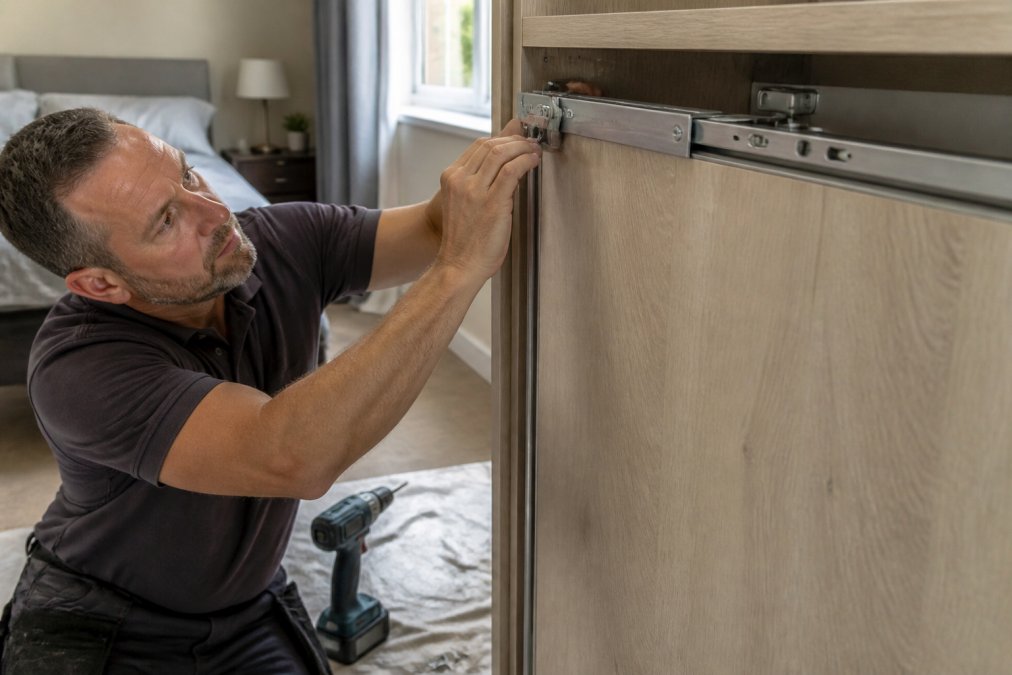
What you'll need:
- Soft close damper kit matched to your track system
- Cordless drill and appropriate screws
- Tape measure and pencil
- Spirit level
- Screwdriver
- Vacuum brush attachment (to clear the track before fitting)
Top-Track Versus Bottom-Track Fitting
The mounting position changes the job more than any other factor.
- Top-track systems carry the panel on rollers above the door. The damper fixes to the underside of the top track, and the activator clip sits on the top edge of the door. This is the easier retrofit because you can reach the track without lifting the panel out.
- Bottom-track systems carry the weight on rollers below. The damper mounts at the closing end of the bottom channel, and the activator sits on the bottom edge of the door. You will normally need to lift the door clear of the track, so allow a second pair of hands.
Fitting a Retrofit Kit to Existing Doors
- Slide the door to one side and expose the full length of the track. Vacuum out dust and carpet fibres first, since grit under the bracket stops the damper seating flat. [Time: 5 minutes]
- Measure from the closing end of the track to position the damper, following the kit's spacing guide. [Time: 5 minutes]
- Mark and drill pilot holes, then fix the damper bracket to the track. Pilot holes prevent the track metal from splitting or burring. [Time: 10 minutes]
- Attach the activator clip to the door edge, the top edge on top-track systems, the bottom edge on bottom-track systems. [Time: 10 minutes]
- Slide the door closed slowly and check the damper engages in the final 50mm of travel. [Time: 10 minutes]
- Adjust the spring tension screw until the door seats smoothly without bouncing. Turn in small increments and test after each. [Time: 10 minutes]
Expected result: The door should decelerate on its own and close flush against the frame with light pressure only.
Adjusting After the First Fit
Almost every retrofit needs one adjustment pass. Work through these in order:
- Door still slams: the activator clip is engaging too late. Move it 5mm closer to the damper and test again.
- Door bounces back open: spring tension is too high. Reduce it a quarter turn at a time.
- Door feels stiff and slow: the damper is over-tensioned, or the rollers are worn. Check the rollers before adjusting the damper further.
- Damper engages too early: move the activator clip away from the damper by 5mm.
When to Call a Professional
Retrofit kits suit confident DIYers working on standard woodgrain or lightweight panels. Call in a professional if:
- The panels are glass or mirror, where a dropped door during lifting is expensive and dangerous.
- The track is a proprietary system with no published damper kit.
- The opening is out of square and the door already rubs.
- The door weight is near or above the damper's rating.
Made-to-Measure Sliding Wardrobe Doors: What to Check Before You Order
Ordering made-to-measure sliding wardrobe doors helps ensure a precise fit. Standard doors can sometimes lead to issues with damper engagement due to fixed track length and door weight.
Before you order, confirm four things:
- Opening width and height, measured at three points each, since walls and floors are rarely square.
- Track system type, because damper kits are not universal across top and bottom track designs.
- Door weight, so the rollers and dampers are rated for the panel you have chosen.
- Finish and panel material, as glass and mirror doors behave differently from woodgrain panels under the same damper.
Weight Limits, Track Systems and Door Panel Specs
Every soft close mechanism has a door weight rating, and exceeding it is the fastest way to a failed damper. The rating interacts with panel width, track design and roller quality, getting the combination wrong is why some systems feel sluggish from day one while others fail within a year. Precision is essential because even minor errors in adjusting soft close mechanisms can lead to uneven tension that prematurely wears out the internal hydraulic seals.
How to Match a Damper to Your Door
Work through these four factors before you specify a kit:
- Panel weight. Light panels under 20kg suit most standard dampers. Medium panels in the 20-35kg range need a mid-rated damper and a roller assembly rated for the same load. Heavy glass and mirror panels above 35kg need a higher-rated roller and damper pairing, and often a reinforced top track.
- Panel width. A wider panel carries more momentum into the final 50mm of travel, so it needs a stronger damper. A 1200mm panel and a 600mm panel of the same weight will not close identically on the same damper setting.
- Track type. Top-track systems carry the weight on rollers above the panel, keeping the bottom track clear and letting the damper work with less friction. Bottom-track systems support the weight below, and the damper must be matched to the roller assembly.
- Panel material. Glass and mirror doors are heavier for the same size, have no give at the edge, and need firmer tension and checked edge clearance so the panel does not contact the frame.
Door Type Reference
| Door Type | Typical Weight Range | Damper Consideration |
|---|---|---|
| Woodgrain panel | Light to medium | Standard damper, low tension |
| Mirror door | Medium to heavy | Higher-rated roller and damper |
| Glass door | Medium to heavy | Firm tension, check edge clearance |
| Sofia 3D system | System-specific | Dedicated damper kit required |
Why Over-Damping Is as Bad as Under-Damping
A damper rated above the door's weight does not make the door safer, it makes it slow. The door creeps through the final stretch, feels heavy to push, and the spring never fully releases, wearing the mechanism faster than a correctly rated unit. Narrow panels are the most common victims, because a damper chosen for a wider door in the same range will over-damp them.
Track Design and Friction
Track design matters as much as the damper rating. A top-track system with clean rollers and a clear bottom channel has low friction, so the damper does most of the deceleration work. A bottom-track system with a loaded channel and worn rollers adds drag the damper must overcome first. This is why a damper that works perfectly on a new top-track system can feel weak on an older bottom-track door.
What to Confirm Before You Order
- The damper's stated weight rating covers your panel weight with headroom, not exactly at the limit.
- The kit is listed for your specific track system, not a generic "fits most tracks" description.
- The roller assembly is rated for the same load as the damper.
- Glass and mirror panels have the edge clearance the damper needs to close without contact.
Sliding Wardrobe Door Maintenance Tips for Smooth Closing
Sliding wardrobe door maintenance tips matter more on soft close systems than on standard tracks, because dust and debris interfere with the damper's air vent. A few minutes every few months keeps the closing action smooth.
- Clean the track with a vacuum brush attachment every two to three months.
- Wipe the damper cylinder with a dry cloth, never oil, since lubricant attracts grit.
- Check door alignment by sliding the door slowly and listening for scraping.
- Tighten roller screws if you notice any wobble in the panel.
- Test the final 50mm of travel monthly to confirm the damper still engages.
Faults, Fixes and Safety Around the Home
On DIY versus professional installation: retrofit kits suit confident DIYers, but full door systems with heavy glass panels are best fitted by a professional. DoorsDirect supplies for both trade and DIY, with expert assistance when you need it.
Frequently Asked Questions
What is a sliding door with soft close?
It is a sliding wardrobe door fitted with a spring and air damper unit on the track. In the last 50mm or so of travel, the mechanism takes over and pulls the door gently into its closed position, so it cannot bang against the frame. The result is quiet operation, less vibration through the door panels, and less wear on the rollers and bottom track over the life of the wardrobe.
Can you retro-fit soft close dampers to existing sliding wardrobe doors?
Often yes, if the track profile and door weight suit a retrofit kit. Check the door weight rating of the kit against your panels and confirm the top track has room for the damper housing. DoorsDirect supplies an add soft close option at £90, with a version for Sofia 3D doors at £135.
Do soft close mechanisms require regular maintenance?
They need very little, but a few habits keep them working. Clean the top and bottom track every few months so grit does not jam the damper, and wipe the damper housing rather than oiling it. Check door alignment once or twice a year, since a door that has dropped will drag on the mechanism. If closing becomes stiff, the spring tension or damper unit usually needs replacing rather than adjusting.
Are soft close sliding wardrobe doors durable for daily use?
A quality mechanism is built for years of daily use, and the damper is the part that eventually wears. DoorsDirect covers its products with a ten-year guarantee, which reflects how the hardware is specified. Longevity depends more on correct door weight for the track, accurate alignment, and keeping the runners clean than on how often the doors are opened and closed.
Soft close hardware is only as good as the door system it sits in, and mismatched components are the reason most dampers fail within a couple of years. DoorsDirect builds made-to-measure sliding wardrobe doors with soft close specified from the start, backed by a three-stage quality check process, a ten-year guarantee and nationwide delivery. Order yours today and get a wardrobe that closes quietly for years, not months.
Leave a comment