


Modern Bedroom Storage Design Trends 2026
Table of Contents
- Modern Bedroom Storage Design Trends 2026
- Bespoke Fitted Wardrobes Lead the Way
- How to Maximise Bedroom Storage Space
- Fitted Bedroom Furniture Cost and Value
- Smart Home Integration in Bedroom Storage
- Design Aesthetics: Minimalist to Warm Neutrals
- Accessibility and Universal Design Principles
- DIY vs Professional Installation
- Frequently Asked Questions
Last Updated: September 3, 2026
Modern Bedroom Storage Design Trends 2026
Modern bedroom storage design in 2026 reflects a fundamental shift toward bespoke fitted solutions that transform awkward corners and sloped ceilings into functional space. The most successful projects combine intelligent design responsive to the actual room, finishes that anchor the aesthetic, and storage systems that adapt to how people actually live. This guide explores dominant trends reshaping bedroom storage, from bespoke fitted wardrobes solving the loft conversion problem to smart home integration and why professional installation often delivers better value than DIY.
Bespoke Fitted Wardrobes Lead the Way
Bespoke fitted wardrobes have moved from luxury exception to expected standard because standard furniture fails in most real homes. Sloped ceilings, alcoves, chimney breasts, and uneven walls are the norm in older properties and modern conversions. A fitted wardrobe designed specifically for your space solves this problem at its root.
When a wardrobe is built to your exact dimensions, every inch works. There's no wasted space, no awkward gaps, and no compromises on access. DoorsDirect's made-to-measure approach exemplifies this trend, with each wardrobe engineered for the specific room and a three-stage quality check ensuring precision.
Why Bespoke Matters for Awkward Spaces
Awkward spaces represent the true test of wardrobe design. A sloped ceiling at 45 degrees, a wall that leans 3 centimetres out of plumb, or a ceiling that drops 200mm mid-room are standard conditions in conversions and period properties. Standard wardrobes fail because they assume parallel walls and level ceilings. A 2100mm-wide wardrobe won't fit if your wall is 2087mm at the top and 2103mm at the bottom.
Bespoke solutions measure these variations and build around them. The joinery adjusts, the track runs at an angle if necessary, and doors align with the ceiling slope rather than fighting it.
Aluminium Frames and Premium Finishes
The material shift toward aluminium frames reflects both aesthetic and functional evolution. Steel frames required more maintenance and looked dated. Aluminium offers a cleaner aesthetic, superior durability, and a more contemporary feel.
Premium finishes have expanded beyond simple white or black to include brushed bronze, matte black, champagne, and titanium grey. These finishes coordinate with modern hardware trends, soft close mechanisms, and integrated handles that prioritise flowing lines over visible hardware. A brushed bronze profile against pearl white glass creates a sophisticated, layered aesthetic that becomes part of the room's design language.
How to Maximise Bedroom Storage Space
Maximising bedroom storage requires rethinking what "storage" means. It's not just about hanging rails and shelves, but using every dimension of the room, height, depth, and the space under beds, as functional storage. The most effective approach combines vertical solutions that climb the wall, multi-functional furniture serving dual purposes, and hidden storage that doesn't visually dominate.
Multi-Functional Furniture and Hidden Storage
Multi-functional furniture is now the default for smart bedroom design. An ottoman at the foot of the bed provides seating and storage. A bedside chest combines drawer storage with a surface for lamps. A bench with integrated storage under the window uses otherwise wasted space.
Hidden storage systems take this further. Shelving behind mirrored panels creates display space without visual clutter. Integrated shelving within the wardrobe interior transforms dead space into accessible storage for folded items, bags, and accessories. When storage is concealed, the room feels calmer and more spacious, even if total capacity is identical.
Under-Bed Storage and Vertical Solutions
Under-bed storage represents prime real estate most bedrooms waste. A standard bed leaves 300-400mm of clearance underneath, accommodating storage boxes or purpose-built drawers (the CDC). Wheeled boxes or built-in drawer systems work better than static boxes.
Vertical solutions climb the wall and multiply usable space without expanding the floor plan. Fitted shelving from floor to ceiling uses wall space that freestanding wardrobes ignore. A room with 2.4-metre ceilings has 40% more potential storage volume when you build upward rather than outward. This vertical approach also creates a visual effect of height, making rooms feel larger.
Fitted Bedroom Furniture Cost and Value
A bespoke fitted wardrobe costs more than standard flat-pack alternatives. A two-door sliding wardrobe from DoorsDirect starts at £558 for the economy range and rises to £818 for premium options. Interior storage systems add another £478 upward. However, the value equation shifts when factoring in longevity, fit, and replacement costs.
Investment in Quality and Longevity
Quality in fitted wardrobes manifests in premium aluminium profiles that resist warping and corrosion, soft-close mechanisms preventing gradual wear, and glazing gaskets reducing rattle. The ten-year guarantee on DoorsDirect products reflects confidence in durability. Most homeowners keep a wardrobe 10-15 years minimum, making a solution designed and guaranteed for that duration better value than cheaper alternatives requiring replacement within five years (peer-reviewed research).
Longevity also means the wardrobe adapts to life changes. Bespoke interiors with adjustable shelving, multiple hanging rails, and modular components can be reconfigured as storage needs evolve.
Smart Home Integration in Bedroom Storage
Smart home integration is reshaping how wardrobes function. Motion-sensor lighting inside wardrobe interiors eliminates searching in dim corners (the NIH). Temperature and humidity monitoring prevents moisture damage to delicate fabrics. LED strips illuminate automatically when doors open, ventilation systems activate based on humidity levels, and motorised shelving adjusts height without manual adjustment. These features solve real problems: finding items in dark interiors, preventing mould in poorly ventilated spaces, and accommodating items of varying heights.
Design Aesthetics: Minimalist to Warm Neutrals
Contemporary bedroom storage spans from stark minimalism to warm, textured neutrals. Both approaches share a common principle: the wardrobe should enhance the room's design language rather than dominate it.
Minimalist aesthetics favour clean lines, full-panel designs with single pieces of glass or mirror per door, and profiles in matte black or white. Warm neutral aesthetics incorporate earthy tones, soft whites, warm greys, and natural textures like woodgrain finishes and textured glass, creating a more residential feel.
Curved Silhouettes and Acoustic Panelling
Curved and rounded furniture silhouettes have emerged as a dominant trend. In wardrobe design, this manifests as curved door edges and flowing lines that soften traditional boxy appearance. Curved design serves both aesthetic and practical purposes: visually sophisticated, ergonomically superior, and easier to grip than sharp-edged alternatives.
Acoustic panelling integrated into wardrobe design addresses reflected sound in bedrooms with hard surfaces. Fitted wardrobes with acoustic backing reduce noise reflection, creating quieter, more acoustically balanced rooms, particularly valuable in open-plan spaces or properties with thin walls.
Mirrored and Glass Finishes
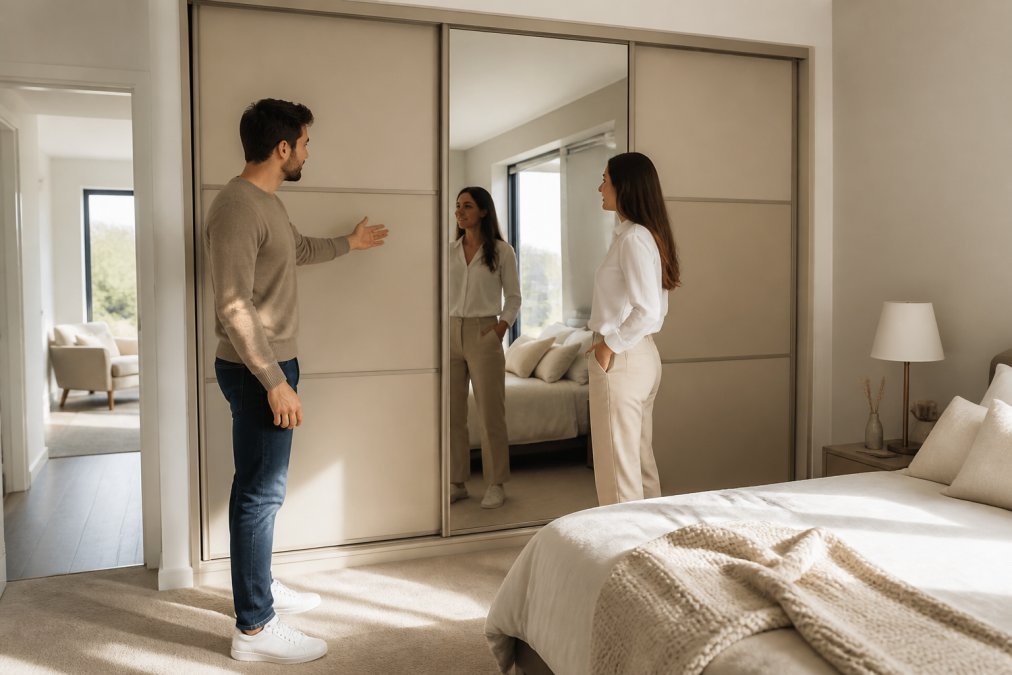
Mirrored panels remain cornerstone elements, but application has evolved. A full-height mirrored panel opposite a window bounces natural light throughout the room, reducing reliance on artificial lighting. Mirrored panels combined with glass panels create visual layering that's more sophisticated than solid mirrors alone.
Glass finishes (clear, frosted, or tinted) offer visual lightness without reflection. Frosted glass provides privacy while maintaining visual benefit of transparency. Tinted glass adds colour without reflective intensity. This trend reflects a broader principle: contemporary bedroom storage prioritises visual sophistication over pure concealment.
Accessibility and Universal Design Principles
Accessibility in bedroom storage has moved from specialist accommodation to mainstream design principle. Universal design creates spaces working for people of all ages and abilities. Practical features include lower hanging rails not requiring reaching above shoulder height, shelving positioned at waist level, and soft-close mechanisms eliminating forceful pulling. Drawer systems with smooth glide rails require minimal effort. These features benefit everyone: lower hanging rails ease access to everyday items, waist-level shelving reduces bending, soft-close mechanisms are gentler on joints.
Contemporary wardrobe design assumes all users benefit from thoughtful ergonomics and accessible operation, eliminating the need for retrofitting or special requests.
DIY vs Professional Installation
The DIY versus professional installation decision represents one of the most important choices in a wardrobe project. DIY appeals to homeowners seeking cost savings and works well for straightforward spaces with parallel walls, level ceilings, and standard dimensions. However, DIY becomes problematic when the space is awkward, measurements are complex, or installation requires precision beyond typical DIY capability.
Professional installation eliminates measurement errors, fitting problems, and installation mistakes. Professionals understand adjusting for out-of-plumb walls, sloped ceilings, and architectural quirks. For complex spaces or high-value projects, professional installation often represents better value than DIY, even accounting for labour costs.
DoorsDirect supports both approaches, providing expert guidance for DIY customers and dedicated support for professional installers. The decision often comes down to one question: if something goes wrong, what's the cost and consequence? For straightforward projects in standard spaces, DIY becomes more attractive because risk is lower.
| Decision Factor | DIY Installation | Professional Installation |
|---|---|---|
| Cost | Lower upfront | Higher labour cost |
| Complexity | Works for standard spaces | Handles awkward spaces |
| Time | Longer, flexible schedule | Faster, fixed timeline |
| Risk | Higher for complex projects | Minimal, guaranteed result |
| Warranty | May affect guarantee | Full guarantee maintained |
| Skill Required | Intermediate carpentry | Professional expertise |
Modern bedroom storage design in 2026 reflects maturation of the category. The best contemporary solutions combine precision engineering with thoughtful aesthetics, creating wardrobes that work beautifully and perform reliably for years. Whether working with a loft conversion, awkward alcove, or standard bedroom, the principle remains constant: the wardrobe should fit your space perfectly, support how you actually live, and enhance your room's design.
At DoorsDirect, we've built our reputation on this principle. Our made-to-measure sliding wardrobe doors and bespoke storage interiors solve real problems that standard furniture ignores. With a 10-year guarantee and expert guidance from measurement through installation, we ensure your investment delivers lasting value. Explore our range of premium aluminium solutions, from the economical York 2 Door at £568 to the sophisticated Beijing 3 Panel Shaker at £818, and discover how precision-engineered storage transforms a bedroom from functional to exceptional. Order yours today and experience the difference that bespoke design makes.
Frequently Asked Questions
What are the key bedroom storage design trends for 2026?
Modern bedroom storage in 2026 emphasises bespoke fitted solutions tailored to individual spaces, particularly for awkward layouts like lofts and alcoves. Minimalist aesthetics dominate, with warm neutral colour palettes and earthy tones replacing bold statements. Multi-functional furniture, hidden storage systems, and smart home integration represent significant shifts. Mirrored and glass finishes remain popular for creating visual space, whilst curved furniture silhouettes offer sophistication. Acoustic panelling is increasingly integrated for both sound control and aesthetic appeal, making storage solutions work harder for the whole room.
How do bespoke sliding wardrobe benefits compare to standard options?
Bespoke sliding wardrobes offer precision fit for any room dimension, from standard spaces to sloped ceilings and irregular alcoves where standard units fail. They feature premium aluminium frames with soft brush pile edging, track fittings designed for longevity, and customisable interiors using furniture-grade board. The 10-year guarantee reflects superior construction quality. Unlike off-the-shelf alternatives, bespoke solutions include expert measurement guidance, three-stage quality checks, and nationwide delivery. This investment in joinery and integrated design means your storage becomes a permanent, sophisticated part of your bedroom rather than a temporary addition.
How much should I expect to spend on fitted bedroom furniture?
Fitted bedroom storage starts from £528 for a basic 2-door sliding wardrobe system and ranges up to £889 for 3-door premium collections with split panel designs. Interior storage packages begin at £478. Bedside units with soft-close drawers cost around £400. Costs reflect quality materials (aluminium frames, furniture-grade board), bespoke customisation, and the 10-year guarantee included. Whilst higher than mass-produced alternatives, fitted solutions offer durability, perfect fit, and the ability to adapt interiors with hanging rails (£8) and shelf brackets (£16.80). Total bedroom storage investment typically reflects the space size and customisation level required.
Can fitted wardrobes work in rooms with sloped ceilings or awkward shapes?
Yes. Bespoke fitted wardrobes are designed specifically for non-standard spaces. Made-to-measure systems accommodate heights up to 2540mm and widths from 900mm to 3130mm, with tracks supplied longer than the opening width for on-site trimming. Sloped ceilings, alcoves, and angled walls are standard challenges for custom joinery. The measurement and fitting process accounts for these irregularities, ensuring doors operate smoothly despite the space's geometry. This adaptability is where bespoke solutions outperform standard wardrobes, making them essential for period properties, loft conversions, and unconventional layouts where off-the-shelf options simply won't fit.
This article was written using GrandRanker
Leave a comment