


Sliding Wardrobe Door Alignment: Fix It Fast (2026 Guide)
Table of Contents
- Why Sliding Wardrobe Door Alignment Issues Happen
- Tools and Hardware You Need Before You Start
- Sliding Wardrobe Door Roller Adjustment: Step-by-Step
- How to Clean Wardrobe Door Tracks Properly
- Replacing Sliding Wardrobe Door Wheels That Have Seized
- Lubrication and Preventative Maintenance Schedule
- When to Call a Professional (and What Quality Hardware Looks Like)
- Frequently Asked Questions
Last Updated: September 27, 2026
Why Sliding Wardrobe Door Alignment Issues Happen
Sliding wardrobe door alignment issues almost always come down to three culprits: worn rollers, dirty tracks, or a door that has slipped out of square.
Common causes include:
- Roller wear, where the wheel flattens or the bearing seizes
- Debris in the bottom track lifting the door
- Loose adjustment screws working free over time
- A top guide rail that has shifted or bent
- Heavy doors on cheap hardware that was never built for the load
Vertical vs Horizontal Alignment: Which Is Off?
The two faults look similar but need different fixes. Vertical alignment is how the door sits in relation to the track, controlling whether it drags or floats. Horizontal alignment is how it sits side to side, controlling the gap between panels and the frame.
Here's the quick test:
| Symptom | Likely Fault | Where to Look |
|---|---|---|
| Door scrapes the floor | Vertical, too low | Bottom rollers |
| Door catches at the top | Vertical, too high | Top guide wheels |
| Uneven gap between panels | Horizontal | Roller mounting plates |
| Door wanders off the track | Horizontal plus anti-jump | Top guide rail |
Tools and Hardware You Need Before You Start
You don't need a full workshop to fix wardrobe door alignment. A small kit covers nearly every job, and most of it is already in a typical toolbox. What matters more is knowing which mechanism your door uses, because the adjustment method differs completely between the two main systems.
Gather these before you start:
- A Phillips and flathead screwdriver set
- A spirit level, ideally 600mm or longer
- A tape measure
- A small adjustable spanner
- A vacuum with a brush attachment
- A soft cloth and mild soapy water
- A torch for looking into the track
- A 10mm or 13mm spanner for locking nuts (sizes vary by system)
Top-Hung vs Bottom-Rolling: Know Your System First
This is the single most useful thing to establish before you touch anything.
Anti-Jump Devices and Other Fittings
Many modern systems include an anti-jump device, a small block or clip that stops the door lifting off the track. If your door has one, disengage it before lifting the door clear. Look for a spring clip or screw-down block at the top of the door edge, release it, lift the door, and re-engage it once the door is back on and aligned.
Sliding Wardrobe Door Roller Adjustment: Step-by-Step
Sliding wardrobe door roller adjustment is a matter of small turns, not big moves. Most rollers need only a quarter turn to shift the door several millimetres, so work slowly and check as you go.
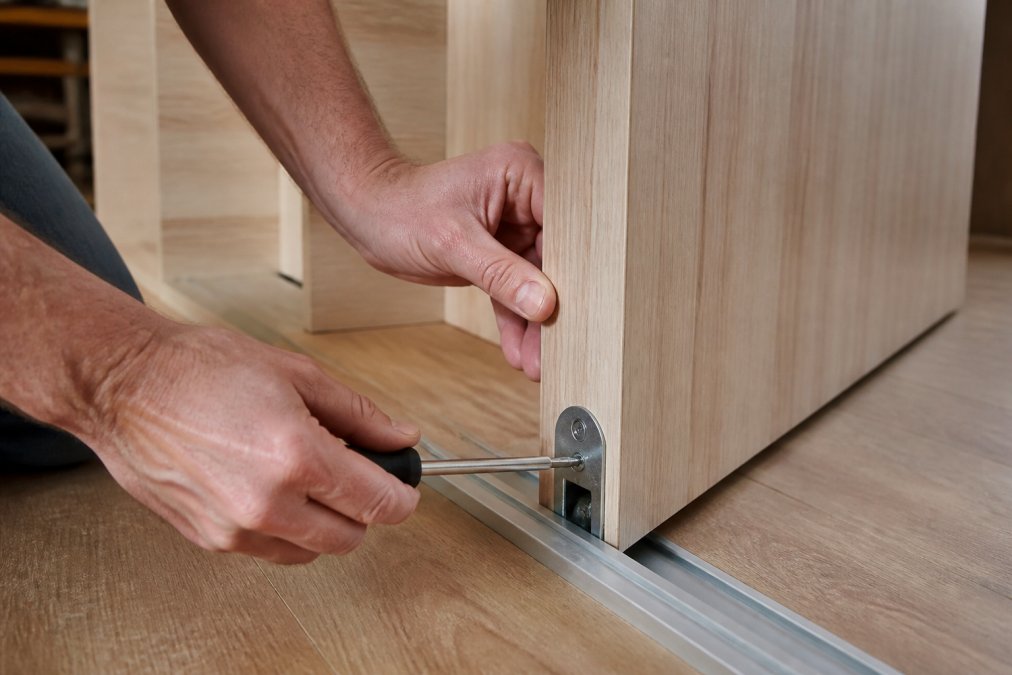
Follow these steps:
- Empty the door side. Remove anything resting against the panel so it hangs freely.
- Lift the door clear. On most systems, lift the door up into the top track and tilt the bottom out.
- Find the adjustment screws. These sit on the roller mounting plate, usually one per roller.
- Turn clockwise to raise, anticlockwise to lower. Make a quarter turn at a time.
- Rehang and test. Slide the door the full length of the track and watch for scraping.
- Repeat until smooth. Adjust both rollers evenly so the door stays level.
Adjusting Bottom Rollers and Top Guide Wheels
The bottom rollers carry the weight, so they set the door height. The top guide wheels only keep the door upright and should never carry load. If your top wheels are bearing weight, the bottom rollers are set too low.
Adjust each in turn:
- Bottom rollers: turn both evenly to raise or lower the panel. Uneven turns tilt the door.
- Top guide wheels: these usually need only a light touch to keep the door centred in the track.
- Check the gap: aim for an even gap between the door and the frame on both sides.
How to Clean Wardrobe Door Tracks Properly
Cleaning the tracks is the cheapest fix you'll ever make and solves more alignment complaints than any adjustment. Grit in the bottom track lifts the door, and a lifted door scrapes, sticks, and jumps.
- Vacuum the full length of the track with a brush attachment.
- Loosen packed dirt with a soft cloth and mild soapy water.
- Wipe out the channel with a dry cloth.
- Check the track for bends or dents while it's clear.
- Run the door back and forth to test the glide.
Clearing Debris and Checking the Bottom Track
The bottom track takes the most punishment because gravity pulls everything into it. Hair, fluff, and hardened dust collect there, and a small obstruction is enough to throw a door out of line.
- Grit or hardened debris
- Small dents or bends
- Loose or lifted sections of track
- Anything sitting proud of the channel
Replacing Sliding Wardrobe Door Wheels That Have Seized
A seized roller is the one fault you can't adjust away. When the bearing inside the wheel stops turning, the door drags and the flat spot grows with every use.
Signs a wheel has seized:
- The door shudders or jerks as it moves
- You can see a flat spot on the wheel
- The door leans to one side
- The roller no longer spins freely by hand
Removing the Door Safely
Before you lift anything, empty the door side and check for an anti-jump device at the top edge. Release it first, a spring clip or screw-down block, or you'll fight the door and risk bending the guide rail. On bottom-rolling systems, lift the door into the top track and tilt the bottom out towards you. On top-hung systems, the door lifts off the top hangers and the bottom guide simply clears.
Matching the Replacement Roller
Replacing sliding wardrobe door wheels is a straightforward swap on most systems. Unscrew the old roller from its mounting plate and fit the new one in the same position, matching it on four points:
- Roller diameter, a larger wheel rolls more easily over small debris
- Fixing centres, the distance between mounting holes must line up
- Load rating, match or exceed the weight of your door panel
- Track profile, the wheel shape must sit correctly in your track
When Replacement Won't Fix It
If a new roller still drags, the fault is elsewhere. A bent bottom track, a worn top guide rail, or a warped door panel will defeat any roller swap. Check the track for dents and the door for twist before spending money on hardware. If rollers have seized more than once in a year, the underlying problem is usually load, the hardware was undersized from the start, and no replacement of the same rating will hold.
Lubrication and Preventative Maintenance Schedule
Lubrication is the most misunderstood part of wardrobe maintenance. Too much is worse than none, because excess oil traps dust and turns into grinding paste.
A simple schedule keeps doors running true:
| Task | Frequency | Time Needed |
|---|---|---|
| Vacuum tracks | Monthly | 5 minutes |
| Wipe tracks with damp cloth | Quarterly | 10 minutes |
| Check roller spin by hand | Every 6 months | 5 minutes |
| Check and tighten screws | Every 6 months | 10 minutes |
| Full alignment check | Yearly | 20 minutes |
When to Call a Professional (and What Quality Hardware Looks Like)
Some jobs are worth handing over. If the track is bent, the door is cracked, or the frame itself is out of square, adjustment won't solve it. Those faults need a proper repair or a new door.
Call a professional when:
- The bottom track is bent or damaged
- The door panel is warped or cracked
- The frame has moved or gone out of square
- Rollers have seized more than once in a year
- The door is too heavy to lift safely alone
Frequently Asked Questions
Why won't my wardrobe doors align?
Misalignment usually comes from three things: rollers that have shifted out of position, debris built up in the bottom track, or worn wheels that no longer sit at the right height. Check the gap between the door edge and the frame first. If it is uneven top to bottom, the vertical adjustment screws need turning. If the door rubs along one side, the track is likely obstructed or the mounting plates have loosened.
How do I adjust the height of my sliding wardrobe doors?
Locate the adjustment screws on the bottom rollers, usually accessible through a small cutout in the door frame. Turn clockwise to raise the door and anticlockwise to lower it. Make quarter-turn adjustments and test the glide after each one. For heavier panels, ask someone to lift the door slightly while you turn the screw so the roller mechanism is not under load. Always check both rollers on the same door move by the same amount to keep the panel level.
What causes sliding wardrobe doors to jump off the track?
Doors jump the track when the anti-jump device is disengaged, when rollers are badly worn, or when the top guide rail has shifted. Inspect the top guide first. If the door lifts out with minimal effort, the anti-jump fitting needs repositioning. Seized or flat-spotted rollers also let the panel ride too high, so replacing sliding wardrobe door wheels is often the permanent fix rather than repeated realignment.
How do I know if my wardrobe door rollers need replacing?
Three signs point to replacement: visible flat spots or cracks in the wheel, a grinding noise during the glide, and doors that will not hold alignment after adjustment. Run the door slowly and listen. Smooth glide with no resistance means the rollers are fine. If you hear scraping or the door catches at one point along the track, the roller wear is uneven and new wheels will solve it faster than further adjustment.
Sliding doors that jump, scrape, or stick are almost always telling you the same story: the hardware or the track needs attention. Most fixes take under an hour, and a little routine care keeps them from coming back.
When the fault runs deeper than an adjustment, DoorsDirect can help. Our made-to-measure sliding wardrobe doors come with a three-stage quality check, a ten-year guarantee, and expert guidance from measurement to final fit. Order yours today and get doors built to stay aligned.
Leave a comment