


High Quality Sliding Wardrobe Components: A Guide
Table of Contents
- What Makes High Quality Sliding Wardrobe Components Different
- Sliding Wardrobe Doors with Soft Close: Benefits and Selection
- Track Systems and Sliding Door Gear: Top-Hung vs Bottom-Rolled
- How to Install Sliding Wardrobe Tracks: Step-by-Step
- Wardrobe Door Roller Replacement and Maintenance
- Interior Components: Shelves, Drawers, and Storage Solutions
- Weight Capacity and Load-Bearing Calculations
- Compatibility Checklist for Your Wardrobe Setup
Last Updated: August 21, 2026
What Makes High Quality Sliding Wardrobe Components Different
Premium sliding wardrobe components separate themselves through precision engineering, durability, and flawless operation across thousands of cycles. High-quality systems use reinforced aluminium profiles, metal-sided drawers with soft-close mechanisms, and precision-engineered rollers that glide without friction or noise.

The key lies in three areas: the quality of the sliding door gear, the precision of track systems, and the durability of supporting hardware like rollers and alignment mechanisms. The real test of quality isn't how doors perform on day one, it's how they perform on day 1,000. Cheap components use plastic rollers that wear flat quickly, causing binding and noise. Premium rollers use ball-bearing systems that maintain smooth operation indefinitely.
Sliding Wardrobe Doors with Soft Close: Benefits and Selection
Soft-close technology eliminates the harsh slam when doors meet the track's end. Instead of an abrupt stop, damping technology decelerates the door gradually over the final 50-100mm, creating a whisper-quiet close every time.
Soft-close mechanisms reduce stress on track systems and rollers by absorbing impact energy, directly extending component lifespan and preventing the annoying rattle that develops when standard doors repeatedly hit their stops with force. Quality soft-close systems use precision-engineered dampers filled with silicone fluid or compressed air that respond consistently regardless of temperature (peer-reviewed research).
Track Systems and Sliding Door Gear: Top-Hung vs Bottom-Rolled
The track system you choose fundamentally determines how your sliding wardrobe doors operate, how much weight they can safely support, and their long-term performance. The two primary options, top-hung and bottom-rolled mechanisms, represent different engineering approaches with distinct advantages.
Top-Hung Mechanisms
Top-hung systems suspend the door from an overhead track, with rollers mounted on the top of the door frame. This creates a cleaner aesthetic because there's no visible track at floor level, and the overhead track can be concealed within the wardrobe frame or pelmet. Top-hung systems also eliminate floor-level dust accumulation, making them easier to maintain.
The primary limitation is load capacity. Because all weight hangs from the overhead track and rollers, there's a practical ceiling on how wide or heavy individual doors can be. Quality sliding door gear with precision-engineered rollers compensates for minor track imperfections, though installation must be precise, if the overhead track isn't perfectly level, doors will drift open or closed on their own.
Bottom-Rolled Systems
Bottom-rolled mechanisms place the primary track at floor level, with rollers mounted on the bottom of the door. A secondary guide track at the top prevents the door from swinging outward. This configuration distributes weight more evenly and allows greater load capacity, making it ideal for wider doors or heavier materials like glass and mirror panels.
Bottom-rolled systems are more forgiving of minor installation imprecision than top-hung alternatives. The floor track doesn't need to be perfectly level; door rollers are more tolerant of small variations. This makes bottom-rolled systems practical for loft conversions, sloped ceilings, or awkward spaces. The trade-off is that a visible track sits at floor level and can accumulate dust, requiring occasional cleaning.
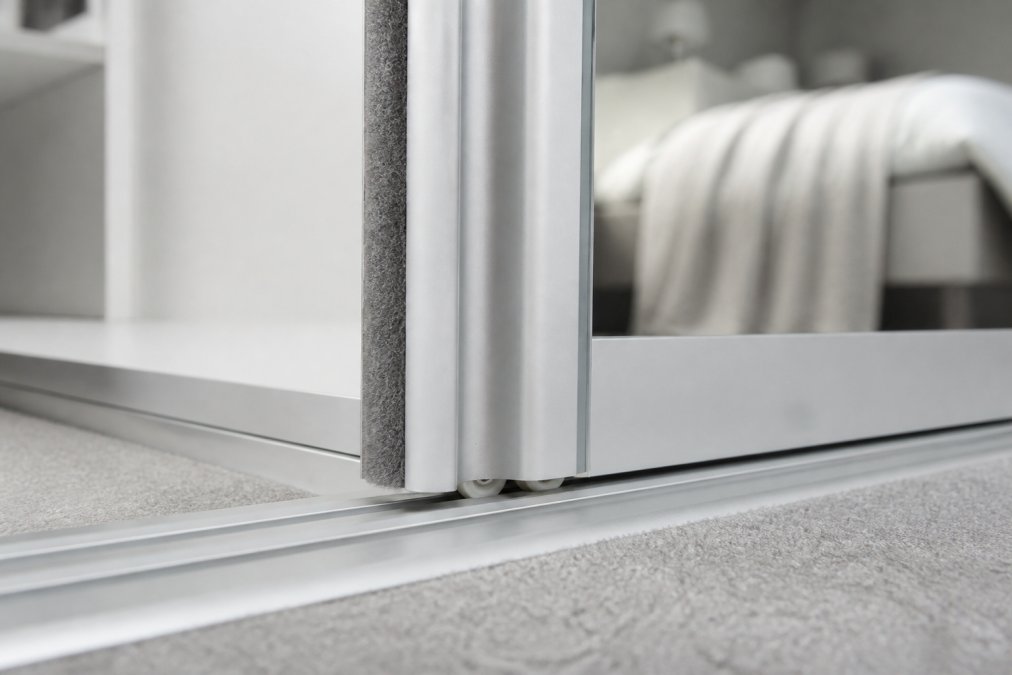
DoorsDirect offers both configurations, each paired with premium sliding door gear designed for smooth, quiet operation. The choice depends on your space, aesthetic preferences, and specific wardrobe design demands.
How to Install Sliding Wardrobe Tracks: Step-by-Step
Installing sliding wardrobe tracks correctly is the foundation for everything that follows. Poor installation leads to binding doors, noise, misalignment, and accelerated wear on rollers and other components.
What You'll Need:
- Spirit level (600mm minimum)
- Measuring tape (5m or longer)
- Pencil and marking gauge
- Drill with bits for your wall type
- Screwdriver (manual or power)
- Spacer blocks (typically 10-20mm)
- Anti-jump clips (for bottom-rolled systems)
- Wall anchors appropriate to your wall construction
Step 1: Measure and Mark the Track Position [Time: 15 minutes]
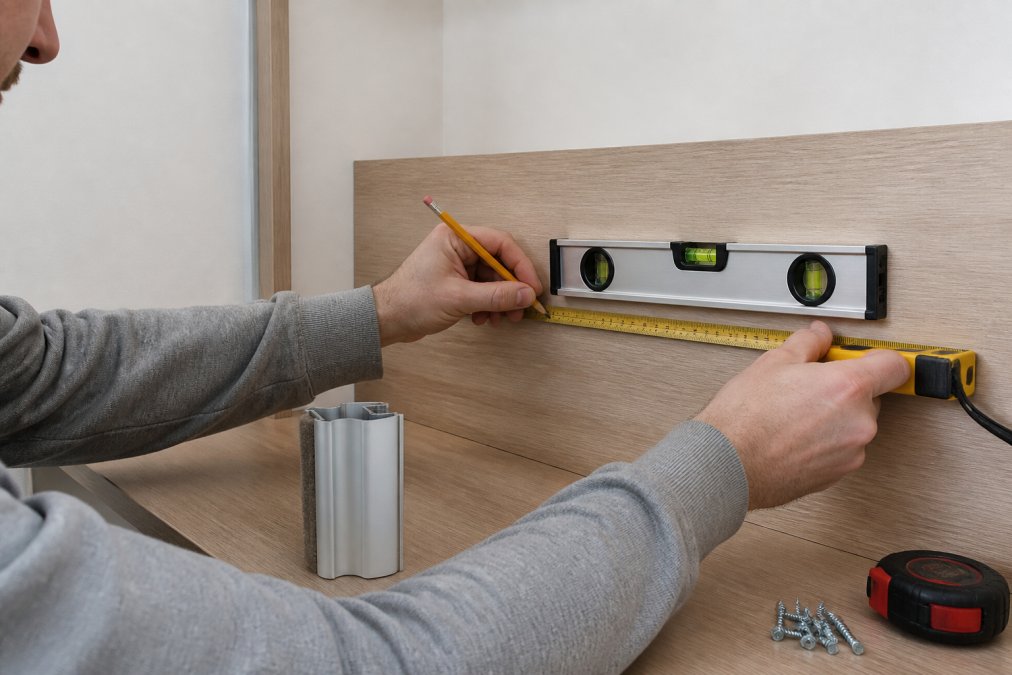
Measure the exact opening dimensions at three points: top, middle, and bottom. For top-hung systems, the track typically sits 50-100mm below the opening's top edge. For bottom-rolled systems, the track sits on the floor or on a small spacer block. Use your spirit level to establish a perfectly level reference line, even 2-3mm of deviation across a 1.2m width will cause doors to drift.
Step 2: Locate Wall Studs and Mark Fixing Points [Time: 10 minutes]
For top-hung systems, the overhead track must be fixed to solid structure, wall studs, a beam, or a reinforced lintel. Use a stud finder to locate studs, then mark fixing points at 400-600mm intervals along the track length. For bottom-rolled systems, fixing points go into the floor, screwing directly into joists on wooden floors or using appropriate concrete anchors on concrete.
Step 3: Install Spacer Blocks [Time: 10 minutes]
Spacer blocks (typically 10-20mm) sit between the wall and track mounting points. They create a small gap allowing the track to sit proud of the wall, preventing door edges from catching on wall irregularities and ensuring the track sits at the correct height relative to the door frame.
Step 4: Attach the Track [Time: 15 minutes]
Position the track along your marked line, ensuring it's perfectly level. Drill pilot holes through the track mounting points into the spacer blocks and wall structure. Use screws appropriate to your wall type, typically 8mm x 100mm screws for solid walls with spacer blocks. Tighten screws progressively, checking level after every 2-3 screws to prevent tilting.
Step 5: Install Guide Tracks and Anti-Jump Clips [Time: 10 minutes]
For top-hung systems, install the guide track at the bottom of the opening to prevent doors from swinging outward. For bottom-rolled systems, install the guide track at the top. Position it so doors glide smoothly without binding, typically 3-5mm gap between door edge and guide track.
Step 6: Test and Adjust [Time: 15 minutes]
Hang a test door and check alignment. The door should glide smoothly without binding. If it binds, the track isn't level; adjust spacer blocks or shim the track until movement is smooth. Check that the door doesn't drift open or closed when released halfway through its travel.
Wardrobe Door Roller Replacement and Maintenance
Rollers take the most punishment in any sliding door system. They're in constant contact with the track, bearing the full weight of the door (for bottom-rolled systems) or part of it (for top-hung systems), and experience repeated stress with every opening and closing cycle. High-quality rollers use ball-bearing systems encased in precision-machined housings that reduce friction and allow doors to glide with minimal effort.
Signs Your Rollers Need Replacement:
Doors that require increasing force to move smoothly indicate worn rollers. Grinding or squeaking noises during operation signal roller wear. Visual inspection helps too, look for flat spots on the wheel surface or visible damage to the bearing housing.
Maintenance to Extend Roller Life:
Regular cleaning prevents debris accumulation that accelerates wear. For bottom-rolled systems, vacuum or wipe the floor track monthly to remove dust and hair. Use a silicone-based track lubricant (never oil-based, which attracts dust) applied sparingly to the track every 6-12 months. A light coat reduces friction and keeps rollers rolling smoothly.
Replacing Rollers:
Roller replacement typically requires removing the door from the track, then unbolting the old roller assembly and bolting on the new one. For made-to-measure doors, ensure replacement rollers are compatible with your specific door profile; dimensions and bolt patterns vary. DoorsDirect can advise on compatible replacement rollers for your specific wardrobe configuration.
Interior Components: Shelves, Drawers, and Storage Solutions
The interior of your wardrobe is where functionality meets personalisation. Shelves, drawers, and hanging rails transform a simple wardrobe shell into a customised storage system. Quality interior components make the difference between a wardrobe that feels cramped and poorly organised versus one that maximises every millimetre of space.
Shelving Options:
Made-to-measure shelves cut to your exact dimensions ensure efficient use of space. DoorsDirect offers shelves in three width categories: up to 600mm (£48.00), 601-850mm (£58.00), and 851-1100mm (£64.00), all featuring 18mm melamine faced chipboard edged with 2mm PVC edging. Shelves come complete with brackets designed to work with aluminium columns, allowing you to position shelves at any height. Standard shelf depth is 500mm, which accommodates most folded clothing and accessories.
Drawer Systems:
Drawers provide concealed storage for smaller items, underwear, and accessories. DoorsDirect offers two-drawer boxes in 600mm (£340.00) and 850mm (£380.00) widths, both featuring high-quality metal-sided drawers with soft-close action. You can stack multiple drawer boxes vertically to create 4, 6, or even 8-drawer configurations.
Hanging Rails and Specialist Storage:
Hanging rail brackets (£8.00 per pair) work with aluminium columns. Install rails at different heights, one at 1.5m for full-length items, another at 1m for shirts and shorter pieces. A made-to-measure shoe rack (£40.00) fits between columns and keeps footwear organised and accessible.

Design Principle: Layered Storage
The most efficient wardrobes use layered storage: hanging space for frequently worn items, shelves for folded clothing and accessories, drawers for smaller items, and specialist racks for shoes and accessories. This layered approach means you're not hunting through piles to find what you need.
Weight Capacity and Load-Bearing Calculations
Understanding weight capacity is essential for safe wardrobe design. Overloading shelves or drawer systems causes structural failure, damaged components, and potentially dangerous situations where shelves collapse or drawers derail.
Shelf Load Capacity:
Standard 18mm melamine faced chipboard shelves supported by quality brackets can typically handle 20-30kg per shelf when weight is distributed evenly (bsigroup.com). Spread weight evenly across the shelf length; never place all weight at the front or back, which creates a lever effect that stresses bracket connection points.
Drawer System Capacity:
DoorsDirect drawer boxes are engineered for 40-50kg total capacity when fully loaded. The soft-close mechanism adds stability and prevents sudden movement that could overload brackets or derail the drawer.
Track System Load Capacity:
Top-hung systems typically support 25-35kg per door, depending on roller quality and track design (din.de). Bottom-rolled systems support 40-60kg per door because weight is distributed along the entire track length rather than concentrated at mounting points.
Reinforcement Options:
If you're planning to store particularly heavy items, consider reinforcement. Additional brackets at 300mm intervals instead of 400mm increase load capacity. Deeper shelves with more bracket support handle more weight than shallow shelves.
Compatibility Checklist for Your Wardrobe Setup
Before ordering components, verify that everything you've selected actually works together. Incompatible components lead to installation frustration, wasted money, and wardrobes that don't function as intended.
Key Compatibility Points:
Your door profile must match your chosen track system. Rollers must match your specific door profile and track system. Shelf brackets, hanging rail brackets, and drawer boxes are designed to work with specific column systems. Tracks must be ordered to match your opening width. Determine how many doors you need and whether they'll bypass each other or configure differently. Calculate total weight of items you plan to store, then verify that your chosen shelves and drawer systems can handle that load. For top-hung systems, verify that you have adequate clearance for the overhead track. Identify your wall type and ensure you have appropriate fixings for track installation.
| Component | Specification | Your Choice | Verified |
|---|---|---|---|
| Track System | Top-hung or bottom-rolled | [ ] | [ ] |
| Door Profile | Model/type | [ ] | [ ] |
| Opening Width | Exact measurement in mm | [ ] | [ ] |
| Door Count | Number of doors | [ ] | [ ] |
| Shelf Quantity | Number of shelves | [ ] | [ ] |
| Drawer Configuration | Number and size of drawers | [ ] | [ ] |
| Wall Type | Brick, plasterboard, timber | [ ] | [ ] |
| Ceiling Height | Measurement at track point | [ ] | [ ] |
| Total Load | Estimated weight in kg | [ ] | [ ] |
| Finishes | Door and interior finishes | [ ] | [ ] |
Investing in high-quality sliding wardrobe components means choosing durability over cost, precision over approximation, and solutions that work reliably for years. DoorsDirect specialises in made-to-measure wardrobe solutions backed by a ten-year guarantee and a three-stage quality check process. Whether you're a homeowner tackling a bedroom renovation, a joiner specifying components for a client project, or a developer outfitting new build interiors, DoorsDirect provides the expertise, quality, and support to ensure your wardrobe performs perfectly. Order yours today and experience the difference that precision engineering and premium components make.
Frequently Asked Questions
Q: What makes high quality sliding wardrobe components worth the investment?
A: High quality sliding wardrobe components use precision-engineered track systems, durable metal-sided drawers with soft-close mechanisms, and robust door hardware that withstands years of daily use. Superior materials reduce friction, minimise noise, and prevent doors from coming off tracks. Components from DoorsDirect include a ten-year guarantee and undergo rigorous quality checks before dispatch, ensuring they fit perfectly and perform reliably.
Q: Are soft-close mechanisms worth the investment for sliding wardrobes?
A: Yes. Soft-close mechanisms prevent doors slamming, reduce wear on hardware, and extend the lifespan of your wardrobe system significantly. They also improve the user experience by providing smooth, controlled door movement. Metal-sided drawers with soft-close action, like the 600mm and 850mm drawer boxes, cost more upfront but eliminate the need for costly repairs and replacements. The durability and comfort justify the higher initial investment.
Q: What is the difference between top-hung and bottom-rolling wardrobe door systems?
A: Top-hung systems suspend doors from an overhead track, ideal for spaces where floor-level obstacles exist or sloped ceilings require flexibility. Bottom-rolled systems use floor tracks and are typically more stable for heavy doors and high-traffic areas. Your choice depends on room layout, ceiling height, and load requirements. DoorsDirect can customise either system to fit your space precisely.
Q: How often should I replace wardrobe door rollers, and what signs indicate they need replacement?
A: Quality rollers typically last 5-10 years with proper maintenance. Replace them if doors jump off tracks, stick, or operate with grinding sounds. Regular cleaning of tracks and light lubrication extend roller life. If rollers fail prematurely, check for misalignment or overloading, both common causes. DoorsDirect's ten-year guarantee covers defective components, so replacements due to manufacturing faults are covered.
Q: How do I know if my wardrobe will fit an awkward space like a loft conversion or sloped alcove?
A: Measure the space accurately at multiple points, accounting for slopes, angles, and obstacles. Document ceiling height, floor level variations, and wall irregularities. Made-to-measure wardrobe components are cut to the millimetre, so precise measurements are essential. DoorsDirect offers expert guidance during the measuring process to identify potential issues before production. If you're unsure, it's far better to resolve uncertainties upfront than receive doors that don't fit.
This article was written using GrandRanker
Leave a comment