


Sliding Wardrobe Door Replacement Components
Table of Contents
- Essential Replacement Wheels and Rollers for Sliding Wardrobe Doors
- Top and Bottom Track Systems: Compatibility and Fitting
- How to Fix Sliding Wardrobe Doors: Common Issues and Solutions
- Sliding Wardrobe Door Rollers Replacement: Step-by-Step Installation
- Adjusting Sliding Wardrobe Doors for Perfect Alignment
- Wardrobe Interior Fittings and Hardware Kits
- Maintenance Tips and Repair vs. Replace Decisions
- Conclusion
Essential Replacement Wheels and Rollers for Sliding Wardrobe Doors
Sliding wardrobe door replacement components are critical because worn rollers cause sticking, grinding, and derailing. These small parts bear the full weight of your doors every time you open or close them, which is why they wear faster than any other component.
Replacement wheels and rollers come in different sizes and load ratings. A roller rated for a lightweight glass door won't perform the same way on a heavy timber panel. Rollers typically sit in the bottom track, though some systems use top-hung configurations where wheels run along an upper guide rail. When these wear out, you'll notice increased noise, difficulty opening doors, or panels that sit unevenly.
Quality matters because a cheap roller will start binding within months, especially in high-traffic bedrooms.
| Roller Type | Best For | Typical Load Rating | Maintenance Frequency |
|---|---|---|---|
| Bottom track rollers | Standard sliding doors | 50-80kg per pair | Every 2-3 years |
| Top guide wheels | Lightweight glass doors | 30-50kg per pair | Every 3-4 years |
| Heavy-duty carriers | Timber or mirror panels | 100kg+ per pair | Every 2-4 years |
The rollers you choose should match both your door weight and your usage pattern.
Top and Bottom Track Systems: Compatibility and Fitting
Your sliding wardrobe door track system is the highway your rollers travel on. Both top and bottom tracks must be perfectly aligned and free from debris for smooth operation. Misaligned tracks cause more door problems than worn rollers, yet they're often overlooked during troubleshooting.
Bottom track systems bear the weight and accumulate dust, pet hair, and debris that creates friction and causes rollers to bind. A clogged bottom track can make even brand-new rollers feel sluggish. Top guides are primarily directional, keeping the door aligned vertically and preventing it from tilting or swinging outward.
Track compatibility is non-negotiable. A track designed for 50mm rollers won't work with 40mm wheels. When replacing either track, measure the width, depth, and profile of your existing system. Many suppliers use standardised profiles, but older wardrobes sometimes use bespoke dimensions.
Installation of new track systems requires precision. The bottom track must sit perfectly level; even a 2-3mm slope will cause doors to drift open or closed on their own. Use a spirit level during fitting and shim under the track if your floor isn't perfectly flat.
How to Fix Sliding Wardrobe Doors: Common Issues and Solutions
Most sliding wardrobe door problems fall into a predictable pattern. Understanding what's actually broken saves time and money on unnecessary replacements.
Doors stick or drag: The culprit is usually a clogged bottom track or misaligned rollers. Vacuum the entire track system, paying special attention to corners where debris accumulates. Use a dry cloth to wipe down the track surfaces. If doors still drag after cleaning, the rollers may be sitting too low in the track or a roller may be worn flat on one side.
Doors won't stay closed: A door that swings open on its own indicates the bottom track is tilted or a roller is binding. Check the track level first. If it's level but the problem persists, inspect each roller for flat spots or debris wrapped around the wheel.
Doors jump or derail: This suggests the top guide is misaligned or the door panel itself is warped. Check that the top guide is securely fastened and sits at the correct height.
Excessive noise: Grinding or squeaking usually means the track needs cleaning or the rollers need lubrication. Some systems benefit from silicone-based track lubricant applied sparingly to the rolling surfaces. Avoid oil-based lubricants, which attract dust.
Uneven gap between door and frame: This is a door alignment issue. Doors can be adjusted vertically and horizontally using the fixing blocks or adjustment bolts on the rollers.
Sliding Wardrobe Door Rollers Replacement: Step-by-Step Installation
Replacing rollers is straightforward if you follow the correct sequence. The key is supporting the door safely whilst you remove the old rollers and fit the new ones.
Step 1: Prepare and support the door (Time: 10 minutes)
Remove the door from the track by lifting it slightly and sliding it forward until the bottom rollers clear the bottom track. You'll need help; a standard wardrobe door weighs 20-40kg. Lay the door flat on a padded surface like an old blanket or foam sheet. Never rest it on its edge, as this can warp the door panel.
Step 2: Locate and remove the old rollers (Time: 15 minutes)
Examine the bottom of the door. You'll see either bolted roller assemblies or rollers housed in a carrier that slides into a channel. If bolted, unscrew the bolts holding the roller carrier. If housed in a channel, you may need to remove a retaining clip or slide the carrier out from the side. Take a photo of the old roller's orientation before removal.
Step 3: Install the new rollers (Time: 15 minutes)
Position the new roller assembly in exactly the same orientation as the original. Align the mounting holes and bolt down firmly, but don't over-tighten, as this can cause the door to bind. For carrier-style rollers, slide the new assembly into the channel and secure any retaining clips.
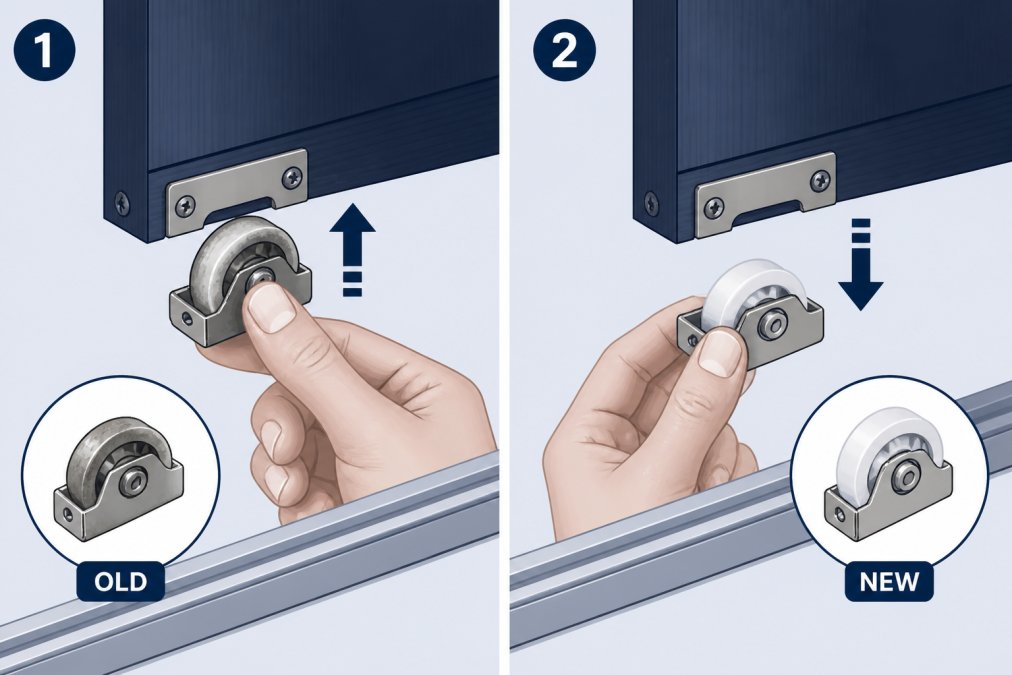
Step 4: Rehang the door (Time: 10 minutes)
Lift the door and position it so the bottom rollers align with the bottom track. Lower it slowly, ensuring the rollers seat properly in the track. Slide the door forward to check that it moves smoothly.
Step 5: Test and adjust (Time: 5 minutes)
Open and close the door several times through its full range. It should move smoothly without noise or resistance. If it still feels stiff, check the top guide alignment.
Adjusting Sliding Wardrobe Doors for Perfect Alignment
Even with new components, doors sometimes sit unevenly or don't close properly. Most sliding wardrobe door systems include adjustment bolts or shims that allow fine-tuning without removing components.
Alignment problems typically fall into two categories: vertical (doors sit at different heights) and horizontal (doors don't close flush or have uneven gaps).
Vertical adjustment: Most doors can be raised or lowered by adjusting bolts on the roller carriers. Locate these bolts, usually positioned at the front and rear of each roller assembly. A quarter-turn of the bolt raises or lowers the door by approximately 1-2mm. Adjust both rollers equally to keep the door level. Use a spirit level across the top of the door to verify it's sitting horizontally.
Horizontal adjustment: Doors that don't close flush require horizontal adjustment, typically done by adjusting the top guide position. Loosen the guide fasteners slightly and shift the guide left or right as needed. Make small adjustments, 1-2mm at a time, and test after each change.
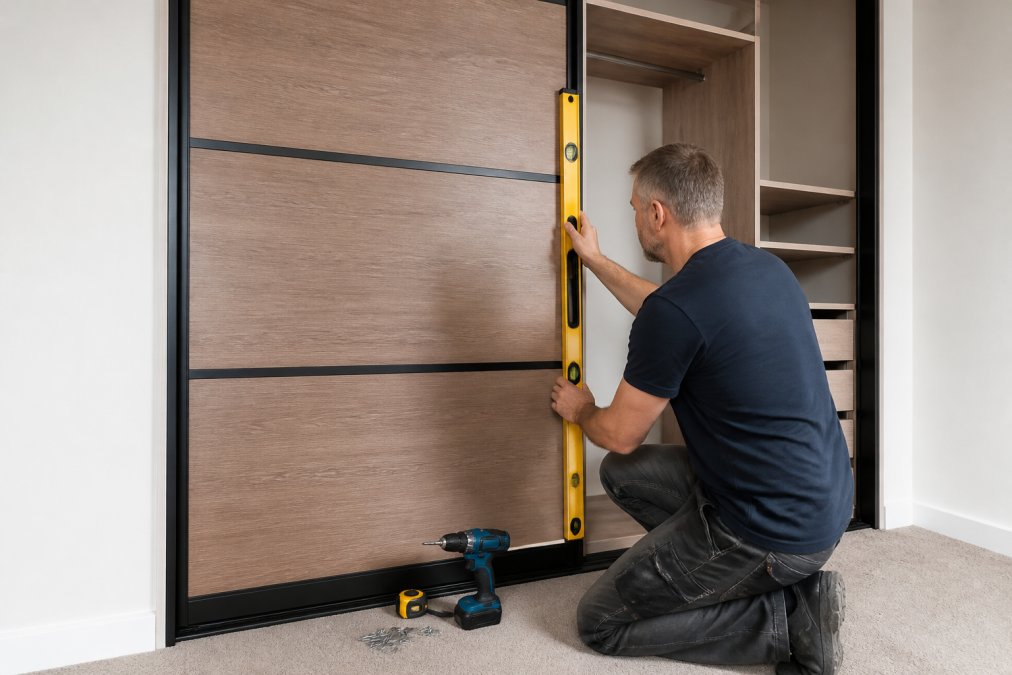
The anti-jump clips (small brackets that prevent the door from lifting off the track) should sit just above the roller wheels with a small gap, typically 2-3mm. If this gap is too tight, the door will be hard to open. If it's too loose, the door can derail.
Start with small adjustments and test thoroughly before making larger changes.
Wardrobe Interior Fittings and Hardware Kits
Beyond the doors themselves, interior fittings determine how functional your wardrobe actually is. The right combination of shelves, hanging rails, and brackets transforms a basic storage box into a properly organised space.
Most interior fittings are modular and can be customised to suit your specific needs. A typical wardrobe might include a hanging rail for clothes, shelves for folded items, and drawer units for smaller accessories. These components attach to the side panels or interior columns using brackets and fixing blocks.
Shelf brackets come in different styles depending on whether they support glass, solid timber, or melamine shelves. The load rating matters; a shelf rated for 20kg per bracket will sag if you load it with 40kg of winter coats.
DoorsDirect supplies complete hardware kits that work together seamlessly. Their Pair of Shelf Brackets Spacepro Relax (£16.80) are engineered to support both glass and solid shelves on aluminium columns. For larger shelves, their Made to Measure shelves come complete with integrated brackets. A shelf up to 600mm wide costs £48.00, whilst wider options up to 1100mm are available at £64.00.

Hanging rail brackets are equally important. The Pair of Spacepro Relax Hanging Rail Brackets (£8.00) attach directly to columns and support a standard hanging rail. For storage-intensive needs, drawer units provide concealed organisation. DoorsDirect's 600 drawer box (£340.00) and 850 drawer box (£380.00) both feature soft-closing metal-sided drawers and solid base panels.
Strike plates and end panels complete the interior. A Strike Plate Premium (£26.00) bridges gaps where doors close against walls, whilst an End Panel Premium (£78.00) forms the side boundary when doors don't extend to a wall.
Maintenance Tips and Repair vs. Replace Decisions
A well-maintained wardrobe system lasts decades. Neglected systems fail within years.
Monthly maintenance: Vacuum the bottom track to remove dust and debris. Use a dry cloth to wipe down all visible track surfaces. This single task prevents 80% of sliding door problems.
Quarterly maintenance: Check that all fasteners, bolts, screws, and brackets remain tight. Vibration from daily use can loosen hardware over time.
Annual maintenance: Inspect rollers for flat spots or visible wear. If a roller shows significant damage, replace it before it causes track damage. Check that door panels sit level and close evenly.
When to repair vs. replace: A single worn roller should always be replaced; the cost is minimal and the fix is quick. Misaligned tracks can usually be corrected by shimming or adjusting fastener positions. Warped door panels or cracked frames require full door replacement.
If your wardrobe is over 15 years old and experiencing multiple issues simultaneously, replacement may be more economical than piecemeal repairs. Modern systems are quieter, smoother, and more durable than older designs.
For ongoing support and troubleshooting, DoorsDirect offers expert guidance from measurement to final fit. Their ten-year guarantee covers manufacturing defects, providing peace of mind that your investment is protected.
Sliding wardrobe door replacement components are an investment in daily convenience and long-term home value. Whether you're fixing worn rollers, upgrading interior fittings, or replacing an entire system, choosing quality components makes the difference between a wardrobe that frustrates you and one that works flawlessly for years.
DoorsDirect's made-to-measure approach ensures your replacement components fit perfectly, even in awkward spaces like lofted bedrooms or sloped ceilings. Their three-stage quality check process and ten-year guarantee back every product. Get started with DoorsDirect and transform your storage with components engineered to last.
Frequently Asked Questions
How do I know which sliding wardrobe door rollers I need?
Check your existing roller assembly first. Measure the wheel diameter and note the track width to ensure compatibility. Most sliding wardrobe door rollers come in standard sizes, but your door's age and brand matter. If you're unsure, photograph your current rollers and track system, then compare against the hardware kits available. DoorsDirect can help match your existing components to ensure the replacement wheels fit your specific track configuration.
Can you replace just the wheels on sliding wardrobe doors?
Yes, you can replace individual wheels or rollers without replacing the entire door or track system. Most roller assemblies are removable and can be swapped out in minutes. However, if your track is damaged or bent, replacing wheels alone won't solve the problem. Inspect the track for dents or debris before assuming the wheels are the issue. If the track needs attention, addressing that alongside roller replacement will restore smooth operation.
What are the most common parts that fail on sliding wardrobe doors?
Runner wheels and bottom rollers wear out fastest due to constant friction and weight bearing. Anti-jump clips can break if the door is forced off-track, and soft-close mechanisms may fail over time. Track liners can become misaligned, and fixing blocks may loosen. The hanger bar occasionally bends under uneven loading. Most failures happen because debris builds up in the track or doors are forced past their natural stopping point. Regular maintenance and gentle handling extend component life significantly.
Are sliding wardrobe door tracks universal?
No, sliding wardrobe door tracks are not fully universal. Top guides and bottom track systems vary by manufacturer and door weight capacity. Some tracks are aluminium, others steel, and dimensions differ. Replacement components must match your existing track profile and width. This is why measuring your current system carefully is essential before ordering replacements. DoorsDirect supplies replacement track systems and components designed for compatibility with standard wardrobe door configurations, ensuring your new parts fit your existing frame.
How do I adjust sliding wardrobe doors that keep coming off the track?
First, check that the bottom track is level using a spirit level. Adjust the fixing blocks at the base to correct any tilt. Next, inspect the anti-jump clips at the top to ensure they're properly seated and not bent. If clips are damaged, replace them. Ensure the door is not overloaded and that rollers are clean and free of debris. If the door still comes off, the track may be bent or the roller assembly worn. In that case, replace the affected components and retest alignment before full use.
This article was written using GrandRanker
Leave a comment