


How to Repair Sliding Wardrobe Doors: A 2026 Guide
Table of Contents
- Why Sliding Wardrobe Doors Derail and Stick
- Tools and Safety Checks Before You Start
- Wardrobe Door Track Cleaning and Lubrication
- How to Adjust Sliding Wardrobe Door Height
- Sliding Wardrobe Door Rollers Replacement: A Step-by-Step Guide
- Handling Mirrored and Glass Door Panels
- When to Call a Professional or Replace Instead
- Frequently Asked Questions
Last Updated: September 14, 2026
Why Sliding Wardrobe Doors Derail and Stick
A sliding wardrobe door that jumps its track almost always has one of three problems: debris packed into the bottom track, a roller worn flat, or a door that has dropped out of alignment. This guide from DoorsDirect walks through how to repair sliding wardrobe doors at home, from cleaning the track to fitting new rollers.
Most derailment is mechanical, not mysterious. The door carriage rides on small rollers inside a channel that collects dust, hair and carpet fibres. Add a loose top guide and you get the classic symptoms: a door that drags, jams halfway, or pops off the bottom track.
Diagnose the fault before you touch a screwdriver: the fix for a misaligned door differs from the fix for a worn roller. Get that right and most repairs take under an hour.
Tools and Safety Checks Before You Start
Before any repair, clear the area and gather the right tools. Sliding wardrobe door panels are heavier than they look, and a mirror door can cause serious injury if it falls.
You'll need:
- A cordless screwdriver with Phillips and flat bits
- A spirit level
- A vacuum with a narrow crevice attachment
- Silicone spray lubricant
- Replacement rollers matched to your door carriage
- Work gloves and, for glass panels, safety glasses
Check the floor and ceiling tracks first. If the bottom track is loose or the top guide has pulled away, fix that before adjusting anything else, a track that moves will undo every adjustment you make.
Wardrobe Door Track Cleaning and Lubrication
Track cleaning is the most overlooked part of wardrobe maintenance and solves more sticking problems than any adjustment. Grit in the bottom track increases friction, which makes a door feel heavy and eventually jump the rail. Regular debris removal prevents the accumulation of debris that often makes it necessary to fix a sticking door through more intensive mechanical realignments.
Clearing Debris from the Bottom Track
Run a vacuum crevice tool along the full length of the bottom track, then wipe it with a damp cloth. Pay attention to the corners, where debris compacts hardest. Loosen hardened deposits with a plastic scraper, not a metal one, which can scratch the track and create new friction points.
Silicone Spray and What to Avoid
Once the track is clean and dry, apply a light coat of silicone spray to the running surface. Silicone dries without attracting dust. Avoid oil-based lubricants and grease: they trap grit, which turns into a grinding paste that wears rollers faster.
How to Adjust Sliding Wardrobe Door Height
Adjusting door height means turning the adjustment screw on each roller, usually at the bottom corner of the panel. A quarter turn moves the door a small amount, so work in small increments and check after each one.
The process:
- Loosen the locking screw on the roller housing, if your carriage has one.
- Turn the height adjustment screw clockwise to raise the door, anticlockwise to lower it.
- Slide the door back and forth to test for resistance.
- Check the gap at the top with a spirit level and confirm the door sits parallel to the frame.
- Tighten the locking screw once the door runs freely.
Adjust both rollers evenly. Raising one side more than the other tilts the panel and binds the top guide against the track. On a wide panel, have a second person hold the door steady while you turn the screws.
Sliding Wardrobe Door Rollers Replacement: A Step-by-Step Guide
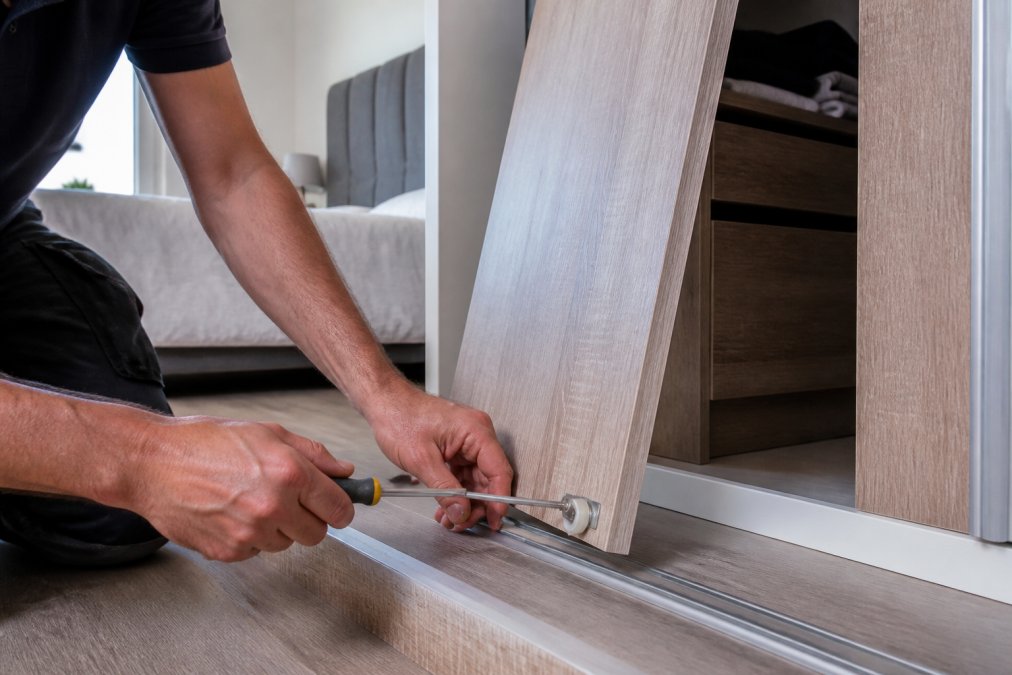
Replacing worn rollers restores smooth running when cleaning and adjustment no longer help. The job is straightforward once you have identified your roller type and removed the door safely.
Identifying Your Roller Type and Door Carriage
Roller compatibility is where most DIY repairs go wrong. Two carriages can look identical and still differ in wheel diameter by two millimetres, enough to make the door bind or jump. Before ordering, work through these four checks in order.
1. Top-hung or bottom-rolling? Look at where the door's weight is carried. On a bottom-rolling system, rollers sit in a channel at the base and the top guide is a small nylon block that stops the door tipping forward. On a top-hung system, rollers hang from a track under the wardrobe's top panel and the door's base runs in a shallow floor guide. Top-hung carriages are under constant tension and wear faster, so they are the more common replacement part. If lifting the door a few millimetres disengages it from above rather than below, it is top-hung.
2. Wheel diameter. Measure across the wheel with a ruler or calipers. Common diameters fall between roughly 20 mm and 30 mm, and the replacement must match within about half a millimetre (bsigroup.com). Too small drops the door onto the track; too large lifts it into the top guide and causes binding.
3. Fixing method. Carriages attach in one of three ways: screw-fixed through a metal plate, clip-in where the housing snaps into a slot, or slot-mounted where the roller slides into an extruded channel and locks with a grub screw. Photograph the fixing before removal, clip-in housings often have a small release tab that snaps easily.
4. Brand or profile stamp. Many carriages carry a moulded brand name, part number or profile code. Note it exactly, a single letter can distinguish two otherwise identical rollers. With no stamp, measure the fixing-hole distance as well as the wheel diameter; that pair is usually enough for a supplier to identify the carriage.
If these four checks fail, photograph the carriage from the side, top and fixing face, and send the images to your supplier with the door's approximate width and weight. Our team can help match rollers to the carriage you already have, avoiding a part that will not seat properly.
Fitting Replacement Rollers and Checking the Top Guide
- Remove the door panel and lay it flat on a padded surface.
- Unscrew or unclip the old roller from the bottom corner.
- Fit the replacement roller and tighten the fixings, leaving the height screw at its midpoint.
- Lift the door back onto the bottom track, then ease the top edge into the top guide.
- Adjust the anti-jump device so it clears the track but prevents lift.
- Test the door through its full travel and fine-tune the height.
The top guide is the part most people ignore. If worn or loose, the door can lift and derail even with new rollers. Check that it holds the door with minimal play and that its fixings are tight.
Why New Rollers Sometimes Still Bind
If the door runs no better after a roller swap, the cause is usually one of three things, none of them the roller itself. First, the track may be worn into a groove where the old wheel ran, so the new wheel sits in a dip and catches on the lip. Second, the rollers may be set at different heights, tilting the panel and loading one wheel more than the other. Third, the door may be too heavy for the carriage rating, common on wide mirror panels. Check the carriage's load rating against the panel weight before blaming the part.
Handling Mirrored and Glass Door Panels
Mirror and glass panels need different handling from woodgrain or melamine doors: the weight sits differently, the edges chip easily, and the surface shows every scratch.
Lift a mirrored door by its frame, never the glass. Keep the panel vertical while moving it and never lay it face-down on a hard floor. If you must set it down, use a blanket or foam sheet and rest it on its edge against a wall.
Keep silicone spray off the glass itself, overspray leaves a film that smears and is hard to remove. Mask the panel edge with tape before spraying the track if the door is already in place.
When to Call a Professional or Replace Instead
Most sliding wardrobe door faults are either a DIY fix or they are not, but the two categories look similar from the outside: a door that will not run smoothly may have a worn roller or a frame that has moved, and the symptoms overlap. Use the checks below to place your fault before buying parts.
Faults You Can Fix Yourself
These are mechanical, localised and reversible. If your door matches any of them, DIY repair is the right call:
- A roller that has worn flat, cracked, or seized
- Debris or hardened deposits in the bottom track
- A door that has dropped on one side and needs height adjustment
- A top guide that has worked loose or needs its fixings tightened
- An anti-jump device set too high or too low
- A door that binds only at one point along its travel
All are fixed by cleaning, adjusting or replacing a single component, and none requires the door to come off its frame permanently.
Faults That Need a Professional
These are structural. Adjusting rollers will not fix them, and attempting a repair can make the damage worse:
- A bottom track that is bent, twisted, or no longer straight along its length
- A top track that has pulled away from the wardrobe carcass or is sagging in the middle
- A door frame that has moved out of square, so the door binds at one end and gaps at the other
- A glass or mirror panel that is chipped, cracked, or has a damaged edge
- Carriage mounting points that have torn out of the door panel, leaving nothing to screw a new roller into
- A wardrobe carcass that has swollen or delaminated from moisture
A useful test: place a spirit level along the bottom track. If the bubble sits off-centre by more than a few millimetres over the door's length, the track has moved and no roller adjustment will compensate. Check the top track for sag by sighting along its length.
Repair or Replace the Door?
If the fault is in the track or the frame, repair the structure rather than the door. If the fault is in the door itself, the decision comes down to the panel:
- Repair when the panel is flat, the edges are sound, and the carriage mounting points are intact. Rollers, guides and fixings are all replaceable, and a repaired door will run as well as a new one.
- Replace when the panel is warped, the frame is rotten or swollen, the carriage mounting points have torn out, or a mirror panel has chipped. These are not repairable at home, and a new door is usually the cheaper route once you account for the labour of a structural fix.
A Note on Ageing Doors
A door that has needed three or more repairs in as many years is telling you the carriage, the track, or both are at the end of their service life (Common dishwasher faults and how to fix them). Replacing the door and its running gear together is then more economical than replacing individual parts, because a new carriage on a worn track wears out faster than it should.
DoorsDirect supplies made-to-measure sliding wardrobe doors and the components that keep them running. Every product carries a ten-year guarantee and passes a three-stage quality check before dispatch, so you are not gambling on a part that fails in a year. If you would rather not repair an ageing door at all, our team can help you specify a replacement that fits your existing opening.
Frequently Asked Questions
What are the most common problems with sliding wardrobe doors?
The most frequent issues are derailing, where the door jumps off the track, and jamming caused by debris or misaligned rollers. Resistance when sliding often points to worn ball bearings in the door carriage or a build-up of dust in the bottom track. Sticking can also result from a top guide that has worked loose or screws that need tightening. Most of these faults are repairable with basic tools once you identify the cause.
Can I repair a sliding door myself?
Yes, most common faults are within reach of a confident DIYer. Cleaning tracks, adjusting roller height and replacing worn rollers are all straightforward tasks. The job becomes a professional one when the door frame is damaged, the track itself is bent, or you are handling heavy mirrored panels.
How do I fix a sliding wardrobe door that keeps derailing?
Start by checking track alignment and removing any debris from the bottom track. A door that repeatedly derails usually has a worn or incorrectly seated roller, or a top guide that is no longer holding the panel upright. Inspect the anti-jump device if your system has one, and confirm the door height is set correctly. If the track itself is misaligned, the door will continue to jump regardless of new rollers.
When is it better to replace sliding wardrobe doors rather than repair them?
Replacement makes more sense when the door panel itself is warped, the frame is cracked, or the track has worn so thin that new rollers will not sit securely. If you have already replaced rollers once and the door still sticks or derails, the sliding mechanism may be past saving. Upgrading to made-to-measure doors with a ten-year guarantee can be more cost-effective than repeated repairs on ageing hardware.
Leave a comment