


How to Clean Matte Black Wardrobe Doors: 2026 Guide
Table of Contents
- How to Clean Sliding Wardrobe Doors: The Essentials
- Best Cleaning Products for Matte Black Finishes
- Step-by-Step: How to Clean Matte Black Wardrobe Doors
- Removing Fingerprints from Matte Black Surfaces
- Tackling Stubborn Marks and Grease
- Protecting and Maintaining Your Matte Finish
- Frequently Asked Questions
Last Updated: September 13, 2026
How to Clean Sliding Wardrobe Doors: The Essentials
Cleaning matte black wardrobe doors is straightforward once you understand one thing: the finish is a thin, non-reflective coating, and anything abrasive takes it off permanently. This guide from DoorsDirect covers how to clean matte black wardrobe doors without dulling the surface, plus the products that work, the ones that ruin the finish, and how to keep fingerprints away for longer.
Matte black is a lacquer finish with a flattening agent added to the top coat. That agent scatters light instead of reflecting it, which is what gives the surface its soft, velvety look. It also means every smear, fingerprint and dust particle sits visibly on top of the door rather than blending into a gloss shine. The trade-off is real: you get a striking, contemporary panel that hides scratches well, but you have to clean it more carefully than a standard gloss door.
Total time: 15-20 minutes for a standard two-door wardrobe Difficulty: Beginner
What You'll Need
Gather everything before you start, so you are not running back and forth with a wet cloth in hand:
- Two lint-free microfibre cloths (one damp, one dry)
- A pH-neutral mild detergent or a few drops of washing-up liquid
- Warm water in a spray bottle or bucket
- Distilled vinegar for greasy marks
- Bicarbonate of soda for stubborn spots
- A soft sponge (never a scouring pad)
- A second dry microfibre cloth for buffing
Best Cleaning Products for Matte Black Finishes
The best cleaning products for matte black are pH-neutral, solvent-free formulas: a diluted mild detergent, distilled vinegar, or a dedicated matte-surface cleaner. Anything labelled "shine", "polish" or "wax" is designed for gloss and will leave a greasy film on a matte panel.
That rule holds across the board, but the safest product depends on what the matte black surface is actually made of. Most guides treat all matte finishes as identical. They are not, and using the wrong routine on the wrong substrate is how people end up with a permanent shiny patch or a lifted edge.
Match the product to the finish
| Finish type | What it is | Safest routine | Watch out for |
|---|---|---|---|
| Matte lacquer | A sprayed top coat with a flattening agent | Mild detergent + warm water, buffed dry; diluted distilled vinegar for grease | Abrasives, alcohol, ammonia, cream cleansers, these cut through the flattening agent |
| Foil-wrapped | A textured vinyl foil bonded to a core board | Damp microfibre with pH-neutral cleaner only; dry immediately | Solvents and prolonged moisture, which can soften the adhesive at edges and seams |
| Wood veneer | A real timber layer under a matte top coat | Slightly damp cloth, then dry; avoid saturating the surface | Standing water and over-wetting, which can raise the grain or stain the timber |
| Black glass | A tinted glass panel, not a painted finish | pH-neutral cleaner or a diluted vinegar solution, buffed dry | Abrasive pads, which scratch the glass; the matte look comes from the coating, not the glass itself |
If you are not sure which you have, check the product specification or the care leaflet that came with the door. When in doubt, treat it as foil-wrapped: the gentlest routine is safe on every finish, while the harshest is not.

What to keep in your cupboard
| Product | Use it for | How to apply |
|---|---|---|
| Mild detergent + warm water | Everyday dust and light marks | Dampen a microfibre cloth, wipe, dry immediately |
| Distilled vinegar (diluted) | Grease and cooking residue | Spray onto a cloth, wipe, buff dry |
| Bicarbonate of soda paste | Stubborn dried-on spots | Apply with a soft sponge, rinse, dry |
| pH-neutral matte cleaner | Routine maintenance | Follow the bottle dilution, always buff dry |
Products to avoid
Abrasive cleaners, cream cleansers, bleach-based sprays, ammonia, alcohol wipes and anything with a wax or silicone additive will damage a matte finish (which.co.uk). On lacquer, the flattening agent sits in the top coat, and abrasive particles scratch it away, leaving a shiny patch that cannot be polished back out. On foil, solvents attack the bond at the edges. On veneer, excess water is the enemy rather than the cleaner itself.
If you would rather not mix your own solution, buy a cleaner specifically labelled for matte surfaces. Every product you use on a matte black wardrobe should be non-abrasive and solvent-free.
Step-by-Step: How to Clean Matte Black Wardrobe Doors
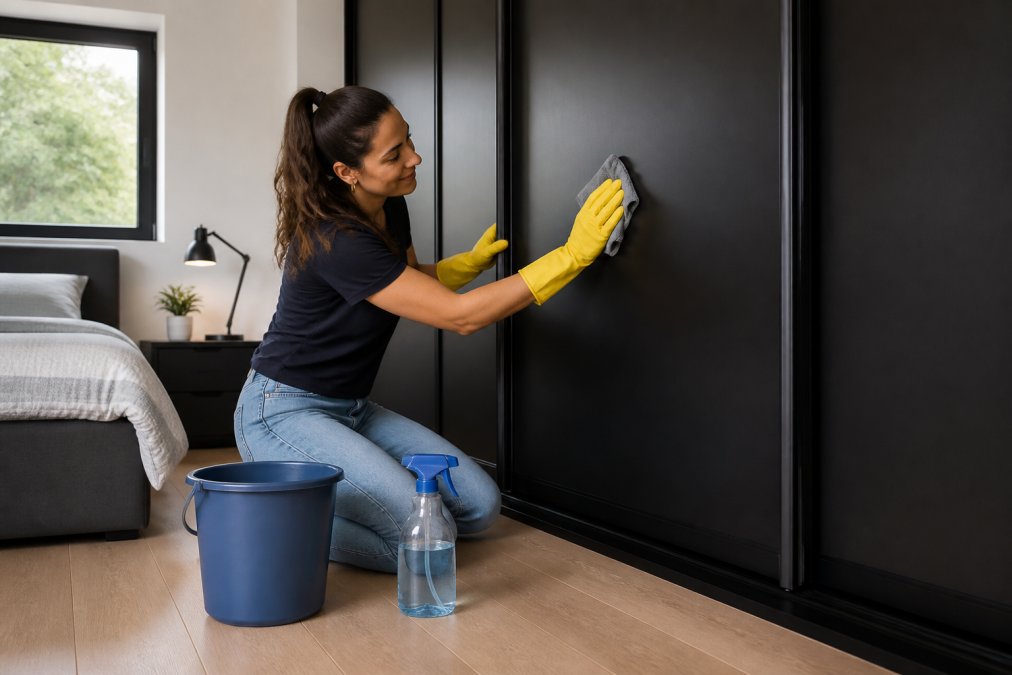
Follow these steps in order, working top to bottom so dust and drips do not fall onto areas you have already cleaned.
- Dust first, dry. Run a dry microfibre cloth over the whole door, including the frame and the top edge. Skipping this turns dust into muddy streaks the moment moisture hits it.
- Mix your solution. Add a few drops of mild detergent to warm water, or use a pH-neutral matte cleaner at the dilution on the bottle.
- Dampen, don't soak. Wring the cloth until it is barely damp. Excess water on the surface is the main cause of streaks and surface residue.
- Wipe in straight strokes. Work from the top down in vertical passes, overlapping slightly. Avoid circular scrubbing, which leaves visible swirl marks on a matte finish.
- Buff dry immediately. Follow behind with a clean, dry lint-free cloth before the surface air-dries. This is the step most people skip, and it is the one that decides whether you get a streak-free result.
- Finish the tracks. Wipe the top and bottom runners with a dry cloth, then vacuum out grit. Debris in the track is what makes sliding doors jump and scrape over time.
Expected result: an even, streak-free sheen with no visible wipe marks under angled light.
Removing Fingerprints from Matte Black Surfaces
Fingerprints are the single most common complaint about matte black. The oils in your skin sit on top of the finish and scatter light differently to the surrounding surface, so they show up far more than they would on gloss.
The fix is quick if you catch it early. Dampen a microfibre cloth with warm water, add a single drop of mild detergent, and wipe the print in one direction. Buff dry straight away with a second cloth. For a single smudge, a dry microfibre cloth alone often lifts it without any moisture at all.
For doors that seem to collect prints constantly, particularly around handles and edges, a matte-safe protective coating helps. These are applied as a thin, solvent-free layer that makes the surface easier to wipe and gives it some fingerprint resistance. Test any coating on an inconspicuous area first, and check it is compatible with a lacquer finish before applying it across the door.
Tackling Stubborn Marks and Grease
Dried-on marks and greasy residue need a targeted approach rather than more pressure. Pressing harder with a damp cloth pushes residue into the grain and risks scratching the surface.
For grease, spray a diluted distilled vinegar solution onto a cloth rather than directly onto the door, then wipe the area in one direction and buff dry. Vinegar cuts through oils without leaving the film that detergent can leave behind.
For stubborn, dried-on marks, mix bicarbonate of soda with a little water to form a paste (the NHS). Apply it with a soft sponge, let it sit for a minute, then wipe it away with a damp cloth and dry the area thoroughly. This works well on scuffs and dried splashes, and it is gentle enough for a lacquer finish as long as you use a soft sponge and light pressure.
A few marks resist everything you try at home: deep scratches, chips and areas where the top coat has worn through. Those are not cleaning problems, and no product will blend them back in.
Protecting and Maintaining Your Matte Finish
The best protection is a light, regular routine rather than an occasional deep clean. Dust the doors weekly with a dry microfibre cloth, and do a damp wipe with mild detergent every few weeks (goodhousekeeping.com). Spot-clean fingerprints and marks as they appear instead of letting them build up.
A few habits make a measurable difference to how long the finish lasts:
- Keep the tracks clear of grit so the door does not scrape as it slides
- Avoid leaning anything against the panel, which can leave pressure marks
- Use the handle every time rather than pushing the door with your palm
- Keep abrasive pads, cream cleansers and solvent sprays away from the surface
Long-term protective coatings
A matte-safe protective coating is the single most effective way to cut down on fingerprint adhesion and make future cleaning easier. These products work by leaving a thin, solvent-free layer that fills the microscopic peaks of the matte surface just enough to stop skin oils gripping it, without adding a shine.
A few practical points before you apply one:
- Check the label says it is suitable for matte and lacquer finishes. A coating designed for gloss will add the very sheen you are trying to avoid.
- Apply to a clean, fully dry door. Trapping dust under the coating leaves a permanent speckled texture.
- Test on an inconspicuous area first and leave it for a full day before doing the whole door.
- Reapply according to the manufacturer's interval. Most matte-safe coatings are not permanent and wear off in high-touch zones first.
Wax is a common mistake here. Traditional furniture wax is designed to build a shine and will leave a streaky film on matte black, so stick to coatings explicitly labelled for matte surfaces.
Repairing light scratches
Matte black hides scratches better than gloss, but it is not immune to them. The good news is that most marks people assume are scratches are actually transfer marks, paint from a belt buckle, a scuff from a shoe, or residue from a ring. Try the bicarbonate paste routine first; if the mark lifts, it was never damage.
If it is a genuine scratch, work through this order:
- Identify the depth. Run a fingernail lightly across it. If your nail catches, the scratch has gone through the top coat and no cleaner will fix it.
- Try a matte scratch-repair pen. These are matched to the finish and deposit colour into the scratch rather than polishing the surface. Polishing is the wrong move on matte, because it burnishes the area around the scratch and leaves a shiny halo.
- Feather the edges. Apply in thin layers, building up rather than flooding, and wipe away any excess immediately with a dry cloth.
- Accept the limit. Deep scratches, chips and areas where the top coat has worn through are not cleaning problems. No product will blend them back in, and on a foil or veneer door a repair that looks worse than the scratch is a real risk.
For deeper damage, replacement of the door panel is usually the cleaner route than an attempted repair.
When to call it a replacement
A matte black door that has been cleaned with the wrong products for years will show a patchwork of shiny areas where the flattening agent has been worn away. This is not reversible. If the finish has gone patchy across a large area, or if scratches are deep enough to catch a fingernail, a new door panel is the practical answer rather than an ongoing battle with polish.
That is also where material choice matters. A glass panel holds its finish differently to a lacquered one, and the cleaning routine should follow the material rather than the colour. If your wardrobe is due an upgrade, DoorsDirect supplies made-to-measure sliding wardrobe doors in finishes including black glass, mirror and woodgrain, each covered by a ten-year guarantee and a three-stage quality check. You can order a Black Glass sample to check the finish against your room before committing.
Frequently Asked Questions
What is the best way to clean matte black without leaving streaks?
Use a pH-neutral mild detergent diluted in warm water, applied with a soft, non-abrasive microfibre cloth. Wipe in gentle, overlapping strokes rather than scrubbing back and forth. Rinse the cloth frequently and finish with a dry lint-free cloth to buff away any surface residue. Avoid abrasive cleaners and paper towels, which leave lint and can scratch the finish. Distilled vinegar diluted with water also works well for a streak-free result on matte black wardrobe doors.
Can I use vinegar to clean matte black wardrobe doors?
Yes, distilled vinegar is a safe and effective option for matte black finishes when diluted with warm water, roughly one part vinegar to three parts water. It cuts through light grease and leaves a streak-free finish without the chemical damage that harsh solvents can cause. Avoid using undiluted vinegar or leaving it on the surface for extended periods, as the acidity can affect the protective layer over time. Always test on a small hidden area first.
How do I remove stubborn grease marks from matte black surfaces?
For grease removal on matte black wardrobe doors, mix a small amount of washing-up liquid with warm water and apply with a soft sponge, working gently along the wood grain or panel direction. For tougher marks, make a paste from bicarbonate of soda and water, apply it to the spot, leave for a minute, then wipe away with a damp cloth. Rinse thoroughly and dry with a lint-free cloth to prevent streaks.
How often should I clean my sliding wardrobe doors?
A weekly spot clean with a dry microfibre cloth keeps dust and fingerprints from building up on matte black surfaces. A deeper clean using a mild detergent solution every four to six weeks maintains the finish and prevents grease or residue accumulation. In busier households or where doors are touched frequently, increase the frequency of spot cleaning. Regular maintenance protects the surface integrity and keeps the matte sheen consistent.
Matte black shows every mistake, which is exactly why it is worth buying a finish that is built properly in the first place. DoorsDirect makes made-to-measure sliding wardrobe doors with expert guidance from measurement to final fit, a three-stage quality check and a ten-year guarantee, so the surface you are carefully maintaining is one that holds up. Order yours today and get a finish that stays even for years, not months.
Leave a comment