


Gliderobes vs MySlidingWardrobe: 2026 Comparison
Table of Contents
- Gliderobes vs MySlidingWardrobe: Quick Comparison Table
- Made to Measure Sliding Wardrobe Doors: How the Two Suppliers Compare
- Bespoke Storage Interiors: What Each Supplier Offers
- Pricing and Cost-Effectiveness: Where the Money Goes
- Installation: DIY vs Professional Fitting
- Best Sliding Wardrobe Suppliers for Joiners and Trade Buyers
- Warranty, Lead Times and After-Sales Support
- Verdict: Which Sliding Wardrobe Supplier Fits Your Project?
- Frequently Asked Questions
Last Updated: September 18, 2026
Gliderobes vs MySlidingWardrobe: Quick Comparison Table
A sliding wardrobe comparison between Gliderobes and MySlidingWardrobe comes down to one question: are you buying a fitted furniture service or a component supply? At DoorsDirect, we sell made-to-measure doors and interiors, so we have a clear view of both models. Gliderobes operates as a fitted furniture specialist, while MySlidingWardrobe leans toward online door supply. That distinction shapes everything below: cost, lead times, installation and how much control you keep over the finished result.
| Factor | Gliderobes | MySlidingWardrobe | DoorsDirect |
|---|---|---|---|
| Supply model | Fitted service | Online supply | Doors and interiors, trade or DIY |
| Frame material | Varies by range | Varies by range | Aluminium profiles and tracks |
| Made to measure | Yes | Yes | Yes, up to 2540mm height |
| Installation | Professional fitting | Typically self-fit | DIY or professional |
| Warranty | Varies by contract | Varies by product | 10-year guarantee |
| Best for | Full-service buyers | Confident DIY buyers | Joiners and informed homeowners |
Made to Measure Sliding Wardrobe Doors: How the Two Suppliers Compare
Made-to-measure production is standard across both suppliers, so the split is not whether doors are custom built but who controls the specification. Gliderobes bundles measurement, design and fitting into a single contract. MySlidingWardrobe supplies doors and tracks for the buyer to install, which suits anyone comfortable with a level and a drill.
Door Mechanisms, Tracks and Frame Materials
Track quality decides whether a sliding door still runs smoothly in year eight. Aluminium profiles resist flex and corrosion better than steel, and a soft-close action prevents the slam that eventually loosens fixings. DoorsDirect uses aluminium profiles and tracks across its ranges rather than steel, with soft-close available as an option.
- Track length versus opening width. Tracks are supplied slightly longer than the opening so they can be trimmed on site for an accurate fit. Ask how much trimming allowance is included, because a track cut too short cannot be recovered.
- Runner type. Top-hung systems carry the door weight on the head track and keep the floor clear; bottom-rolling systems sit on a floor guide and suit heavier panels. The fixing method at the head is the deciding factor in most homes.
- Panel weight per runner. Every runner has a rated load. A wide mirror door weighs considerably more than a narrow melamine one, so confirm the runner rating covers your widest panel, not the average.
- Soft-close mechanism. Usually an optional extra rather than standard, and worth confirming per door rather than per set.
A Five-Year Wear and Tear View
Most comparison content stops at the showroom. A more useful test is what happens after five years of daily use, because the failure pattern is fairly consistent:
- Years one to two. Poorly fixed head tracks work loose, usually because the fixings missed the timber behind plasterboard. This is an installation fault, not a component fault, and it is the single most common early failure.
- Years two to four. Cheaper steel tracks begin to pit and the runners pick up grit, which shows up as a grinding noise and a door that needs a push to start moving. Aluminium tracks resist this far better.
- Years four to five. Rollers wear and develop flat spots, so the door starts to judder. Rollers are a consumable part and should be replaceable without removing the whole track, check this before you buy.
- Throughout. Doors that are not adjusted square to the track rub at one corner and wear the finish. A five-minute adjustment after the first month of use prevents most of this.
Finishes, Colours and Customisation Options
Finish choice is where a sliding wardrobe comparison stops being technical and starts being personal. Glass, mirror and wood-effect melamine panels cover most briefs, and profile colour is the detail buyers forget until the doors arrive.
Materials and End-of-Life
Neither supplier's marketing tends to address what happens to the wardrobe at the end of its life, which is worth a moment's thought on a long-term purchase. Aluminium is widely recycled and holds a resale value as scrap, so an aluminium-framed system has a cleaner end-of-life story than a steel one. Melamine-faced panels are harder to recycle and typically go to general waste, while glass and mirror panels need separate handling.
Bespoke Storage Interiors: What Each Supplier Offers
Interior configuration separates a wardrobe that works from one that merely fits. Hanging rails, interior drawers and shelving units need to match how you actually store clothes, not a generic template.
Pricing and Cost-Effectiveness: Where the Money Goes
Price differences between these suppliers reflect scope, not just margin. A fitted service carries design time, survey visits and installation labour inside the headline figure. A supply-only order strips those out and leaves them with you.
Installation: DIY vs Professional Fitting
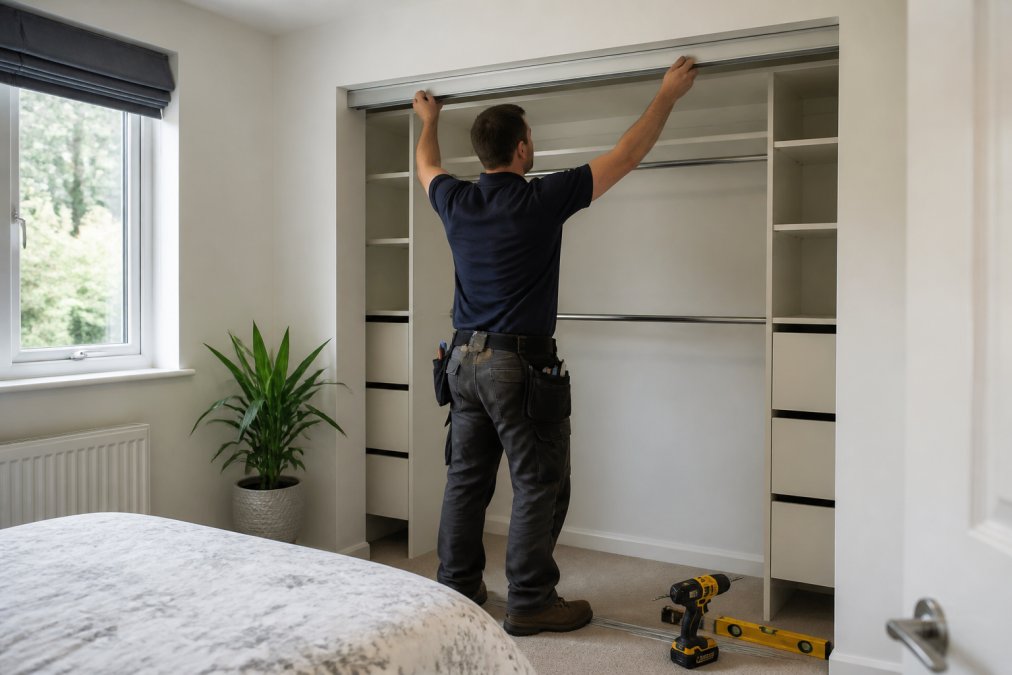
Installation difficulty depends on the opening, not the supplier. A straight, plumb opening with a solid head fixing takes a competent DIYer a few hours per door set. Out-of-square walls or a first-floor joist above the opening push the job toward professional fitting.
DIY Difficulty Rating
Most guides describe installation as 'straightforward' without saying straightforward for whom. Here is a plain rating for a typical two-door set, scored out of five for each stage:
| Stage | Difficulty (1-5) | Time (two-door set) | Main risk |
|---|---|---|---|
| Measuring the opening | 3 | 30-45 min | Out-of-square openings; measure width at top, middle and bottom |
| Locating and preparing head fixings | 4 | 30-60 min | Missing the timber behind plasterboard |
| Fitting the head track | 3 | 30-45 min | Track not level, so doors drift open |
| Hanging and adjusting doors | 2 | 45-60 min | Rollers set unevenly, causing rubbing |
| Fitting floor guide or bottom track | 2 | 20-30 min | Guide not aligned with the door line |
Tools You Will Actually Need
- Cordless drill and a set of masonry and timber bits
- Spirit level, ideally 1200mm or longer
- Tape measure and a pencil
- Stud finder or a thin bradawl to probe for timber
- Fine-tooth saw for trimming the track
- Screwdriver set and a step ladder
If you do not own a long spirit level or a stud finder, that is usually the point at which professional fitting becomes the cheaper option once you price the tools in.
When to Call a Professional
Treat professional fitting as the default when any of the following apply:
- The opening is out of square by more than a few millimetres across its width
- There is no accessible timber above the opening and the head fixing would rely on plasterboard alone
- The wall is a stud partition with no noggin where the track needs to sit
- The doors are wide, glazed or mirrored, and you have no second person to help lift them
- The wardrobe sits in an alcove where both side walls need to be scribed or packed
Best Sliding Wardrobe Suppliers for Joiners and Trade Buyers
For joiners, the deciding factors are consistent tolerances, reliable lead times and a supplier who will not compete for the end client. Trade buyers rarely want a fitted service; they want components that arrive correct and fit first time.
Warranty, Lead Times and After-Sales Support
Warranty length tells you how much confidence a supplier has in its own components. DoorsDirect backs every product with a 10-year guarantee, covering the doors, profiles and tracks it manufactures.
Verdict: Which Sliding Wardrobe Supplier Fits Your Project?
Pick Gliderobes if you want a single contract covering survey, design, supply and fitting, and you would rather not manage any of it yourself. Pick MySlidingWardrobe if you are confident measuring and fitting, and you want to keep costs down by doing the labour.
Frequently Asked Questions
What are the key differences between Gliderobes and MySlidingWardrobe?
The main differences sit in three areas: door construction, interior storage options and how each supplier supports installation. One leans towards a full design-and-fit service, while the other focuses on supplying doors and components for self-installation. Both offer made to measure sliding wardrobe doors, but the specification of tracks, frames and fittings varies, which affects how smoothly doors run over time and what warranty cover you get.
Are bespoke sliding wardrobes worth the investment?
They are worth it when standard sizes leave gaps, block access or waste space in awkward rooms. Made to measure doors sit flush to your opening, so you gain usable storage without boxing in alcoves or losing floor space to swinging doors. If your room is a straightforward rectangle with a standard opening, a freestanding unit may cost less. For anything irregular, bespoke storage interiors usually deliver better long-term value.
How do custom sliding wardrobe lead times compare?
Lead times vary by supplier, range and finish, and popular glass or mirror options often take longer than melamine panels. Always confirm the quoted lead time in writing before ordering, and ask whether it covers manufacture only or delivery as well. If your project is on a tight schedule, such as a loft conversion or refurbishment, check whether the supplier holds stock of your chosen profile and track colour.
Do these suppliers offer installation services or DIY options?
Most made to measure suppliers offer both, but the split differs. Some include a full measure and fit service, while others supply doors, tracks and fittings for you or your joiner to install. If you go the DIY route, check that tracks arrive slightly longer than the opening so they can be trimmed on site, and confirm the supplier provides fitting instructions and technical backup.
How do I ensure my sliding wardrobe doors fit correctly?
Measure the opening at three points for height and width, top, middle and bottom, and use the smallest figure, because walls and floors are rarely perfectly square. Check for skirting boards, coving and any obstruction along the track line. If you are unsure, ask the supplier to review your measurements before manufacture. Custom doors cannot be trimmed down after delivery, so accuracy at the measuring stage matters most.
Choosing between fitted service and component supply is the real decision behind any sliding wardrobe comparison, and getting it wrong costs more than the doors. DoorsDirect supplies premium, made-to-measure sliding wardrobe doors and bespoke storage interiors with aluminium profiles and tracks, a three-stage quality check process and a 10-year guarantee, with expert guidance from measurement to final fit. Order yours today and build a wardrobe that fits the first time.
Leave a comment