


Common Problems With Sliding Wardrobe Doors
Table of Contents
- Common Problems With Sliding Wardrobe Doors: What Goes Wrong First
- Sliding Wardrobe Door Sticking: Why It Happens and How to Fix It
- Sliding Wardrobe Door Off Track: Getting a Panel Back On Safely
- How to Adjust Sliding Wardrobe Doors That Drag or Overlap Unevenly
- Loose Screws, Worn Hardware and Scraping Noises
- Repair or Replace Sliding Wardrobe Doors: Making the Call
- Preventive Maintenance That Keeps Doors Sliding Smoothly
- Conclusion
- Frequently Asked Questions
Last Updated: October 15, 2026
Common Problems With Sliding Wardrobe Doors: What Goes Wrong First
Most problems with sliding wardrobe doors come down to four things: dirt in the track, worn rollers, loose screws, or a panel that has jumped its guide.

At DoorsDirect, we supply made-to-measure sliding wardrobe doors daily, so we hear the same questions repeatedly.
A sliding wardrobe door runs on a top and bottom track, carried by rollers at the top and held steady by a bottom guide.
Nearly every fault warns you first: a slight scrape, more resistance, a door that no longer closes flush. Catch it early and it is a ten-minute job.
Sliding Wardrobe Door Sticking: Why It Happens and How to Fix It
A sticking sliding wardrobe door is almost always caused by a dirty track or a worn roller, not by the door itself. Clean the track first, then check the rollers, before you touch any adjustment screws.
Cleaning and Inspecting the Tracks
Start with the bottom track. It collects dust, carpet fibres, hair and grit, the most common cause of a dragging door.
- Vacuum the full length of the bottom track with a brush attachment
- Wipe it with a damp cloth and a mild cleaner
- Run your finger along the track to feel for burrs, dents or rust
If the track is rusted or dented, cleaning will not fix it. Rust and physical damage need the track replaced, not scrubbed.
Checking the Rollers and Wheels
Worn rollers are the second most common culprit. A roller that has flattened, cracked or seized will drag no matter how clean the track is. Lift the door slightly and watch the roller: it should turn freely and sit squarely in the track. If it wobbles, grinds or has a flat spot, replace it.
Sliding Wardrobe Door Off Track: Getting a Panel Back On Safely
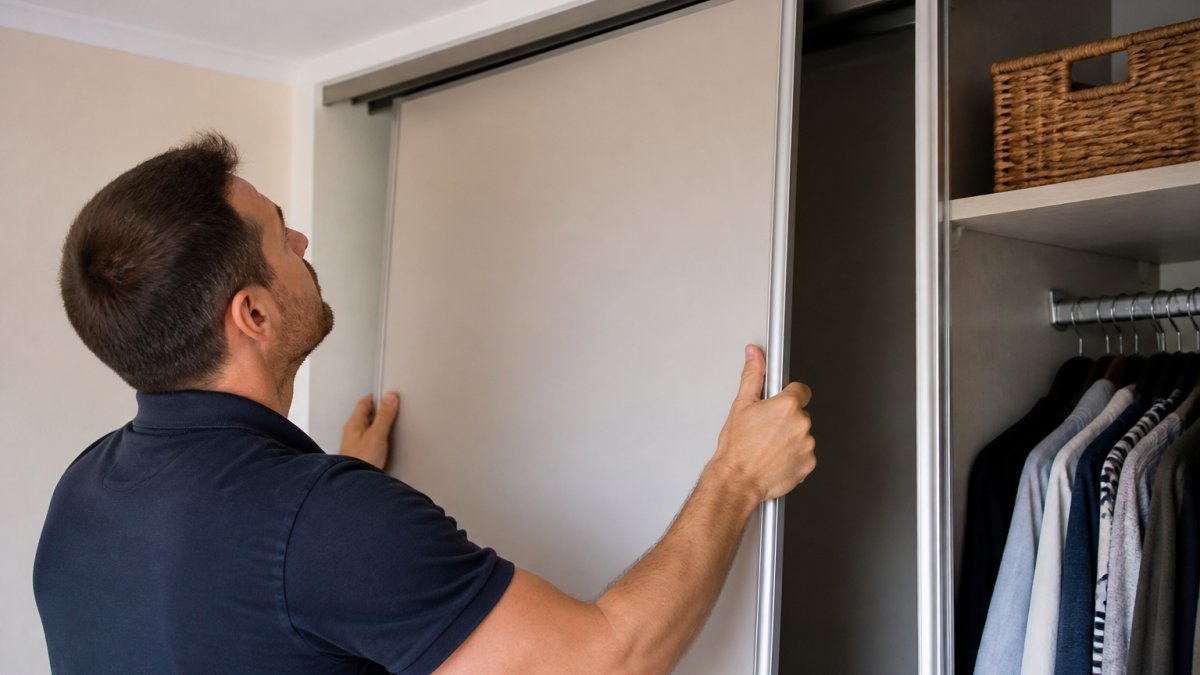
A sliding wardrobe door comes off track when lifted past its guide or when a roller fails completely. Never force it back, take the weight off the panel first, then reseat it.
Know Which System You Have Before You Lift
The rehang method depends on how the door is carried. Two systems dominate:
- Top-hung (top-rolling) doors. The full weight hangs from rollers in a track fixed to the top rail or ceiling; the bottom track is only a guide. These panels are heavy, so a failed top roller drops the door fast.
- Bottom-rolling doors. The panel sits on wheels in a floor-level track, with a top guide keeping it upright. Easier to lift, but the bottom track collects grit and wears.
Before you touch anything, look up and down: whichever track has the rollers carries the load, and that is the one to work with.
Removing a Panel Safely
Most systems let you lift the door into the top track and swing the bottom out; reversing that motion puts it back. Two people make this far safer than one.
- Clear the floor and lay a blanket or cardboard down.
- On bottom-rolling doors, turn the adjustment screws to raise the panel as high as they go, giving clearance to lift it off the wheels.
- On top-hung doors, lift the panel vertically so the rollers clear the track opening, then tilt the bottom edge towards you.
- With a helper on the other end, walk the panel out and set it on its edge, never flat.
If the door will not lift free, stop. Forcing it usually means a roller has jammed in the track, and you will bend the frame before you free the panel.
Removing and Handling Mirrored or Heavy Doors
Mirror doors and heavy panels need extra care, the glass is the risk, and so is your back.
- Wear gloves against cut edges
- Work with a second person, one at each end
- Lift from the frame, never the glass
If a mirror door is chipped or the frame is bent, replace the panel rather than rehanging it.
Rehanging the Panel
Rehang in reverse order, checking guide engagement before you let go:
- Lift the panel so the rollers sit above the track opening.
- Lower it gently until the rollers seat, you should feel them drop into place, not force them.
- On bottom-rolling doors, check the top guide sits in its channel before releasing the weight.
- Slide the door the full length by hand; if it catches, find the obstruction before pushing harder.
- Re-set the height adjustment so the door sits level and clears the floor by a few millimetres.
If the door comes off again within a few slides, the roller or the track is the problem, not your technique. Move on to checking the hardware rather than rehanging a third time.
How to Adjust Sliding Wardrobe Doors That Drag or Overlap Unevenly
Uneven or overlapping doors are an alignment problem, set by the adjustment screws on the rollers. A small turn goes a long way:
- Identify which door is out of line and in which direction
- Loosen the locking screw on the roller housing
- Turn the adjustment screw a quarter turn at a time
- Slide the door back and forth to test
- Tighten the locking screw once the door sits flush
- Repeat on the other roller if the door still tilts
Check height as you go: too low and the panel catches the floor, too high and it will not sit in the guide properly.
Custom 3 Door Sliding Wardrobe Doors →
| Symptom | Likely Cause | First Fix |
|---|---|---|
| Door drags along the bottom | Debris in the bottom track | Clean and inspect the track |
| Door scrapes or grinds | Worn roller or wheel | Replace the roller set |
| Door jumps off the track | Failed roller or lifted past guide | Take the weight off, reseat the panel |
| Doors overlap unevenly | Roller out of adjustment | Adjust the roller screws |
| Door wobbles in place | Loose hardware or screws | Tighten all fixings |
| Door will not close fully | Obstruction or misalignment | Clear the track, then realign |
Loose Screws, Worn Hardware and Scraping Noises
Scraping and grinding noises come from metal rubbing where it should not, usually from loose screws and worn hardware. Check every fixing on the door and track: a loose screw lets the roller housing shift, throwing the door out of line against the track edge.
- Tighten the roller housing screws
- Check the track fixings along the full run
- Look at the bottom guide for wear
If the noise continues after tightening, the roller itself is worn. Grinding means metal on metal, and that only gets worse.
Repair or Replace Sliding Wardrobe Doors: Making the Call
Repair when the track is sound, the frame straight and only the moving parts have failed. Replace when the track is damaged, the frame bent, or the doors keep coming off track despite repairs.
Match the Fix to the Hardware You Have
What you can realistically repair depends on the system:
- Bottom-rolling doors are the friendlier DIY job: rollers, guides and the floor track are accessible, replaceable individually, and the panel lifts off without overhead weight.
- Top-hung doors put the load on a top track and roller carriage that is harder to reach and adjust. Roller replacement is more involved, and a worn top track often means renewing the whole carriage assembly rather than one wheel.
If you cannot identify your roller type or find a matching replacement, that alone can push the job towards full system replacement, mismatched rollers wear the track unevenly and you will be back to the same fault within months.
A Practical Tool List
For most roller and track jobs you will need:
- A screwdriver set (cross-head and flat)
- A small adjustable spanner or the hex keys that came with the door
- A vacuum with a brush attachment
If the job needs a drill, a hacksaw, or cutting a new track to length, you are past a simple repair.
Time and Difficulty
- Cleaning a track: minutes, no tools beyond a vacuum and cloth, easy.
- Tightening loose hardware: minutes, easy.
- Adjusting door height or alignment: a short session of trial and error, moderate.
When to Call a Professional
Bring in a fitter if any of these apply:
- The panel is a full-height mirror or too heavy to lift safely with one helper
- The top track is bent, split or pulling away from its fixings
- The doors have come off track more than twice in a year despite repairs
When Replacement Wins
Replace the whole system when the track is rusted, dented or split, the hardware is obsolete, or repeated repairs have not held. A new made-to-measure set renews the top and bottom track, rollers and guides together, so you are not chasing one worn part after another.
For a full replacement, our Custom 3 Door Sliding Wardrobe Doors come as a made-to-measure set with the top and bottom track included, so the whole system is renewed together rather than piece by piece.
Preventive Maintenance That Keeps Doors Sliding Smoothly
A five-minute routine twice a year prevents almost every fault in this guide. Cleaning and checking take far less time than a repair.
- Vacuum both tracks every three months
- Wipe the tracks with a damp cloth every six months
- Check and tighten all screws twice a year
If you are fitting new doors, choose hardware built to last. Our Anodised Silver Supreme profile is a premium aluminium finish made for sliding door wardrobes, and our Strike Plate Premium tidies the closing edge where the doors meet a wall, covering any irregularities in the wall itself.


Every DoorsDirect product carries a ten-year guarantee and goes through a three-stage quality check, so the moving parts you are relying on are built to hold up.
Conclusion
Sliding wardrobe doors rarely fail without warning, almost always a noise or extra resistance you noticed and ignored. Deal with it early and you avoid the jammed panel and the off-track door entirely.
When the hardware has had its day, replacing the full system beats patching it. DoorsDirect makes made-to-measure sliding wardrobe doors with tracks included, backed by a ten-year guarantee and a three-stage quality check, with expert guidance from measurement to final fit.
Frequently Asked Questions
Why does my sliding wardrobe door keep coming off the track?
The usual culprits are worn rollers, a bent or dirty track, or a panel that has been knocked out of alignment. Check the top and bottom tracks for debris or damage first, then inspect the wheels for flat spots or cracks. If the rollers are worn, replacement parts are inexpensive and straightforward to fit. A door that repeatedly jumps the track after adjustment often points to track damage rather than the rollers themselves.
How do I adjust sliding wardrobe doors that overlap unevenly?
Start by loosening the adjustment screw on the roller housing, usually accessible at the bottom or top edge of each panel. Turn it a quarter turn at a time and test the door's movement after each change. Most systems let you raise, lower and tilt the panel so the edges meet cleanly. Work on one door at a time and check the gap against the frame before moving to the next panel.
When should I repair a sliding wardrobe door rather than replace it?
Repair makes sense when the door panels themselves are sound and the problem sits with the rollers, screws, guides or track. Replacing rollers, tightening hardware and cleaning tracks costs little and restores smooth movement. Replacement is the better route when panels are warped, cracked, delaminating or the track is bent beyond straightening. If a door has come off the track repeatedly despite fresh hardware, the frame or track is likely the underlying issue.
How do I clean and maintain sliding wardrobe door tracks?
Vacuum the top and bottom tracks every few months to lift dust and grit, then wipe them with a damp cloth and dry thoroughly. Avoid oily sprays, which attract dirt and clog the rollers. Check the screws on the track and roller housings twice a year and tighten any that have worked loose.
Leave a comment