


Bespoke Storage Solutions for Trade Professionals
Table of Contents
- Why Bespoke Storage Pays Off for Trade Professionals
- Trade Account Benefits: What You Actually Get
- Made-to-Measure Sliding Wardrobe Doors: Trade Specifications
- Custom Storage Interiors for Commercial Projects
- ROI Analysis: The Numbers Behind Bespoke Storage
- Sustainability and Material Sourcing
- Common Mistakes Trade Professionals Make with Bespoke Storage
- Conclusion
- Frequently Asked Questions
Last Updated: September 10, 2026
Why Bespoke Storage Pays Off for Trade Professionals
Bespoke storage solutions for trade professionals are made-to-measure systems supplied with trade pricing and technical support, which joiners, developers and fit-out contractors install for their own clients. At DoorsDirect, we supply these systems direct to the trade: standard units waste space, waste time on site and generate callbacks, while a made-to-measure system fits first time.
The gap between a stock carcass and a bespoke commission shows up at handover: standard units force you to pack out gaps, scribe around awkward walls and explain why the run stops short of the ceiling.
That is the throughline of this guide: bespoke storage is a project-management decision, not a premium aesthetic choice. Below, we cover what trade accounts include, the specifications that matter on site, and how to price bespoke work so it returns more than it costs.
Trade Account Benefits: What You Actually Get
A trade account with a bespoke storage supplier should deliver more than a discount code. For a fit-out contractor or developer it is effectively a supply agreement, and what sits inside it determines whether a job runs to programme or stalls on a missing component. Assess one across four areas: commercial terms, technical support, logistics and aftercare.
Commercial Terms
Preferential pricing is the headline, but the terms around it matter just as much. Ask any prospective supplier to confirm:
- Whether pricing is held for the duration of a project. A quote valid for 30 days is fine for a single fit, not for a phased development running across two quarters.
- Whether project registration is available. Registering a named project locks pricing and prevents a client or another contractor being quoted a different figure for the same specification.
- What the minimum order value is, if any, and whether it applies per order or per account.
- Whether credit terms are offered and what the application process involves. For repeat trade customers, 30-day terms are common; the paperwork is usually a trade reference and a completed application.
None of this is glamorous, but it separates a supplier you can build a pricing model around from one you must re-quote monthly.
Technical Support
Technical backup is where trade accounts earn their keep. DoorsDirect operates a dedicated trade support line covering measurement queries, component substitutions and delivery scheduling for commercial projects. Mid-fit, when a divider needs cutting down, you need someone who knows the product range answering the phone, not a general enquiries queue.
At account-opening stage, ask who answers technical queries and their response time. If the answer is a shared inbox, plan accordingly.
Logistics and Delivery
Delivery is the part of a trade account that most often goes wrong, so agree the detail in advance:
- Lead times for standard interior sets versus made-to-measure doors, and whether those are quoted in working days.
- Delivery windows, a two-hour slot is workable on site; a full-day window is not.
- Whether kerbside or two-person delivery is standard, and what happens on a failed delivery.
- How split deliveries are handled when a project is phased. Ordering interiors and doors together is simpler, but not always possible.
Quality Checks and Aftercare
Three-stage quality checks matter more to the trade than to homeowners. A defect found in the workshop costs a phone call; the same defect found on site costs a return visit, a delayed handover and an awkward client conversation. Our ten-year guarantee is written for the person who has to stand behind the installation, not just the person living with it.
Aftercare is the final piece. Confirm how a warranty claim is raised, who inspects it, and whether replacement parts go to site or your premises. A guarantee requiring the original purchaser to return a component is little use to a contractor three counties away.
Made-to-Measure Sliding Wardrobe Doors: Trade Specifications
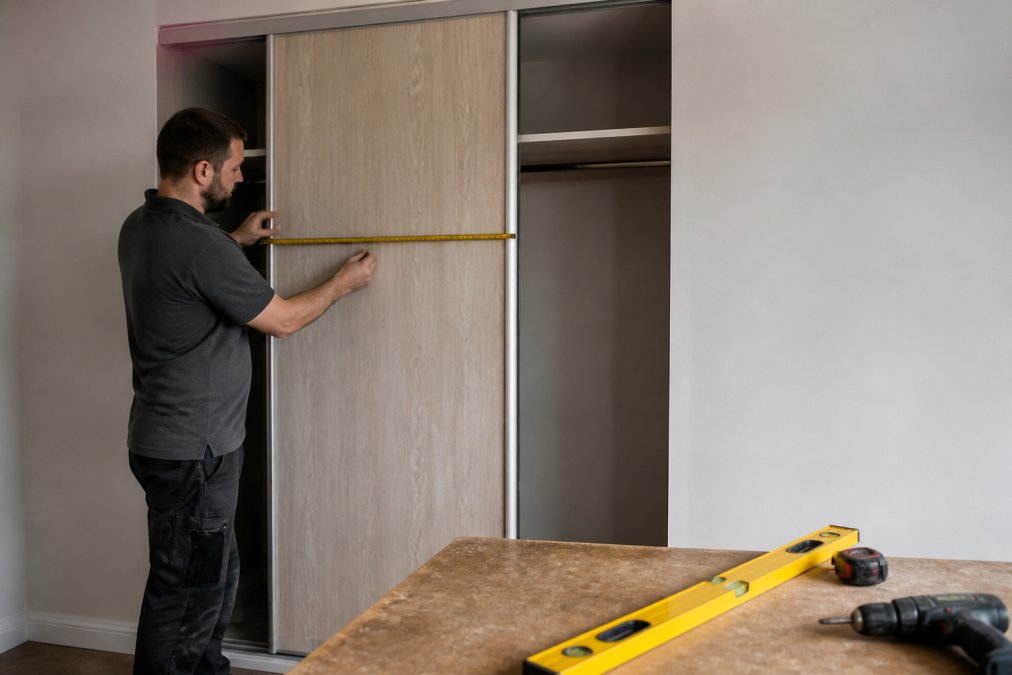
Trade-grade sliding wardrobe doors are specified by three variables: the board the panels are cut from, the edge banding applied to them, and the track system carrying the weight. Get those right and the door performs for a decade; get them wrong and you will be back on site within eighteen months.
Furniture Grade Board and Edge Banding
DoorsDirect interiors are cut from 18mm furniture grade board (Egger), edged with matching 2mm PVC, the difference between a panel that survives a decade of sliding contact and one that chips along the leading edge within a season.
Thin edging is where cheap components give themselves away: 0.4mm tape looks acceptable in the workshop and fails at the first knock, while the 2mm PVC we use takes an impact and still looks factory-finished.
Track Systems and the 10-Year Guarantee
The guarantee is only as good as the track. Most sliding door failures trace back to rollers jumping a worn or poorly aligned track, which is why the guarantee covers the whole assembly rather than individual parts. If a customer calls in year seven about a door off its runner, that call is ours to resolve, not yours.
Explain that distinction to a client at quote stage: it reframes the price difference between a bespoke system and a cheaper online alternative as an insurance policy rather than an upsell.
Custom Storage Interiors for Commercial Projects
Custom storage interiors for commercial projects are specified differently from domestic work: loads are heavier, usage is constant, and the specification must survive a facilities manager's scrutiny. Office fit-outs in particular demand modular systems that can be reconfigured when a tenant changes the floor plan.
Office Fit-Outs and Modular Storage
Modular storage suits commercial interiors because it can be extended, reduced or relocated without a full refit. DoorsDirect interior sets scale from two doors up to five, with components that can be cut to size on site.
The Interior 4 Door A at £885.00 suits up to a 4160mm total opening, supplied with two end panels, three dividers, two floor panels to join, two ceiling panels to join, two shelves and six hanging rails. For smaller commercial alcoves, the Interior 2 Door A at £478.00 covers openings up to 2100mm.


| Project Type | Interior Set | Max Opening Width | Price | Best For |
|---|---|---|---|---|
| Small alcove or single bay | Interior 2 Door A | 2100mm | £478.00 | Compact residential and small office bays |
| Standard domestic run | Interior 3 Door A | 3130mm | £754.80 | Bedroom and dressing room fits |
| Larger residential or office | Interior 4 Door A | 4160mm | £885.00 | Fit-outs and developer projects |
| Full commercial run | Interior 5 Door A | 4860mm | £1,090.20 | Multi-bay commercial storage |
Where a client wants open display rather than closed storage, the Pair of Shelf Brackets Spacepro Relax at £16.80 accommodates both glass and solid shelves on aluminium columns, and the Pair of Spacepro Relax Hanging Rail Brackets at £8.00 lets you set rail heights to suit the brief.

ROI Analysis: The Numbers Behind Bespoke Storage
Most content on bespoke storage is written for the end user and stops at aesthetics. For a trade professional the question is different: does the specification return more than it costs, and can that return be evidenced to a client or main contractor?
The Labour-Saving Calculation
Bespoke storage can offer value through labour saved, not just materials supplied. Three cost lines move in your favour on every bespoke commission:
- Fewer site visits. A made-to-measure system arrives cut to the opening. One fit, one handover.
- Less making good. No packing out, no scribing, no filler panels to hide a gap.
- No callback liability. The guarantee sits with the supplier, so a track failure in year seven does not become unpaid labour in your diary.
The mistake is comparing a bespoke interior set against a flat-pack carcass on unit price alone. Consider comparing it against the hours you would spend making a stock unit fit. Price the job twice, once with a stock carcass plus expected making-good hours, once with a made-to-measure set, and keep both figures in the project file as evidence if a client queries the quote.
Accounting Treatment for Commercial Fit-Outs
Tender Scoring and Specification Evidence
On publicly funded or framework projects, storage is rarely scored on price alone. Tenders commonly weight quality, sustainability and aftercare alongside cost. The practical steps:
- Keep the specification sheet for the board, edging and track system in the project file, ready to submit with the tender.
- Retain chain-of-custody documentation for timber products, since sustainability questions are increasingly scored rather than just asked.
- State the guarantee period and what it covers in the submission, not just in the O&M manual.
- Note the modular compatibility of the system, because a specification that can be reconfigured when a tenant changes the floor plan is a lower whole-life cost than one that cannot.
Whole-Life Cost Versus Purchase Price
A bespoke system may be more expensive at purchase. The variables driving that difference can include edging thickness, track quality, and whether components can be replaced individually. When a client asks why the quote is higher, the answer can be that the failure modes are designed out.
Sustainability and Material Sourcing
Material sourcing is now a specification item on commercial tenders, not a marketing line. Main contractors and facilities teams increasingly ask where board and timber come from.
FSC-Certified Timber and Low-Emission Board
FSC certification is the recognised chain-of-custody standard for timber products and the credential specifiers ask for first. Ask your supplier for the board manufacturer's documentation before committing to a tender, and keep it in the project file.
Low-emission board matters for the same reason. Furniture grade board from established manufacturers such as Egger is produced to documented emission standards, which is what you need when a client's sustainability consultant asks for evidence. The FSC UK certification guidance sets out what chain-of-custody documentation should show, and the UK government guidance on timber procurement explains the policy position for publicly funded projects.
Where a project is publicly funded, timber sourcing requirements are typically written into the contract. Confirm the current position with the official timber procurement advice before pricing, because the rules are updated periodically.
Common Mistakes Trade Professionals Make with Bespoke Storage
Most problems with bespoke storage trace back to decisions made before the order, not during the fit. These are the ones we see repeatedly, and each has a cheap fix at quote stage and an expensive one afterwards.
- Measuring before the plaster is on. Take final measurements after first fix and skim, or you will be fitting to a dimension that no longer exists.
- Ordering doors before interiors. The interior set defines the opening; the doors close it. Sequence the order correctly and you avoid a mismatch.
- Skipping the backing decision. We do not supply backs as standard because they are often unnecessary, but a matching backing is available at £100 per door if the client wants one. Decide at order, not on site.
- Assuming a cheaper door is equivalent. The price gap is usually in the edging and the track, which is exactly where failures happen.
- Not registering the guarantee. The ten-year cover only helps if the installation is documented and the account is linked to the job.
Conclusion
The hardest part of bespoke storage is not the fitting, it is holding the margin while a client compares your quote against a flat-pack alternative. DoorsDirect supplies made-to-measure sliding wardrobe doors and custom storage interiors with trade pricing, a three-stage quality check process and a ten-year guarantee, plus expert guidance from measurement through to final fit. Order yours today and quote bespoke work with confidence that the specification will hold up.
Frequently Asked Questions
What are the benefits of bespoke storage for trade projects?
Bespoke storage lets you fit awkward spaces exactly, which cuts callbacks and wasted material. DoorsDirect interior sets come in four widths from 2100mm to 4860mm, priced from £478 to £1,090.20, so you can match the opening rather than force a standard unit. Every set uses 18mm Furniture Grade Board with 2mm PVC edging, and the three-stage quality check plus 10-year guarantee gives you something concrete to show clients.
How do made-to-measure sliding wardrobe doors improve property value?
Fitted storage reads as part of the building rather than furniture, which buyers notice in loft conversions, alcoves and main bedrooms. Made-to-measure sliding wardrobe doors remove the gaps and dead corners that off-the-shelf units leave, so the room looks finished. DoorsDirect supplies doors and interiors together, so the fit is consistent from measurement through to installation.
What materials hold up best in high-traffic commercial storage?
Look for 18mm board rather than thinner 15mm panels, and edge banding that resists knocks. DoorsDirect uses Egger Furniture Grade Board with matching 2mm PVC edging across the Interior 2 Door A through Interior 5 Door A sets. For offices and fit-outs, pair that with aluminium columns and Spacepro Relax shelf and rail brackets (£16.80 and £8.00) so shelving heights can be adjusted as a tenant's needs change.
What is the typical lead time for bespoke wardrobe and storage installations?
Lead times depend on the size of the set and the finish you choose, so confirm dates when you order. DoorsDirect offers nationwide delivery and a dedicated trade support line, which matters when you are sequencing a fit-out around other trades. Order interiors and doors together where possible so they arrive as one delivery, and check the opening width against the set specification before you book the install date.
Leave a comment