


MySlidingWardrobe vs Spaceslide Quality Review 2026
Table of Contents
- MySlidingWardrobe vs Spaceslide Quality Review: What Actually Decides Build Quality
- Track Systems, Soft-Close Mechanisms and Long-Term Wear and Tear
- Sliding Wardrobe Door Materials Comparison: What Lasts and What Doesn't
- Fitting Instructions, DIY Assembly and Common Installation Challenges
- Sliding Wardrobe Installation Guide: What Good Aftercare Looks Like
- Best Sliding Wardrobe Suppliers for Joiners: What Trade Buyers Should Check
- Conclusion
- Frequently Asked Questions
Last Updated: October 1, 2026
MySlidingWardrobe vs Spaceslide Quality Review: What Actually Decides Build Quality
A spaceslide quality review usually focuses on the wrong things. Most comparisons of MySlidingWardrobe and Spaceslide fixate on showroom photography and headline prices, yet the details that decide whether a wardrobe still runs smoothly in year eight are hidden: the track system, the door construction and the aftercare behind the guarantee. This guide from DoorsDirect strips the question back to what genuinely separates a wardrobe that lasts from one that rattles loose within two winters.
The two brands sit in different corners of the market.
Track Systems, Soft-Close Mechanisms and Long-Term Wear and Tear
The track system is the single most important component in any sliding wardrobe, and it is the first thing to fail on cheaper builds. A quality track uses twin aluminium rails with sealed roller bearings, so doors glide without grinding. Budget systems often use single rails with plastic wheels that flatten and squeak within a couple of years.
Long-term wear shows up in predictable places:
- Rollers flattening and developing flat spots
- Bottom tracks collecting grit that scores the rail
- Soft-close dampers losing tension
- Door frames twisting where the carcass is thin
Sliding Wardrobe Door Materials Comparison: What Lasts and What Doesn't
Door materials decide how a wardrobe looks after five years, not just on delivery day. The table below summarises how the main options compare on durability, finish quality, typical use and end-of-life credentials, the last column being something almost no competitor review bothers to publish.
| Material | Durability | Finish Quality | Best For | End-of-life notes |
|---|---|---|---|---|
| Mirror | High, but edge sealing is critical | Sharp, bright, makes rooms feel larger | Smaller bedrooms needing light | Glass and mirror are recyclable where a local authority accepts flat glass |
| Glass | High when toughened | Sleek, easy to wipe clean | Modern interiors, low-traffic rooms | Toughened glass is not re-meltable with standard container glass |
| Woodgrain laminate | Moderate to high | Warm, convincing texture | Traditional bedrooms | Laminate on MDF is difficult to separate, so most goes to energy recovery |
| Solid wood frame | Very high | Premium, repairable | Period properties, trade projects | Repairable and refinishable, which extends service life considerably |
| MDF with veneer | Moderate | Good until edges chip | Budget-conscious buyers | MDF is recyclable only where a specialist panel recycler operates |
What actually fails first, by material
Long-term wear follows a predictable pattern once you know where to look:
- Mirror and glass: edge sealant drying out, then silvering spotting from the perimeter inwards. Doors hung on a twisted frame fail at the seal before the glass itself.
- Woodgrain laminate: impact chips at the leading edge, then lifting along the bottom rail where a floor guide has been rubbing.
- Solid wood frames: seasonal movement opening joints, which is repairable but needs a joiner rather than a replacement door.
- MDF with veneer: veneer lifting at the cut edge, usually within the first two years if the edge was not banded.
Material sourcing and environmental credentials
This is the angle most reviews skip entirely. Two wardrobes can look identical on a showroom floor and have very different environmental profiles:
- Panel board: look for FSC or PEFC chain-of-custody certification on the MDF or chipboard core. Without it, you cannot verify where the timber came from.
- Adhesives and finishes: low-formaldehyde or E1-rated boards reduce indoor air quality concerns, particularly in a bedroom where the doors sit closed for hours.
- Glass and mirror: both are heavy, so transport distance matters more than the material itself when comparing carbon footprint.
- Packaging: a supplier using moulded pulp corner protectors rather than expanded polystyrene is a reasonable proxy for how seriously they take waste.
Fitting Instructions, DIY Assembly and Common Installation Challenges
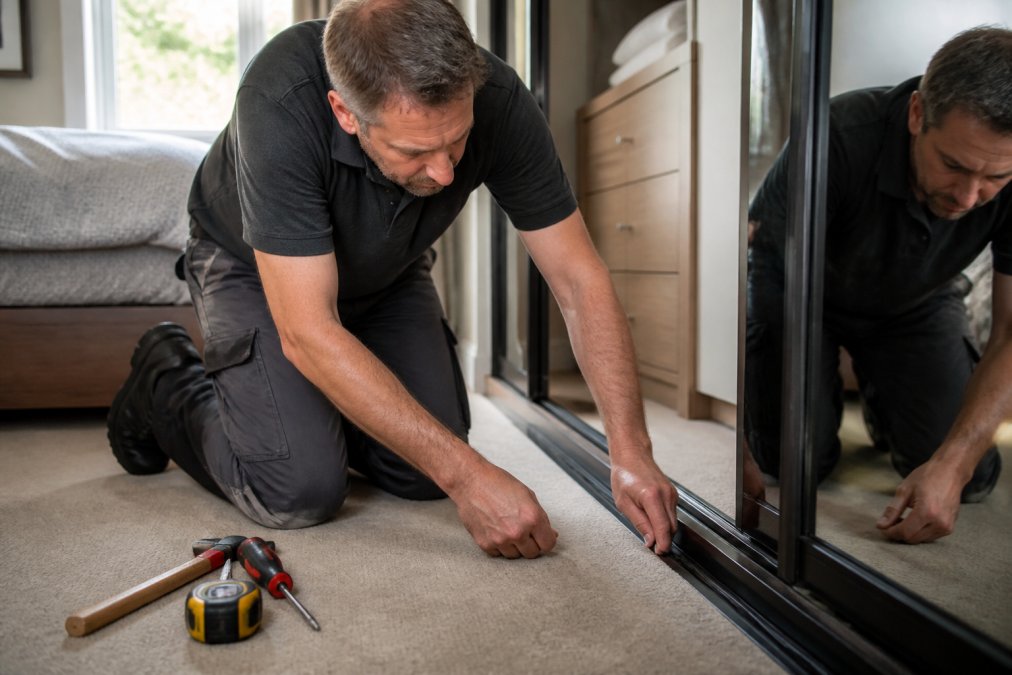
Fitting quality decides whether a good wardrobe performs well or fails early. Even a premium track system will misbehave if the opening is out of level. Most problems trace back to three avoidable mistakes:
- Measuring the opening at one point only. Take readings at the top, middle and bottom, and use the smallest.
- Fixing the track to a bowed wall. Pack and shim the track so it sits dead level, or the doors will drift.
- Skipping the floor guide. Without it, doors swing and clip the frame.
Sliding Wardrobe Installation Guide: What Good Aftercare Looks Like
Aftercare separates a supplier you would use again from one you would not. A ten-year guarantee is only as good as the process behind it, and the process is where most reviews stop short.
What a guarantee should actually say
A common mistake is assuming all guarantees are equivalent. Some cover the frame but exclude the moving parts, which are precisely the components that wear. When you read the terms, check for these specifics:
- Named components. A guarantee that lists the track, rollers and soft-close dampers is worth far more than a vague lifetime promise.
- Labour versus parts. Many guarantees replace the part but not the cost of fitting it. On a made-to-measure door, that labour can exceed the part.
- Void conditions. Fitting to an out-of-level opening, using the wrong fixings, or failing to keep the bottom track clear of grit are common exclusions.
- Transferability. If you sell the property, does the remaining guarantee pass to the new owner? Some do, some do not.
- Claim route. Is there a named contact, a portal, or just a general enquiries inbox?
Delivery timelines and what they signal
Delivery lead times also signal how a supplier operates. Made-to-measure doors take longer than off-the-shelf kits because they are built to your dimensions, and a supplier who is honest about that timeline is usually more reliable than one promising next-day delivery on custom sizes.
A few things worth confirming before you order:
- Lead time measured from when? From order, from survey, or from payment clearing? The difference can be a fortnight.
- Delivery method. A two-person delivery that carries the doors to the room of choice is very different from a kerbside pallet drop.
- Damage protocol. What happens if a door arrives chipped? Is a replacement dispatched before the damaged one is collected, or after?
- Access constraints. Narrow stairwells and period doorways are the most common cause of failed deliveries on large door panels.
Testing customer service before you buy
You can gauge responsiveness before spending anything. Send a specific technical question, for example, what the roller bearing material is, or whether replacement dampers are stocked, and note how long a substantive answer takes. A supplier who replies within a working day with a specific answer is a different proposition from one who replies a week later with a brochure link.
Self-installation versus professional fitting
Self-installation is realistic for a competent DIYer on a straightforward rectangular opening. It becomes far harder when the opening is out of square or the floor runs off level. That is where made-to-measure doors earn their keep, because the supplier sizes the doors to your actual opening rather than a nominal one.
Best Sliding Wardrobe Suppliers for Joiners: What Trade Buyers Should Check
Trade buyers judge suppliers on different criteria than homeowners do. For joiners, the best sliding wardrobe suppliers share a handful of traits: consistent tolerances, reliable delivery dates, trade pricing and technical backup when a job throws up a problem.
- Are the doors made to the exact opening size, with tolerances stated?
- Is there a documented quality check before dispatch?
- Are replacement components stocked for the life of the guarantee?
- Is trade pricing and support available, or is it consumer-only?
- Do the fitting instructions match the product you actually receive?
Conclusion
Choosing between MySlidingWardrobe and Spaceslide comes down to the components and the support behind them, not the showroom gloss. Judge both on track quality, door construction, fitting guidance and how they handle a problem after the sale.
Frequently Asked Questions
How do the build quality and materials compare between MySlidingWardrobe and Spaceslide?
Both suppliers use aluminium door frames and offer mirror, glass and woodgrain finishes, so the difference sits in the details rather than the headline specification. Check the thickness of the frame profile, the weight rating of the track system and whether a soft-close mechanism is included as standard. Ask for the warranty period in writing, because a longer guarantee usually reflects confidence in component reliability. For a like-for-like view, request a full product specification sheet from each supplier and compare the door weights and finish quality before ordering.
What should I look for when comparing sliding wardrobe door suppliers?
Start with the track system, since this decides how smoothly doors run and how long they stay aligned. Then weigh up bespoke sizing, finish quality, warranty period and delivery lead times. Trade buyers should also check whether the supplier offers fitting instructions, trade pricing and technical backup. A supplier that runs a documented quality check before dispatch and backs its doors with a ten-year guarantee gives you a clearer route to redress if something goes wrong than one that simply quotes the lowest price.
Are DIY sliding wardrobe kits as durable as professional installations?
Durability depends far more on the components than on who fits them. A kit with a sturdy aluminium track system, reliable rollers and a soft-close mechanism will perform just as well when fitted carefully by a competent DIYer. The usual failure points are an out-of-level floor, a track fixed into weak plasterboard, and doors hung without checking alignment. Follow the fitting instructions exactly, fix the track into solid timber or masonry, and check the doors run freely before tightening everything down.
What are the common installation challenges with sliding wardrobe systems?
The most frequent problems are uneven floors, walls that are out of plumb, and tracks fixed into plasterboard rather than solid timber or masonry. Doors that come off the track after a year or two usually trace back to a misaligned bottom guide or rollers that were never rated for the door weight. Check the opening is square before ordering, allow clearance for the track depth, and test both doors across their full travel before final tightening. If your opening is irregular, made-to-measure doors remove most of the risk.
Leave a comment