


Durable Sliding Door Mechanisms for Homes: 2026 Review
Table of Contents
- What Separates Durable Sliding Door Mechanisms for Homes From Cheap Kits
- Types of Sliding Door Mechanisms Compared Side by Side
- Sliding Door Tracks and Rollers: The Parts That Decide How Long It Lasts
- Soft-Close Sliding Door Mechanisms: Worth the Upgrade?
- Sliding Door Hardware Maintenance That Prevents Track Drop
- What Durable Sliding Door Mechanisms Cost Over Time
- How to Fit a Sliding Door Mechanism: Step by Step
- Verdict: Which Durable Sliding Door Mechanisms Suit Your Home
- Frequently Asked Questions
Last Updated: October 4, 2026
What Separates Durable Sliding Door Mechanisms for Homes From Cheap Kits
A sliding door mechanism is the hardware that carries a door panel along a track: the rail, rollers, guides and fittings.
At DoorsDirect, we build made-to-measure sliding wardrobe doors and supply the track sets that go with them, so we see where cheaper kits cut corners. Below, we break down what separates a durable system from a budget one and compare the main types.
Aluminium Versus Steel Tracks
Aluminium tracks resist corrosion and stay straight under load. Steel tracks are cheaper to produce but heavier, more prone to rust in humid rooms, and more likely to deform if a door is slammed or overloaded. Every set in our Durham and Ripon collections uses an aluminium profile and track, not steel.
The 10-Year Guarantee and What It Backs
Our products carry a 10-year guarantee, backed by a three-stage quality check before anything leaves the workshop. That cover exists because the components are specified to last.
Types of Sliding Door Mechanisms Compared Side by Side
Sliding door systems fall into three families, each suiting a different room and door weight. Top-running systems carry the panel from a track above the opening and are standard for wardrobes. Floor-track systems guide the door along a base rail, suiting heavier panels but collecting dust. Pocket door systems slide the panel into a wall cavity, saving the most floor space but demanding structural work.
Top-Running, Floor-Track and Pocket Door Systems
| System | How It Carries the Door | Best For | Main Trade-Off |
|---|---|---|---|
| Top-running | Rollers on an overhead track | Wardrobes, interior doors | Needs a solid head fixing |
| Floor-track | Wheels on a base rail with a top guide | Heavier panels | Track collects dust and grit |
| Pocket door | Panel slides into a wall cavity | Tight room entrances | Requires wall rebuild |
DoorsDirect Sets by Door Weight, Material and Use Case
We build each set to the opening rather than a standard size, which matters most in awkward rooms.
| Product | Doors | Made-to-Measure Range | Price |
|---|---|---|---|
| Ripon 2 Door | 2 | Up to 2490mm high, 800-1780mm wide | £478.00 |
| Durham 2 Door | 2 | Up to 2490mm high, 900-2100mm wide | £528.00 |
| Durham 3 Door | 3 | Up to 2490mm high, 1500-3130mm wide | £792.00 |
| Durham 4 Door | 4 | Up to 2490mm high, 2000-4160mm wide | £1,056.00 |
| Custom 4 Door | 4 | Made to measure, your specification | £1,314.00 |
The Ripon 2 Door is the entry point for a standard two-door opening. The Durham range steps up to an aluminium profile with soft brush pile edging and four profile colours. The Custom 4 Door set covers anything the standard ranges cannot, built to your measurements.

Sliding Door Tracks and Rollers: The Parts That Decide How Long It Lasts
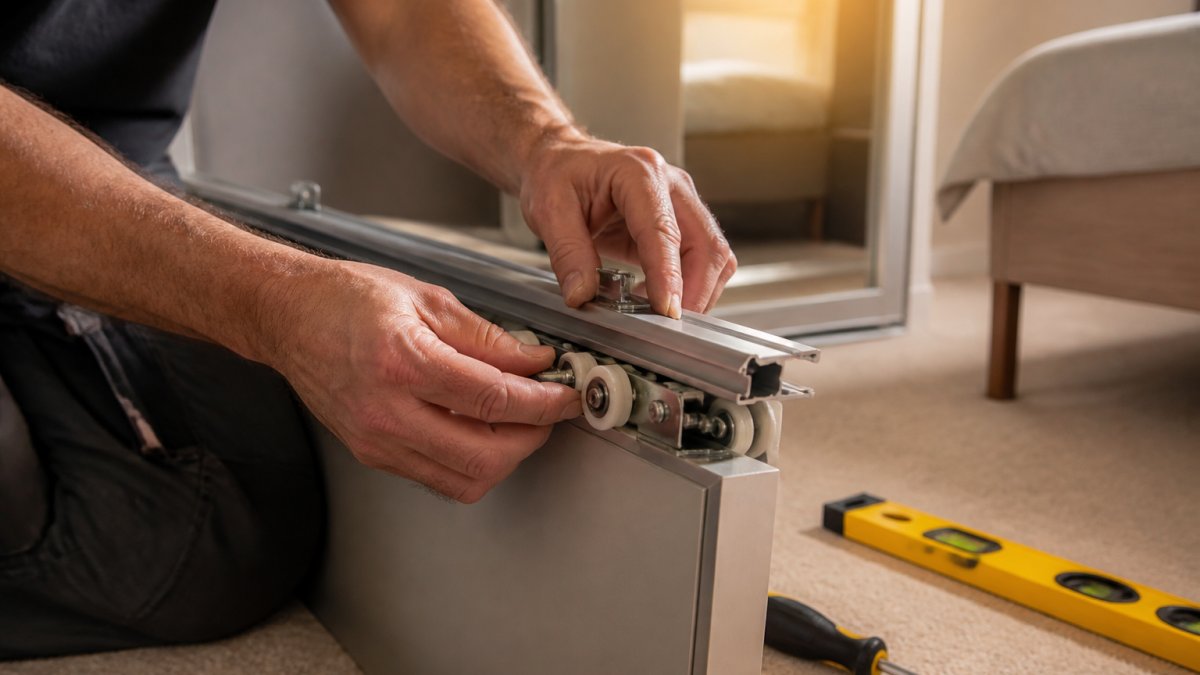
The track and rollers take the load every day. A top-running system relies on a straight rail and a roller carriage that spreads weight across several wheels rather than one.
What the Numbers on a Specification Actually Mean
Most product pages list a load rating and nothing else. A two-door set rated at 40kg per panel is not the same as a four-door run at 40kg per panel, track span and fixing points change the real-world limit.

Cycle life is the other figure worth understanding. A cycle is one complete open-and-close movement. A wardrobe door used twice a day works out at roughly 730 cycles a year, so a carriage tested to tens of thousands of cycles is a multi-decade component.
Bearing Type, Wheel Count and Roller Geometry
Three details separate a track that lasts from one that does not:
- Sealed versus open bearings. Sealed bearings keep dust and grit out of the race. Open or shielded bearings pick up debris and grind themselves flat, which is the single most common cause of a door that suddenly runs rough.
- Wheel count per carriage. A carriage with two or more wheels spreads the load and keeps the panel tracking straight. A single-wheel carriage concentrates the load on one point and wears the rail unevenly.
- Wheel material. Nylon and polyurethane wheels run quietly and resist flat-spotting; cheap hard plastic wheels develop flats and rumble.
Rail Rigidity and Span
The rail must be rigid enough not to bow under the door's weight over a long span. On a wide opening, the mid-span shows any weakness first, so a longer run needs a stiffer profile or an extra fixing point. We supply tracks slightly longer than the opening width so they can be cut accurately on site, giving a clean end and a proper fixing point at each side.
Soft-Close Sliding Door Mechanisms: Worth the Upgrade?
Soft-close is worth it if the doors are used daily, and close to essential in a bedroom. The mechanism catches the panel in the last few centimetres of travel and pulls it gently closed, so the door never slams. It protects the frame and door edges from repeated impact, cuts noise, stops the panel drifting open on a slightly out-of-level floor, and removes the main cause of children trapping fingers. Soft-close is available across our Durham range and as an extra on the Ripon 2 Door.

Sliding Door Hardware Maintenance That Prevents Track Drop
Five minutes of maintenance twice a year keeps most systems running quietly for their full service life. Track drop rarely happens overnight; it builds from grit, a loosening fixing, or a roller that has started to flatten.
The Twice-Yearly Check
- Vacuum or brush the track channel to clear dust and grit
- Wipe the rail with a dry cloth, never a wet one
- Check every fixing screw along the track and tighten any that have worked loose
If a roller feels rough, replace it before it fails. Rollers are the cheapest part of the system and wear first; leaving a worn roller in place puts the load onto the track, and a bowed rail costs far more to put right than a set of wheels.
Safety, Child Protection and Pinch Points
A sliding door has two pinch points in a home with young children: the gap between the leading edge and the frame as it closes, and the gap between two overlapping panels on a multi-door run. Both close quickly if the door is pushed hard, which is where soft-close earns its place.
Custom 4 Door Sliding Wardrobe Doors →
Three hardware features reduce the risk further:
- Anti-jump fittings. These hold the carriage captive on the rail so the panel cannot lift off and fall. Check them at every service, because a disengaged anti-jump fitting is the failure that turns a stuck door into an injury.
- Soft-close on both ends of travel. A damper at the closed end only protects the frame; one at the open end stops the panel slamming into the end stop and rebounding.
- Secure end stops. A positive stop at each end of the track prevents the door running past its intended travel and coming off the rail.
Clearances and Everyday Ease of Use
Leave a finger-safe clearance at the leading edge and keep the floor guide clear of rugs and thresholds, the usual cause of a door that suddenly needs two hands to move. A well-maintained mechanism should glide with light finger pressure; if it takes real effort, the rollers or track alignment need attention before the extra force damages the carriage.
Mark the roller height setting with a pencil line before you adjust anything. If the door still catches after adjustment, you can return to the original position in seconds instead of guessing.
What Durable Sliding Door Mechanisms Cost Over Time
The cheapest kit is rarely the cheapest outcome. A budget mechanism that needs new rollers in year two and a replacement track in year four usually costs more than a well-specified set bought once.
Our pricing runs from £478.00 for the Ripon 2 Door up to £1,314.00 for the Custom 4 Door set, with the Durham range between £528.00 and £1,056.00 depending on door count.
How to Fit a Sliding Door Mechanism: Step by Step
Fitting a top-running wardrobe mechanism is a two-person job and takes roughly half a day for a standard two-door set.
What you'll need: a spirit level, a tape measure, a drill, a screwdriver, a fine-tooth saw for trimming the track, and a pencil.
- Measure the opening at the top, middle, and bottom, and use the smallest figure. Made-to-measure doors are built to this number.
- Mark the track position on the head of the opening, checking it is level across the full span before drilling anything.
- Fix the top track with the supplied fixings, into a solid head or a properly fixed timber batten.
- Trim the track ends to the opening width if needed. Tracks arrive slightly long for exactly this reason.
- Fit the rollers to the top of each door panel and check they run freely before lifting the door.
- Hang the doors, starting with the rear panel, and check the overlap between panels.
- Fit the bottom guide or floor track, which stops the panel swinging out at the base.
- Adjust the roller height until the door sits level and closes cleanly against the frame.
- Test the full travel several times, then set the soft-close action if fitted.
Expected result: the door should glide with light finger pressure, close flush, and stay put when released.
Verdict: Which Durable Sliding Door Mechanisms Suit Your Home
Buy the mechanism for the door weight and the room, not the lowest price. A two-door opening up to 1780mm wide is well served by the Ripon 2 Door.
For most homes, the deciding factor is not the mechanism type but the material and guarantee behind it. Aluminium tracks outlast steel, sealed rollers outlast exposed ones, and a 10-year guarantee turns a one-off purchase into a decade of cover.
Frequently Asked Questions
Which brand makes the most durable sliding door systems?
Look for aluminium profiles and tracks rather than steel, a stated maximum door weight, and a long guarantee. DoorsDirect fits that brief: its Durham and Ripon ranges use aluminium tracks and profiles, come made to measure, and carry a 10-year guarantee. Soft-close action is available on the Durham collection and as an extra on the Ripon range, which reduces slamming wear on the running gear over time.
What are the common problems with sliding doors?
The usual failures are doors jumping or dropping off the track, rollers flattening, and growing noise as the wheels wear. Most trace back to a steel track flexing under a heavy panel or grit left in the channel. Cleaning the track, checking roller alignment and tightening fixings twice a year prevents most of it. Choosing aluminium tracks and a kit rated for your door weight removes the rest.
Are soft-close mechanisms suitable for sliding doors at home?
Yes, and they suit bedrooms particularly well. A soft-close damper catches the panel in the last few centimetres and pulls it shut, so doors never slam against the end stop. That cuts the shock load through the rollers and track, which is what shortens the life of cheaper running gear. DoorsDirect offers soft-close action on the Durham range and as an extra on the Ripon range.
How do you choose the right track and rollers for a sliding door?
Start with the width of your opening and the weight of the panels. DoorsDirect sets are made to measure: the Ripon 2 Door covers widths from 800mm to 1780mm, the Durham 2 Door from 900mm to 2100mm, the Durham 3 Door from 1500mm to 3130mm, and the Durham 4 Door from 2000mm to 4160mm, all up to 2490mm high. Tracks arrive slightly longer than the opening so they can be trimmed on site.
How do you maintain sliding door tracks and rollers?
Vacuum the track channel every few months. Check the top track fixings for movement and adjust the roller height screws if a panel starts to drag. Brush pile edging on DoorsDirect doors can be cleaned with a soft brush to keep the glide quiet.
A sliding door that drops off its track is almost always a specification problem, not a fitting one. DoorsDirect builds made-to-measure sliding wardrobe doors with aluminium profiles and tracks, a three-stage quality check, and a 10-year guarantee on every set, with expert guidance from measurement through to final fit. Order yours today and get a mechanism matched to your opening, your door weight, and the way you actually use the room.
Leave a comment