


Why Choose Premium Sliding Wardrobe Mechanisms
Table of Contents
- Why Premium Sliding Wardrobe Mechanisms Are Worth the Investment
- What Separates a Premium Sliding Mechanism From a Cheap One
- Sliding Wardrobe Doors With Soft Close: What the Feature Actually Does
- Premium Wardrobe Rollers: The Part That Decides How Long Doors Last
- Top-Hung vs Bottom-Rolling Wardrobe Doors: Which Suits Your Room
- Sliding Wardrobe Door Maintenance: Keeping the Gliding Mechanism Smooth
- Getting the Fit Right: Made-to-Measure Sizing and Installation Tolerances
- Conclusion: What Premium Hardware Actually Buys You
- Frequently Asked Questions
Last Updated: October 9, 2026
Why Premium Sliding Wardrobe Mechanisms Are Worth the Investment
Most homeowners judge sliding wardrobe doors by the panel they can see.
Premium sliding wardrobe mechanisms are the engineered assemblies of tracks, rollers, guides and dampers that carry a door's weight and control its travel.
That difference is invisible on a showroom floor. It shows up in year three, when a builder-grade door drags and a premium one still closes with one finger.
What Separates a Premium Sliding Mechanism From a Cheap One
The clearest difference between a premium sliding mechanism and a cheap one is track material and roller quality.
Steel rusts, flexes under load and pits where the wheels run. Aluminium holds its shape, resists corrosion and keeps a consistent surface for the roller, which is why our Monaco, New York and Beijing collections use aluminium profile and track.

Weight capacity matters just as much. A glass or mirror panel is heavy, and a mechanism rated below the door's actual weight wears out its wheels fast. Premium hardware is specified with headroom, not sized to the bare minimum.
Mechanism Components and How They Work Together
Every sliding door system is a small assembly of parts that have to work in sequence:
- Top track - carries the door's weight and sets the horizontal line of travel.
- Bottom track or floor guide - keeps the door aligned and stops it swinging out of plane.
- Rollers or wheels - bear the load and roll along the track; sealed bearings last far longer than plain plastic.
- Anti-jump system - a physical stop that prevents the door lifting off the track if it is knocked.
- Soft-close damper - catches the door in the final few centimetres and pulls it gently shut.
- Brush pile edging and gaskets - seal the gap between door and frame, cutting noise and dust.
When one part is underspecified, the whole system suffers. A good top track with cheap rollers still fails. Premium rollers on a flexing steel track still rattle.
Sliding Wardrobe Doors With Soft Close: What the Feature Actually Does
Sliding wardrobe doors with soft close use a damper that engages in the last few centimetres of travel, slowing the door and pulling it quietly shut.
It is often sold as a luxury extra, but it is really a wear-reduction measure.
On our New York, Beijing and Sofia collections, soft close is available as an option. For a bedroom used at night, or a wardrobe against a shared wall, it is the upgrade we would prioritise over any cosmetic finish.

Premium Wardrobe Rollers: The Part That Decides How Long Doors Last
Premium wardrobe rollers are the load-bearing wheels that run along the track, and the component most likely to fail first on a cheap door.
Sealed bearings keep dust and grit out of the moving parts; unsealed plastic wheels grind themselves down against the track.
Adjustability is the feature buyers overlook. A premium roller assembly lets you raise, lower and square the door after installation, which matters because no opening is perfectly true.
Top-Hung vs Bottom-Rolling Wardrobe Doors: Which Suits Your Room
Top-hung systems carry the door from a track fixed to the ceiling or a head beam, leaving the floor clear. Bottom-rolling systems run the door on a floor-level track with a lighter top guide. The right choice depends on your floor, ceiling and how the room is used, but the deciding factor is usually structural, not aesthetic.
| System | Weight Support | Floor Clearance | Structural Requirement | Best For |
|---|---|---|---|---|
| Top-hung | Ceiling or head beam | Fully clear floor | A fixing point that can take the full door load in tension | Bedrooms where a floor track would be a trip hazard |
| Bottom-rolling | Floor track | Track sits on the floor | A solid, level floor and a sound ceiling for the top guide | Rooms with a solid, level floor and a ceiling that cannot be reinforced |
What Each System Demands Structurally
A top-hung door hangs its entire weight from the head, and that load must transfer into something that will not move: a timber head beam, a steel lintel or a masonry soffit.
Bottom-rolling systems put the load on the floor, usually the strongest surface in the room. The trade-off is the track: it needs a genuinely level floor along its full length.
Installation Tolerances That Decide Whether Either System Works
Both systems depend on tolerances being respected at installation:
- Track level, the track must be set level in both planes. A track that is level front-to-back but not side-to-side will pull the door into the frame at one end.
- Head clearance, top-hung doors need enough headroom above the opening for the track and roller carriage, plus a small allowance for adjustment.
- Floor gap, bottom-rolling doors need a consistent gap between the door bottom and the floor so the door does not scrape as the floor moves seasonally.
This is why made-to-measure sizing matters more than the system choice itself. A correctly specified top-hung door on a sound head beam will outlast a badly fitted bottom-rolling door every time, and vice versa.
Sliding Wardrobe Door Maintenance: Keeping the Gliding Mechanism Smooth
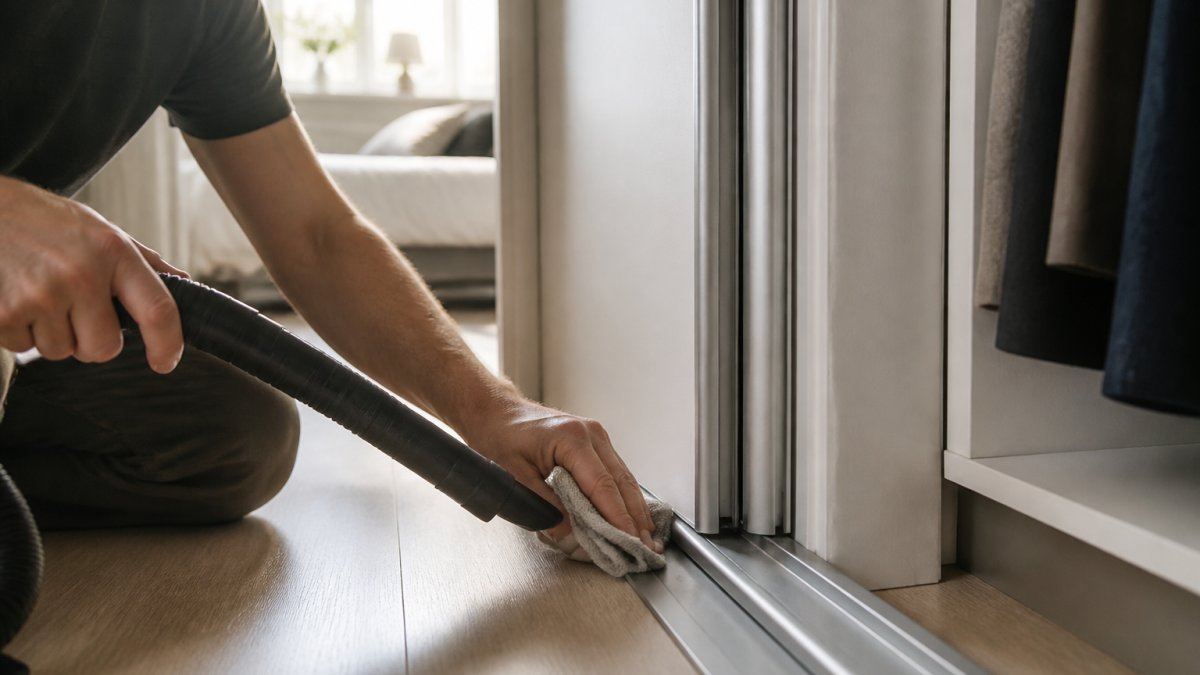
Sliding wardrobe door maintenance takes minutes and prevents most of the problems that send doors to the skip: keep the track clean, keep the rollers free of hair and grit, and check alignment once or twice a year.
The Twice-Yearly Routine
Work through this checklist twice a year:
- Vacuum the top and bottom track to remove dust, hair and grit
- Wipe the track with a soft damp cloth and dry it fully
- Check the rollers for visible wear, flat spots or wobble
Never lubricate a track with oil or grease, it attracts dust and turns into a grinding paste. A clean, dry track keeps a gliding mechanism quiet. If a manufacturer specifies a dry silicone or PTFE treatment for their rollers, follow that instead of a generic lubricant.
Diagnosing the Four Common Faults
Most sliding door problems fall into four patterns, each with a different cause:
- The door drags or is stiff along part of its travel. Usually debris in the track or a roller that has flat-spotted. Clean the track first; if the stiffness remains in one spot, inspect the roller at that position.
- The door squeaks or grinds. Grinding is metal-on-metal or grit in a bearing. Squeaking is often a dry roller or a track that has been contaminated with polish or oil. Clean and dry the track, then check the roller bearings.
- The door has dropped and catches the frame. This is almost always alignment rather than a failed part. Adjusting the roller height usually solves it without any replacement.
- The door lifts or jumps off the track. This is an anti-jump problem, not a panel problem. Check that the anti-jump stop is seated and that the door has not been lifted by an obstruction on the floor.
Realistic Service Life and When to Replace Parts
Component life depends on cycle count and load, not calendar age. A door used twice a day sees far fewer cycles than one in a busy household, and a heavy mirror panel wears its rollers faster than a lighter panel on the same mechanism.
As a working guide:
- Rollers are the first component to show wear. Sealed-bearing rollers on a correctly rated mechanism typically outlast unsealed plastic wheels by a wide margin, but they are still a wear item and should be inspected at each service.
- Track life is mostly a function of cleanliness. A clean aluminium track holds its surface for many years; a track run with grit or contaminated with oil will pit and wear in the roller path.
- Soft-close dampers are rated for a cycle count by the manufacturer. When a damper stops catching the door in the final few centimetres, it has reached the end of its rated life and can be replaced as a unit without changing the track or rollers.
The practical point is that a premium mechanism is designed to be serviced rather than replaced. Rollers, dampers and guides are available as individual parts, so a door that develops a fault after several years can usually be brought back to smooth operation without replacing the whole wardrobe.
Getting the Fit Right: Made-to-Measure Sizing and Installation Tolerances
Made-to-measure sizing is what allows a premium mechanism to perform as designed.
Installation tolerances are the small allowances built into the design: the gap the door needs to travel, the trim allowance on the track, and the adjustment range in the rollers.
This is where made-to-measure beats off-the-shelf. Our Monaco collection fits heights up to 2540mm and widths from 900mm to 2100mm. The Sofia three-door set covers widths from 1500mm to 3130mm.
Conclusion: What Premium Hardware Actually Buys You
A sliding wardrobe is a moving assembly, and moving assemblies wear out. What you are really buying with premium hardware is time: more cycles before the rollers need attention, more years before the track shows wear, and a door that still closes cleanly when a cheap one has started to drag.
The parts that matter most are the ones you never see. Aluminium track instead of steel. Sealed bearing rollers instead of plastic wheels. An anti-jump system that actually holds. Adjustment built in so the door can be squared after installation rather than accepted as it arrives.
Frequently Asked Questions
What makes a sliding wardrobe mechanism premium?
The materials and engineering decide it. Premium sliding wardrobe mechanisms use aluminium profiles and tracks rather than steel, sealed roller bearings instead of plain wheels, and soft-close dampers rated for thousands of cycles. Aluminium resists corrosion and stays dimensionally stable, so door panels keep their alignment over years of daily use. Brush pile edging and glazing gaskets also cut noise and stop dust reaching the rollers.
Are premium wardrobe door rollers worth choosing?
Premium wardrobe rollers are the single biggest factor in how a door feels and how long it lasts. Cheap wheels develop flat spots and start rumbling within a couple of years, which is why sliding doors often come off the track. Sealed-bearing rollers run quietly, carry the door's load without deflecting, and usually come with a long guarantee. If you are upgrading one part of an existing wardrobe, start with the rollers.
How do soft-close mechanisms work on sliding wardrobe doors?
A soft-close unit is a small damper fitted at the end of the track travel. As the door approaches its closed position, a spring-loaded catch engages the damper and pulls the panel the last few centimetres at a controlled speed. That stops the door slamming and removes the shock load that loosens fixings and knocks rollers out of alignment. On premium ranges it is often built into the track rather than added as a separate part.
Why is my sliding wardrobe door noisy or difficult to move?
Most noise and stiffness comes from debris in the track, worn rollers, or a door that has dropped out of alignment. Vacuum the bottom track and wipe it with a dry cloth first. If the door still drags, check the roller adjustment screws, as most premium mechanisms allow the panel to be raised or levelled. Persistent grinding usually means a flat-spotted wheel or a bent track, and both are replaceable without buying new doors.
Choosing a wardrobe door on panel finish alone is the most common mistake we see. The fit and the hardware are what you live with every day. DoorsDirect builds made-to-measure sliding wardrobe doors with aluminium profile and track, soft close action, a three-stage quality check and a 10-year guarantee, with expert guidance from measurement through to final fit. Order yours today and get a wardrobe that still glides smoothly years from now.
Leave a comment