


Why Choose Bespoke Sliding Wardrobe Doors in 2026
Table of Contents
- Why Bespoke Sliding Wardrobe Doors Beat Off-the-Shelf Options
- Sliding vs Hinged Wardrobe Doors: Space, Access and Cost Compared
- Bespoke Wardrobe Interior Storage Solutions That Fit Your Room
- How to Choose Sliding Wardrobe Door Finishes
- Hardware, Tracks and the Ten-Year Guarantee
- Are Bespoke Sliding Wardrobe Doors Worth It? Costs and Property Value
- Conclusion
- Frequently Asked Questions
Last Updated: September 28, 2026
Why Bespoke Sliding Wardrobe Doors Beat Off-the-Shelf Options
Standard wardrobe sizes exist because manufacturers need a small number of boxes to ship. Your bedroom did not get that memo. This guide from DoorsDirect explains why choose bespoke sliding wardrobe doors when standard units leave gaps and waste height.
Sliding vs Hinged Wardrobe Doors: Space, Access and Cost Compared
Sliding doors need no swing clearance, so a 600mm-deep run can sit right against a bed. Hinged doors need roughly their own width in front of them, ruling them out of tighter layouts.
| Factor | Sliding | Hinged |
|---|---|---|
| Floor space needed | None beyond the track | Door width in front |
| Access to interior | Half at a time | Full opening |
| Best for | Tight rooms, full walls | Wide rooms, shallow storage |
| Track and hardware | Top and bottom track set | Hinges and frame |
When Hinged Doors Still Make Sense
Hinged doors win in a wide room with space to spare, especially where you want the whole wardrobe open while you pack. They also suit narrow, shallow units where sliding panels would eat too much depth. With the clearance, hinged is simpler and often cheaper.
Bespoke Wardrobe Interior Storage Solutions That Fit Your Room
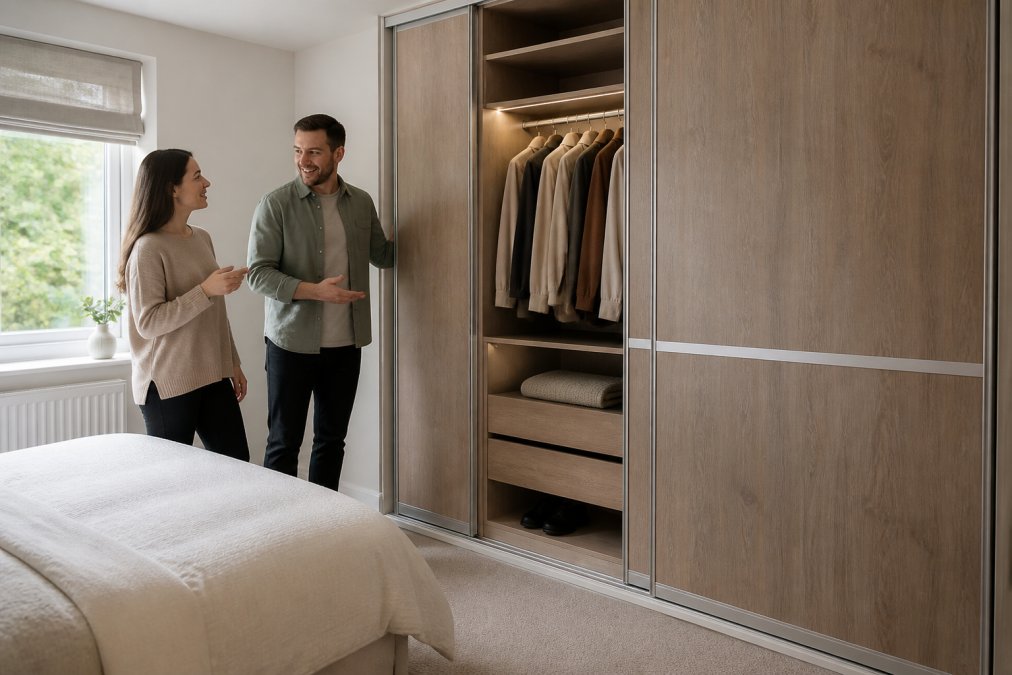
Interior configuration is where bespoke earns its keep. A made-to-measure carcass lets you place hanging rails, shelves and drawers where your clothes actually need them.
Planning Internals Around Awkward Alcoves and Low Corners
Alcoves and low corners are why people go bespoke. A shallow drawer bank fills an alcove a standard unit would leave empty.
How to Choose Sliding Wardrobe Door Finishes
Pick the finish after the layout, not before. Mirror doors bounce light and make a small bedroom feel wider; woodgrain textures add warmth without dominating.
The Main Panel Options and How They Behave
- Mirror. Maximum light bounce, maximum visual space. Needs a safety-backed or film-backed panel so it holds together if struck, and shows fingerprints more than any other finish.
- Lacquered glass. A coloured, reflective panel that reads as a solid colour from a distance but catches light up close. Harder wearing than painted MDF and easier to wipe clean.
- Woodgrain laminate and veneer. Warmth and texture. Laminate is the practical choice for busy rooms; real veneer gives a deeper grain but needs more care around moisture.
- Matte and super-matte panels. The current default for a quiet, built-in look. Super-matte surfaces resist fingerprints far better than standard matte, which matters on a door you touch twice a day.
- Framed panels. A frame profile around each panel adds definition and suits traditional rooms. Slim frames read as modern; wider profiles read as period.
Matching Finishes to Light, Room Size and Style
A north-facing room with little natural light benefits from a reflective panel. A large, bright room can carry a darker woodgrain or bold frame profile without feeling closed in.
Sustainability and Material Sourcing
This is where most guides go quiet, and it is worth asking about before you order. Timber-based panels and frames should carry FSC or PEFC certification, confirming the fibre comes from responsibly managed forests. Ask for the chain-of-custody reference rather than taking a logo at face value.
Other points worth raising with any supplier:
- Recycled content. Some glass and aluminium track components are available with a meaningful recycled proportion. Aluminium in particular is highly recyclable without loss of quality.
- Low-emission boards. Panel substrates should meet low-formaldehyde standards, which matters in a bedroom where the doors sit closed for hours.
- End-of-life. Ask whether the track and rollers can be replaced independently of the panels. A wardrobe designed for part replacement lasts far longer than one that has to be scrapped whole.
- Local manufacture. Shorter supply chains reduce transport emissions and usually mean faster replacement parts.
How Finishes Age
- Mirror and glass hold their appearance well but show smudges and need regular cleaning.
- Painted and lacquered surfaces can chip at the edges where doors overlap; a super-matte or glass finish hides this better.
- Woodgrain laminate is the most forgiving day to day, but cheap laminate can lift at the edges in a humid room.
- Dark, high-gloss panels show every mark. In a bedroom used daily, a mid-tone or textured finish is usually the lower-maintenance choice.
Hardware, Tracks and the Ten-Year Guarantee
Hardware separates a wardrobe that lasts from one that jumps its track. The weak point is almost always the bottom track and roller assembly, not the door panel. A quality mechanism uses a top track to guide and a bottom track to carry the weight, spreading load rather than concentrating it on one edge.
What Actually Wears Out, and Why
Four components do almost all the failing:
- Rollers. Nylon or steel-bearing rollers carry the full door weight. Bearings that are not sealed pick up dust and grit, then flat-spot. A flat-spotted roller makes the door rumble rather than glide.
- Bottom track. This carries the load. An extruded aluminium track holds its shape; a thin rolled-steel track dents under a heavy panel and pulls the rollers out of line.
- Top guide. This does not carry weight, it stops the panel swinging. A worn guide is why doors start to clatter against each other.
- Soft-close damper. The mechanism that catches the door in the last few centimetres. Dampers are consumable, most manufacturers rate them for a set number of cycles, and they are the first part to be replaced.
A common pattern in the trade: a wardrobe is judged on its doors and then fails on its track. Specifying a heavier track than the door weight requires is cheap insurance.
Custom 2 Door Sliding Wardrobe Doors →
Looking After the Mechanism: A Maintenance Routine
Most guides stop at the sale. This is what keeps a bespoke set working for its full life.
Every few months:
- Vacuum the bottom track with a brush attachment, then wipe it with a damp cloth. Grit in the track is the single biggest cause of premature roller wear.
- Check the top guide for looseness and tighten if needed.
- Wipe the door edges where they meet, dust builds up on the overlap and transfers to the rollers.
Once a year:
- Inspect the rollers for flat spots or visible wear. Most roller assemblies are replaceable without removing the whole door.
- Check that the door still hangs level. A door that has dropped slightly on one side usually needs a roller height adjustment, not a new track.
- Lubricate the track sparingly with a dry silicone spray, never oil or grease. Oil attracts dust and turns the track into a grinding paste.
What the Ten-Year Guarantee Covers
A guarantee is only worth what it excludes, so read the terms before you buy. A typical ten-year cover on a bespoke sliding set applies to the door panels, track and roller assembly against manufacturing defects. It generally does not cover:
- Wear items such as soft-close dampers, which are consumable by design.
- Damage from impact, moisture ingress or fitting onto an uneven floor.
- Adjustments that were never carried out.
Are Bespoke Sliding Wardrobe Doors Worth It? Costs and Property Value
Bespoke costs more than a flat-pack unit, and it is worth it when the room is awkward or the wardrobe is a permanent fixture. A two-door made-to-measure set starts at £837, a three-door at £1,075, a four-door at £1,016 and a five-door at £2,328. Each price includes the top and bottom track set.

Conclusion
The hard part of a wardrobe project is not choosing a colour, it is getting a fit that works in a room never designed around a standard box. That is the problem made-to-measure solves, and why we build every set to your dimensions rather than a catalogue size.
Frequently Asked Questions
What are the main advantages of choosing bespoke sliding wardrobe doors?
Bespoke sliding wardrobe doors are made to your exact opening, so they reach floor-to-ceiling and reclaim the clearance space a hinged door needs. You choose the panel finishes, track set and interior configuration, which means no wasted gaps and storage that suits how you actually live. A made-to-measure set also handles awkward alcoves and uneven walls that standard sizes cannot. DoorsDirect backs its sets with a three-stage quality check and a ten-year guarantee.
Are bespoke sliding wardrobe doors worth the investment?
They are worth it when standard sizes leave dead space or doors that foul furniture. A made-to-measure set such as the Custom 2 Door Sliding Wardrobe Doors at £837 or the Custom 3 Door set at £1,075 gives a fitted look and uses the full height of the room. Because the doors are built to your dimensions, you avoid the gap-filling and rework that cheaper off-the-shelf sets often need.
What are some common problems with sliding wardrobe doors?
The usual complaints are doors jumping or coming off the track, stiff movement and rattling panels. These trace back to cheap rollers, thin frames and tracks fitted out of level. A quality set uses a proper top and bottom track set, soft-close runners and panels matched to the door weight. Correct fitting matters too, which is why a ten-year guarantee on the hardware gives real peace of mind.
How do I choose between sliding and hinged wardrobe doors?
Sliding doors need no swing space, so they suit tight bedrooms, alcoves and rooms where a bed or chest sits close to the wardrobe. Hinged doors give full-width access to the whole interior at once and can be simpler in a large room with clear floor. If floor space is tight or the opening is wide, sliding usually wins. Measure your clearance first, then decide.
Choosing a wardrobe is a long-term decision, and the difference between a set that lasts and one that does not comes down to fit and hardware. DoorsDirect builds made-to-measure sliding wardrobe doors to your exact opening, backs them with a ten-year guarantee, and supports you from the first measurement to the final fit. Browse the custom two-door, three-door and five-door sets, or talk to our team about trade pricing for your next project.
Leave a comment