


Top 8 Under Stair Wardrobe Ideas for Your Home
Table of Contents
- Why Under Stair Wardrobes Are the Smartest Storage Move You'll Make
- 1. Fitted Under Stair Wardrobe: Made-to-Measure for Awkward Spaces
- 2. Under Stairs Coat Storage: Hanging Rails That Work Harder
- 3. Under Stairs Shoe Storage: Drawers, Shelves, and Pull-Out Solutions
- 4. Under Stairs Cupboard Ideas: Concealed Storage That Looks Built In
- 5. Pull-Out Drawers and Modular Interiors for Deep, Sloping Spaces
- 6. Lighting, Ventilation, and Damp Prevention for Under Stair Wardrobes
- 7. Costs, Trade-Offs, and What to Expect from a Fitted Wardrobe Project
- Frequently Asked Questions
Last Updated: October 14, 2026
Why Under Stair Wardrobes Are the Smartest Storage Move You'll Make
An under stair wardrobe turns the dead space beneath your staircase into a full-height storage run that most homes simply waste.
The staircase void is one of the few genuinely large volumes left in a modern home.
Below, we break down eight ideas for using it well, from coat and shoe storage to pull-out drawers, lighting and ventilation, plus what a fitted project actually involves.
The single biggest mistake we see is treating the space as a cupboard first and a wardrobe second.
1. Fitted Under Stair Wardrobe: Made-to-Measure for Awkward Spaces
A fitted under stair wardrobe is built to the exact geometry of your staircase.
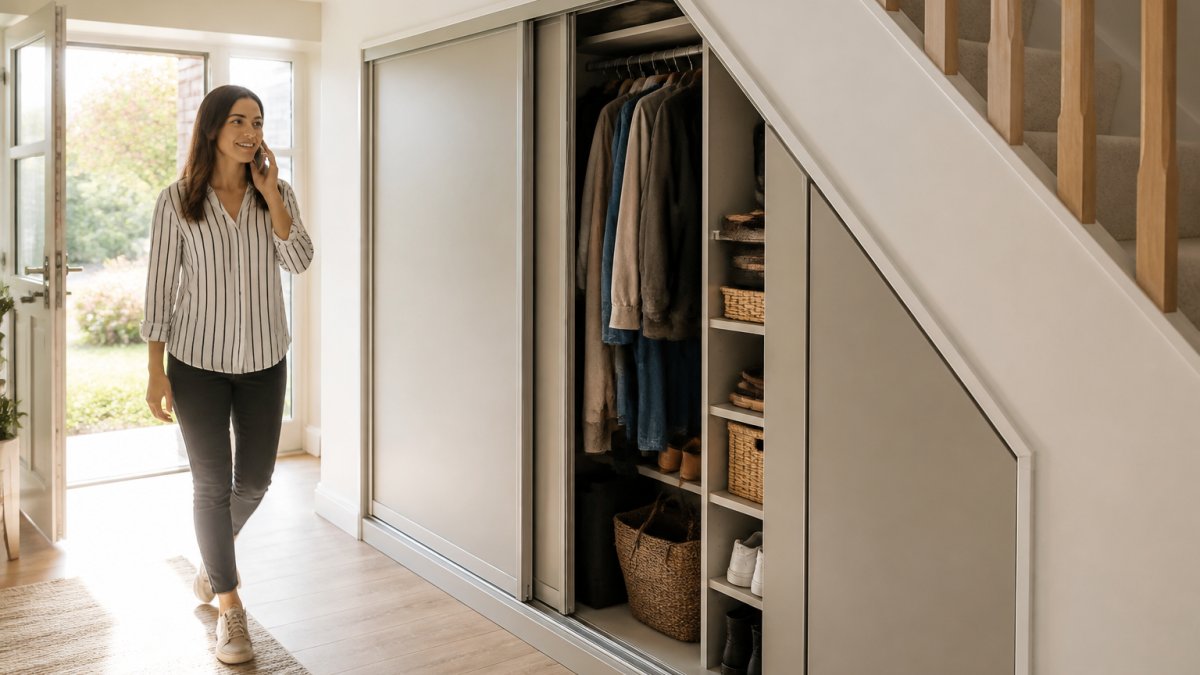
That range matters because stair voids vary enormously. A short run under a straight flight is a different job from a long diagonal under a dog-leg stair.
How to Plan Your Layout by Stair Shape
The shape of your staircase decides the layout. Work out where the headroom is tallest, that is where full-height hanging goes, and where it drops away, where shelves and drawers belong.
- Straight flight: headroom falls steadily from one end to the other. Put long-hanging clothes at the tall end, short-hanging and shelves in the middle, and shoe drawers or low cupboards at the shallow end.
- Dog-leg or winder stair: the void is often taller in the middle and lower at both ends. Use the central section for a full-height cupboard and the two ends for coats, shoes or a utility cupboard.
- Under a half-landing: you often get a taller, boxier void. This is the best shape for a proper wardrobe with a hanging rail and a shelf over it.
- Narrow hallway void: depth is limited, so favour shallow shelves, pull-out drawers and a single hanging rail over a deep cupboard.
Measure the height at three points, tallest, middle and lowest. Those three numbers tell you more about what will fit than any floor plan.
2. Under Stairs Coat Storage: Hanging Rails That Work Harder
Under stairs coat storage works best when the hanging rail is set at the right height for what actually hangs on it. Coats need a long drop. Shirts, jackets and children's clothing do not.
Most people fit one rail at a single height and then wonder why half the space above it is empty.
A few practical points we have learned from fitting these:
- Long-hanging clothes need roughly 1500mm of clear drop. Short-hanging needs around 1000mm, which is why stacking two short rails doubles your capacity in the same footprint.
- Put a shelf above the long-hanging rail for bags, boxes and out-of-season items.
- Keep the deepest part of the void for the rail. Hanging clothes need depth front to back, so a shallow end is wasted on a rail.
- Add a low drawer bank under the short-hanging section for gloves, scarves and umbrellas.
For a hallway that doubles as a mudroom, this is the layout that earns its keep. Coats go in, shoes come off, and the floor stays clear.
3. Under Stairs Shoe Storage: Drawers, Shelves, and Pull-Out Solutions
Under stairs shoe storage is where the wedge shape helps you: the shallow end is too low for hanging but perfectly sized for shoe drawers and shallow shelves.
The mistake is building deep shelves for shoes. A pair is roughly 300mm long, so a 600mm-deep shelf wastes half its depth and hides the back pair forever.
Three approaches work well in a stair void:
- Pull-out shoe drawers: shallow drawers on runners, one or two pairs deep. Ideal in the low end where you cannot stand upright.
- Tiered shelves: two or three stepped shelves so the back row sits higher than the front. Good for a family with a lot of shoes in rotation.
- Deep pull-out trays: for the tall end of the void, where you can stack more and pull the whole tray out to reach the back.
If you have children, put the lowest drawer at their height. A drawer they can open and close themselves is the difference between shoes on a shelf and shoes on the floor.
4. Under Stairs Cupboard Ideas: Concealed Storage That Looks Built In
An under stairs cupboard idea only works if it disappears into the room: doors running the full height of the opening, finishes matching the surrounding joinery, and no visible gaps where the staircase meets the frame.
Concealed storage is why sliding doors suit this space so well.
Where the doors do not run up to a wall, you need an end panel to close the run. Our premium end panel is 2750mm x 640mm x 18mm, melamine faced with 2mm PVC edging on one long edge, and we can supply specific cut and edged sizes if your run needs them.

A few finishes and details that make the difference:
- Mirror doors bounce light around a dark hallway and make the space feel wider.
- Glass and woodgrain finishes let the cupboard read as furniture rather than a boxed-in void.
- Full-height doors hide the sloping ceiling line entirely, so the cupboard looks like a built-in wall.
For a pantry or utility cupboard in a kitchen hallway, the same approach applies. Concealed doors, full-height run, interior shelving sized to what you actually store.
5. Pull-Out Drawers and Modular Interiors for Deep, Sloping Spaces
Pull-out drawers solve the one problem every stair void has: the back of the cupboard. In a deep, sloping space, anything beyond arm's length from the opening becomes a black hole.
Drawers on full-extension runners bring the contents to you, which matters most in the tall end of the void where depth is greatest and reach is worst.
Our interior sets are built on this principle.
Because the components are modular, you can mix hanging, shelving and drawer space in one run.
6. Lighting, Ventilation, and Damp Prevention for Under Stair Wardrobes
Lighting, ventilation and damp control are the three things most under stair projects get wrong, and they decide whether the wardrobe stays usable. A dark, sealed void with no airflow will smell musty within a season.
Start with light.
Ventilation matters just as much. Coats and shoes hold moisture, and a sealed cupboard traps it against the walls.
For damp, the priority is keeping the structure clear of the cold surface. Our interiors are supplied without backs by design, which keeps the wardrobe components off the wall and allows air to circulate behind.
A quick pre-fit check:
- Is there any sign of existing damp or staining on the walls behind the void?
- Can air move in at the bottom and out at the top?
- Is the interior clear of the external wall by a small gap?
- Is there a light source inside the run, not just in the hallway?
- Are shoes and coats dry before they go in?
7. Costs, Trade-Offs, and What to Expect from a Fitted Wardrobe Project
A fitted under stair wardrobe costs more than a flat-pack cupboard, and it should.
Here is how our interior sets compare, so you can match the run to your opening width:
| Interior Set | Max Opening Width | Shelves | Hanging Rails | Price |
|---|---|---|---|---|
| Interior 2 Door A | 2100mm | 1 | 3 | £478.00 |
| Interior 2 Door B | 2100mm | 6 | 1 | £658.20 |
| Interior 3 Door A | 3130mm | 2 | 4 | £754.80 |
| Interior 3 Door B | 3130mm | 6 | 3 | £906.00 |
| Interior 4 Door A | 4160mm | 2 | 6 | £885.00 |
| Interior 4 Door B | 4160mm | 6 | 5 | £1,039.80 |
| Interior 5 Door A | 4860mm | 3 | 7 | £1,090.20 |
| Interior 5 Door B | 4860mm | 8 | 6 | £1,236.00 |
The "A" sets lean towards hanging space for coats and everyday clothing; the "B" sets lean towards shelving for shoes, folded items, boxes and utility storage. Neither is better, they suit different voids.
The honest trade-offs:
- Measure carefully. These are made to measure, so the fit depends on your numbers.
- Sliding doors need a clear track run. On a tight landing, that is the constraint that decides the layout.
- A backing panel is optional. We do not supply backs as standard because they add cost without adding function in most voids. If you want one, it is an extra £100 per door.
Every set carries our 10-year guarantee and a three-stage quality check before it leaves us.
An awkward staircase void is one of the hardest storage problems in a house, and one of the most rewarding to solve.
Frequently Asked Questions
Can you fit a wardrobe under the stairs?
Yes, and it is one of the most effective ways to reclaim dead space in a hallway. The trick is using made-to-measure interiors rather than standard flat-pack units. A fitted under stair wardrobe is built around the actual shape of your staircase, so the sloping ceiling and wedge-shaped footprint become part of the design instead of obstacles. Sliding doors work particularly well here because they need no clearance to open, which matters when the space in front is a busy walkway.
Are sliding doors a good choice for under stair storage?
They are often the best choice. Hinged doors need room to swing out, and under-stair areas usually sit in a hallway where floor space is tight. Sliding doors run along a track and take up no extra room, so you can place furniture or coat hooks right up to the wardrobe. They also suit the low, angled sections of a staircase because each panel can be sized individually.
How can I make an under-stair wardrobe more practical?
Plan the interior around what you actually store. Long-hanging clothes need a rail at full height, while short-hanging items can sit above a bank of shoe drawers. Use the deep end of the space for pull-out drawers and reserve shallow shelves for folded items near the low end. Add a light inside so you can see the back of the wardrobe, and leave a small gap or vent to keep air moving. A made-to-measure interior set lets you combine shelves, dividers, and rails in one unit.
What should I store in an under-stair wardrobe?
Coats, shoes, and bags are the most common choices because the wardrobe sits near the front door. You can also use it for household items such as vacuum cleaners, ironing boards, or cleaning supplies in a dedicated utility cupboard. If the space is in a hallway rather than a bedroom, think of it as a mudroom: a hanging rail for everyday coats, shoe drawers at the bottom, and a shelf above for hats and gloves. Keeping categories separate stops the space becoming a dumping ground.
How do I organise an under-stair wardrobe?
Start by sorting items into groups: long-hanging clothes, short-hanging clothes, shoes, and bulky items. Assign the tallest section to long-hanging garments and the lowest section to shoes or folded items. Pull-out drawers work well in the deep end where reaching to the back is difficult. Add labels to shelves if several people share the space. A modular interior with adjustable shelves and rails lets you change the layout later without replacing the whole unit.
Leave a comment