


How to Measure Sliding Wardrobe Doors: 2026 Guide
Table of Contents
- Before You Start: What You'll Need to Measure Sliding Wardrobe Doors
- Step 1: Measuring Wardrobe Opening Width
- Step 2: Measuring Ceiling Height at Multiple Points
- Step 3: How to Install Sliding Wardrobe Tracks on Carpet
- Step 4: Accounting for Obstructions and Calculating Aperture Size
- Common Measuring Mistakes to Avoid with Sliding Wardrobe Doors
- Conclusion
- Frequently Asked Questions
Last Updated: September 15, 2026
Before You Start: What You'll Need to Measure Sliding Wardrobe Doors
Getting the measurements right is the difference between a wardrobe that glides for fifteen years and one that jams by Christmas. At DoorsDirect, we've handled thousands of made-to-measure orders, and the vast majority of fit problems trace back to a single cause: the opening was measured at one point instead of several. This guide shows you how to measure sliding wardrobe doors properly, using the same sequence our trade customers follow on site.

Measure the opening in three places for width and three for height, then take the smallest figure. That rule alone prevents most of the returns we see.
British Standard BS 8600 on domestic furniture safety sets out general safety expectations for built-in storage, and it's worth knowing that made-to-measure doors are cut to your figures, not adjusted on site.
Best Tools for Measuring Wardrobe Spaces
You need five things, and none of them are expensive:
- A steel tape measure, 5m or longer. Fabric tapes stretch and will cost you millimetres.
- A spirit level, ideally 1m, for checking plumb on side walls.
- A pencil and a notepad, or masking tape to mark positions directly.
- A step or platform so you can read the top track line comfortably.
- A helper for anything wider than 1.8m.
Step 1: Measuring Wardrobe Opening Width
Measure the opening width at three heights: near the floor, at the midpoint, and near the ceiling. Record all three, then use the smallest. A typical bedroom alcove might read 1780mm at the bottom, 1785mm in the middle, and 1772mm at the top, and 1772mm is the figure you order to (Accelerating Progress Towards a Sustainable World).
This is where most DIY measurements go wrong. Walls bow, plaster varies in thickness, and skirting boards throw the base line out. The smallest figure is the only one that guarantees the door system will pass through the whole opening.
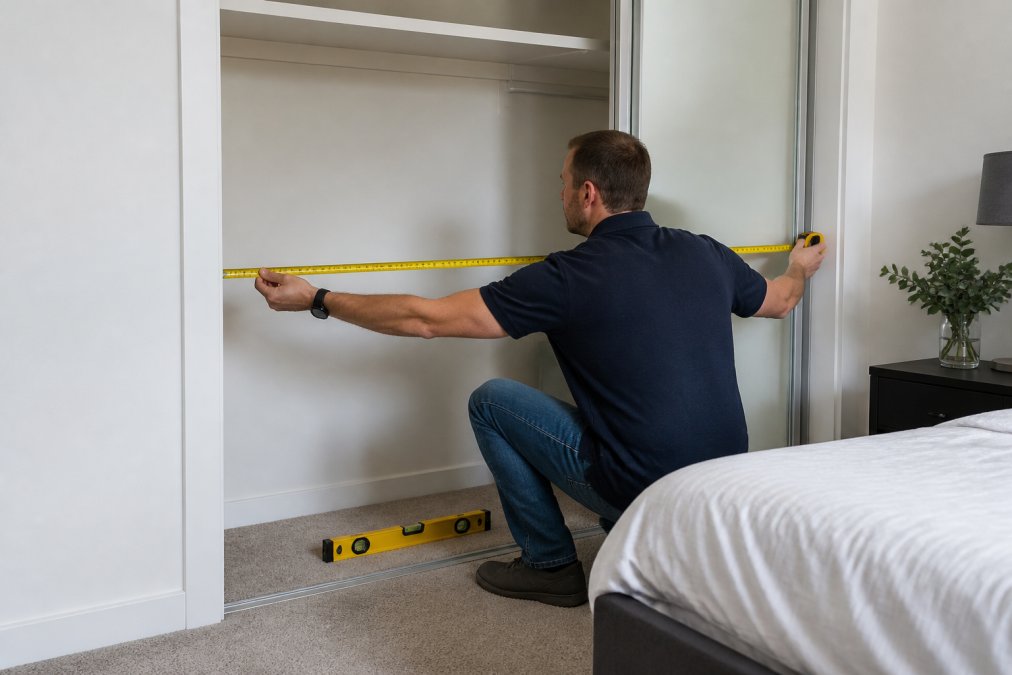
Checking for Out-of-Square Walls
An opening is out of square when the diagonal measurements differ. Measure corner to corner in both directions. If the two figures differ by more than about 10mm, the opening is out of square and you need to plan for it.
DoorsDirect cuts every door to your supplied dimensions, which means an out-of-square opening is handled by the door sizing rather than by forcing a standard panel into place. Tell us the diagonal figures when you order and we'll factor them in.
Step 2: Measuring Ceiling Height at Multiple Points
Take the height at the left edge, the centre, and the right edge of the opening, then use the smallest. Ceilings in older properties routinely vary by 15mm or more across a 2m span, and a top track fitted to the highest point will leave a visible gap at the lowest (the NHS).
For a floor-to-ceiling installation, subtract your track and clearance allowance from the smallest height. If you're fitting a frame or casing instead, measure to the underside of the head casing.
Accounting for Floor and Ceiling Levels
Check the floor with your spirit level before you commit to a height. A floor that falls 8mm across the opening will make a level bottom track sit proud at one end. Packing under the track solves it, but you need to know before you order.
The same applies overhead. If the ceiling slopes or dips, the top track needs packing to stay level, and your door height must allow for that packing.
Step 3: How to Install Sliding Wardrobe Tracks on Carpet
Fitting tracks over carpet is straightforward, but the carpet changes your height calculation. Measure to the floorboards or screed, not to the pile, then add the depth of the carpet and underlay at its compressed thickness.
- Lift the carpet and underlay back from the track line.
- Fit the bottom track directly to the subfloor for the most stable result.
- If you must fit over the carpet, use a track with a deeper profile so the doors clear the pile.
- Check clearance at both ends of the track, since carpet is rarely level.
DoorsDirect supplies top and bottom track sets with every made-to-measure door order, so you're not sourcing a compatible track separately. For a two-door setup, the Custom 2 Door Sliding Wardrobe Doors come as a complete set at £538.00.
Step 4: Accounting for Obstructions and Calculating Aperture Size
The aperture is the clear opening you actually walk through. It is always narrower than the full track width, because the doors overlap where they meet and because the end panels and track returns eat into the space at each side. Accounting for these physical constraints ensures that your wardrobe fits seamlessly within the room, a principle that remains equally critical when measuring space for furniture throughout the rest of your home.
Calculating the Aperture
Work it in three stages:
- Start with the smallest width reading from Step 1, not the wall-to-wall figure.
- Subtract the total overlap. A two-door system typically loses one overlap; a four-door system loses three. The overlap figure for your chosen track is supplied with the door set, so check it before you finalise the order rather than assuming a round number.
- Divide by the number of doors to get the individual door width, then check that figure against the minimum door width your track is rated for.
A worked example: an opening measuring 1772mm at its smallest, with a two-door system losing 60mm to overlap, gives 1712mm of door run, or 856mm per door. That is comfortably above the minimum for most domestic tracks, but a four-door system on the same opening would give roughly 428mm per door, which is tight for a walk-through and worth checking against the track specification.
Obstructions That Change the Measurement
Most guides ignore these, and they are the single most common cause of a door set that fits the opening but not the room:
- Light switches and sockets. A socket sitting 200mm inside the opening will foul the end panel or the door return unless the panel layout is planned around it. Measure from the obstruction face to the opposite wall, not from the wall behind it.
- Radiators. Measure to the front face of the radiator, not the wall. If the radiator sits under the opening, the bottom track line may need to move forward, which changes your height calculation.
- Skirting boards. Skirting throws the base line out by its thickness, commonly 12-18mm. Either measure above the skirting or plan to notch the track around it.
- Coving and picture rails. These reduce the usable height at the top of the opening. Measure to the underside of the coving, not the ceiling, if the top track has to sit below it.
- Door architraves and adjacent door swings. An inward-opening room door beside the wardrobe can clash with a sliding panel. Measure the clear swing and note it.
What Happens If You Get It Wrong
Getting the aperture calculation wrong does not usually stop the doors going in, it stops them working properly afterwards:
Common Measuring Mistakes to Avoid with Sliding Wardrobe Doors
| Mistake | What It Causes | The Fix |
|---|---|---|
| Measuring width at one point only | Doors bind where the wall bows | Take three width readings, use the smallest |
| Using the largest height | Top track gap or doors that won't fit | Use the smallest of three height readings |
| Ignoring skirting boards | Bottom track sits proud | Measure above skirting or notch the track |
| Forgetting door overlap | Aperture narrower than expected | Subtract overlap, then divide by door count |
| Measuring over carpet pile | Doors drag on the pile | Measure to subfloor, add compressed carpet depth |
| Skipping the diagonal check | Out-of-square opening, uneven gaps | Compare both diagonals before ordering |
Conclusion
Frequently Asked Questions
Are sliding wardrobe doors standard sizes?
No, sliding wardrobe doors are almost never standard sizes. Because every room has different dimensions, most suppliers, including DoorsDirect, make doors to measure. This means you provide the exact opening width, ceiling height and track clearance, and the panels are cut to suit. Trying to force a standard-size door into a non-standard opening leads to gaps, sticking and premature track wear.
What tools do I need to measure for sliding wardrobe doors?
You need a retractable tape measure at least 3 metres long, a spirit level, a pencil, and a notepad. A plumb line helps check that walls are vertical. For wider openings, a second person makes the job easier and reduces the chance of a misread. Avoid cloth tapes, which stretch and give inaccurate readings.
Do I need to account for floor and ceiling levels when measuring?
Yes. Floors and ceilings are rarely perfectly level, and even a 10mm slope across the opening affects how the top and bottom tracks sit. Measure ceiling height at three points: left, centre and right. Use the shortest measurement as your maximum height. This ensures the doors clear the floor and the track fits without forcing.
How do I measure the height of my wardrobe opening?
Measure from the highest point of the floor to the lowest point of the ceiling within the opening. Take readings at the left, centre and right, then use the smallest figure. Subtract any allowance your supplier specifies for the top and bottom tracks, typically 40 to 50mm combined. This prevents the doors from fouling the ceiling or dragging on the carpet.
Leave a comment