


Best Sliding Wardrobe Doors for Home Renovation 2026
Table of Contents
- Quick Comparison: Sliding Wardrobe Doors at a Glance
- How to Choose Sliding Wardrobe Doors for a Renovation
- Made-to-Measure Sliding Wardrobe Doors: Why Fit Beats Standard Sizes
- Sliding Wardrobe Door Finishes: Mirror, Glass and Wood-Effect
- The Best Sliding Wardrobe Doors for Home Renovation
- Fitting, Lead Times and Long-Term Care
- Conclusion
- Frequently Asked Questions
Last Updated: September 25, 2026
Quick Comparison: Sliding Wardrobe Doors at a Glance
Choosing the best sliding wardrobe doors for a home renovation comes down to three things: opening width, ceiling height, and budget. This guide walks through every option in the DoorsDirect made-to-measure range.
| Model | Doors | Price | Max Height | Max Width | Best For |
|---|---|---|---|---|---|
| Ripon 2 Door | 2 | £478 | 2490mm | 1780mm | Tight budgets |
| Durham 2 Door | 2 | £528 | 2490mm | 2100mm | Most renovations |
| Monaco 2 Door | 2 | £558 | 2540mm | 2100mm | Tall ceilings |
| Sofia 3 Door | 3 | £889 | 2540mm | 3130mm | Wide openings |
| Custom 2 Door | 2 | £837 | Made to measure | Made to measure | Awkward layouts |
How to Choose Sliding Wardrobe Doors for a Renovation
Start with the opening, not the finish. Measure the full width and floor-to-ceiling height, then note anything that interrupts the space, such as a chimney breast or doorway return.

Opening Width and Door Count
Two doors suit openings up to roughly 2100mm; beyond that, panels get heavy and the overlap eats into access. A three-door set like the Sofia handles widths up to 3130mm and gives a wider clear opening when the middle panel slides across.
Track System and Frame Profile
Aluminium tracks outlast steel, which is why every DoorsDirect set uses aluminium. Slimline profiles keep the frame visually light, and soft-close action is available as an extra on most ranges to stop doors slamming at the end of their run.
Made-to-Measure Sliding Wardrobe Doors: Why Fit Beats Standard Sizes
Standard door sizes force compromises. Made-to-measure sliding wardrobe doors are built to your exact opening, so there are no filler panels, gaps at the edges, or wasted millimetres.

Sliding Wardrobe Door Finishes: Mirror, Glass and Wood-Effect
Finish is the decision most people make first and regret last. Each material behaves differently under daily use, and the right choice depends on the room's light, who uses the wardrobe, and how much cleaning you will do.
Mirror
Mirror panels make a small bedroom feel twice the size by bouncing light back into the room. They suit alcoves and loft spaces where natural light is limited, and double as a full-length dressing mirror without taking up wall space.
Glass
Glass finishes, including tinted, frosted and reeded options, give a modern aesthetic without a mirror's full reflectivity. Frosted and reeded glass hide the wardrobe's contents while letting light through, suiting bedrooms where the wardrobe should read as a wall rather than a storage unit.
Wood-Effect
Wood-effect melamine brings warmth and hides fingerprints better than glass or mirror. It is the most forgiving finish for family homes and the easiest to live with day to day; modern foils replicate grain convincingly and wipe clean with a damp cloth.
Mixing Finishes Across a Set
You can mix finishes across a single set. A common configuration pairs a mirror door with a wood-effect door so one panel reflects light while the other anchors the colour scheme. On a three-door set, a popular layout is wood-effect, mirror, wood-effect, the mirror in the middle, framed by the outer panels.
Frame Finish Matters Too
The frame profile is visible even when the doors are closed, so it must work with the panel finish. Aluminium frames come in powder-coated colours from white and cream through to anthracite and black. A slim anthracite frame around a mirror panel reads contemporary; the same frame around a light oak-effect panel reads warmer and more traditional.
Sustainability and Material Sourcing
Wood-effect panels are typically built on a substrate board. Aluminium is one of the most recyclable metals in common use, so an aluminium frame has a lower end-of-life impact than steel or composite.
The Best Sliding Wardrobe Doors for Home Renovation
The best sliding wardrobe doors for a renovation match your opening, ceiling height, and budget without compromise. Here is how the range breaks down.
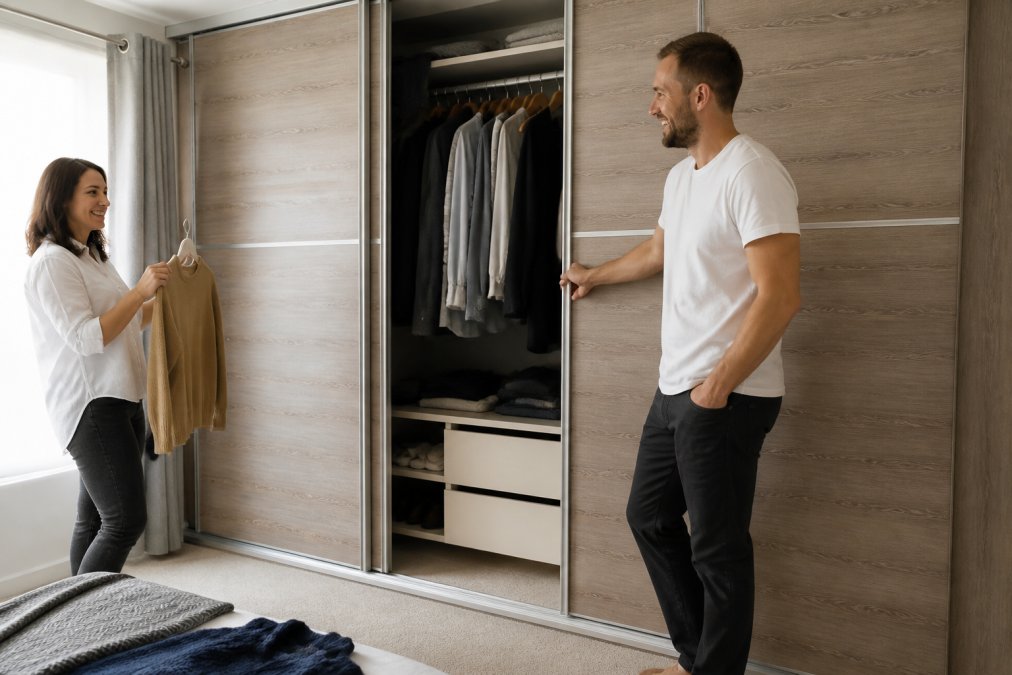
Budget Pick: Ripon 2 Door
At £478, the Ripon 2 Door is the cheapest way into a made-to-measure set. Full-panel design, aluminium profile and track, and a white finish as standard. It fits openings from 800mm to 1780mm and heights up to 2490mm.
Best All-Rounder: Durham 2 Door
The Durham 2 Door costs £528 and covers the widest range of ordinary bedrooms: openings from 900mm to 2100mm, four profile colours, and the same aluminium track system as the premium sets.
Custom 2 Door Sliding Wardrobe Doors →

Best for Tall Openings: Monaco 2 Door
Ceilings above 2490mm rule out the economy ranges. The Monaco 2 Door reaches 2540mm, comes in eight profile colours and two profile shapes, and at £558 costs £30 more than the Durham for that extra 50mm of height.
Best Wide-Span Option: Sofia 3 Door
The Sofia 3 Door is the only three-door set in the range and the answer to a wall-to-wall opening, spanning 1500mm to 3130mm and reaching 2540mm in height at £889.
Best for Custom Layouts: Custom 2 Door Sliding Wardrobe Doors
When nothing standard fits, the Custom 2 Door Sliding Wardrobe Doors are built around your dimensions. At £837, this suits loft conversions, alcoves and openings that fall between two catalogue sizes.
Fitting, Lead Times and Long-Term Care
This is the section that decides whether your wardrobe still slides smoothly in five years' time.
DIY or Professional Installation?
Fitting a sliding set is a two-person job. The track goes up level and square first, then the doors hang and run. Whether you do it yourself depends on the system and the room.
A rough difficulty guide:
- Straightforward (competent DIYer, half a day to a day): a two-door set on a plumb, square wall with a level floor, standard ceiling height, and no obstructions. The track fixes to the wall or ceiling, the doors hang on rollers, and the only fiddly part is adjusting the rollers so the doors sit flush.
- Moderate (experienced DIYer or a handyperson): a three-door set, or a two-door set where the opening is wider than about 2100mm. More panels mean more weight and more adjustment, and the middle door on a three-door run needs careful alignment so it slides past both outer panels without catching.
- Professional (joiner or fitter): any opening where the reveal is out of square, the floor slopes, or the wall is not plumb. Older properties almost always fall into this category. A fitter will pack and shim the track to compensate, which is the difference between a door that glides and a door that binds.
Lead Times
Made-to-measure doors are not off-the-shelf items, so lead time matters when coordinating a renovation. Allow for manufacture plus delivery, and build that into your schedule before booking a fitter. Order the doors before the installation date, not after, a fitter arriving to a room with no doors is an expensive rescheduling.
Long-Term Care
Care is simple but not nothing: a sliding wardrobe that is never maintained will start to drag within a couple of years.
- Tracks: vacuum the bottom track monthly, and use the brush attachment on the top track every few months. Grit in the bottom track is the single most common cause of a door that suddenly stops running smoothly. A dry soft brush or an old toothbrush gets into the channel better than a vacuum alone.
- Panels: wipe glass and mirror panels with a non-ammonia cleaner. Ammonia can attack the backing film on some mirror panels over time, so check the label before you spray. Wood-effect melamine wipes clean with a damp cloth and needs nothing more.
- Rollers: check the rollers once a year. Most are adjustable, and a quarter-turn on the adjustment screw is often all that is needed to bring a door back to level. If a roller is worn flat or noisy, replace it, rollers are a consumable part and are inexpensive compared to a new door.
- Alignment: if a door starts to catch at one end of its run, the cause is almost always the track settling or a roller going out of adjustment, not the door itself. Re-level the track first, then re-adjust the rollers. Do not force a binding door, because you will damage the roller housing.
- Frames: aluminium frames do not rust, and the powder-coated finish wipes clean. Avoid abrasive pads, which will dull the coating.
Warranty and What It Actually Covers
Every range carries a 10-year guarantee and passes a three-stage quality check before dispatch. The important question is what the guarantee covers: one covering the mechanism, track, rollers, runners, is worth more than one covering only the panels, because the mechanism is where cheaper sets fail first.
Conclusion
The hardest part of a wardrobe renovation is not choosing a finish, it is finding a set that fits an opening no standard size was built for. DoorsDirect makes every door to measure, from the £478 Ripon through to fully bespoke sets, with aluminium tracks, soft-close options, and a 10-year guarantee.
Frequently Asked Questions
Are sliding wardrobe doors better than hinged doors for small rooms?
Sliding wardrobe doors open along the track rather than swinging out, so they need no clearance space in front of the wardrobe. In a small bedroom that frees up floor area for a bed or desk, and you can position furniture closer to the wardrobe run. Hinged doors need roughly their own width of clear space to open fully. Sliding doors also suit wall-to-wall installations where a hinged door would clash with a neighbouring wall or door frame.
What materials are best for durable sliding wardrobe doors?
Look at the frame and track first. Aluminium profiles and tracks resist bending and stay true over years of use, which keeps door panels running smoothly. Panel materials such as glass, mirror and melamine-faced board are all hard-wearing when supported by a solid frame, and glazing gaskets plus soft brush pile edging help keep dust out of the mechanism. A 10-year guarantee is a useful signal that the maker expects the doors to last.
How do I choose the right finish for my sliding wardrobe doors?
Start with the light in the room. Mirror panels bounce daylight around and make a small bedroom feel larger, while glass in tinted or textured options adds a modern aesthetic without a full reflection. Wood-effect finishes in oak or grey tones tie the wardrobe into existing flooring and furniture. You can also mix materials across panels, for example a mirror centre with wood-effect outer panels, and pick a profile colour that matches your door handles and skirting.
What are the benefits of made-to-measure sliding wardrobe doors?
Made-to-measure doors are built to your exact opening width and height, so they close flush against the frame with no filler panels or gaps. That matters in rooms where standard sizes do not fit, and it lets you set the door count to suit the space, from a narrow two-door run up to a three-door set for a wide wall.
Can sliding wardrobe doors be installed in any room?
They work in most rooms where you have a straight run of wall and enough height for the top track. Bedrooms are the usual choice, but the same door sets suit alcoves, home offices and hallway storage. The main checks are that the floor is reasonably level, the wall is straight enough for the track to sit flat, and the opening width falls within the range of the door set you pick. Tracks arrive slightly longer than the opening so they can be trimmed on site.
Leave a comment