


Are Made to Measure Wardrobes Worth It? A 2026 Guide
Table of Contents
- Are Made to Measure Wardrobes Worth It? The Verdict Up Front
- Made to Measure vs Off-the-Shelf: A Direct Comparison
- How to Maximize Bedroom Storage Space With a Custom Fit
- Wardrobe Internal Layout Configurations That Actually Work
- The Impact on Property Value and Long-Term Investment
- Maintenance, Longevity and Environmental Considerations
- Conclusion: Making the Right Choice for Your Home
- Frequently Asked Questions
Last Updated: September 30, 2026
Are Made to Measure Wardrobes Worth It? The Verdict Up Front
Yes, made to measure wardrobes are worth it when your room has awkward proportions, you plan to stay several years, and you want storage that fits the space rather than the space bending around a standard unit. This guide from DoorsDirect weighs the real costs, resale implications and practical trade-offs.
Made to Measure vs Off-the-Shelf: A Direct Comparison
The core difference is fit, and fit is what you're paying for. Off-the-shelf units come in fixed widths, so you either leave gaps at the sides or lose height by not going to the ceiling. Bespoke fitted wardrobes are cut to your room's actual measurements, so they handle alcoves, chimney breasts and uneven walls far better.
| Factor | Off-the-Shelf | Made to Measure |
|---|---|---|
| Fit | Fixed sizes, filler gaps | Exact wall-to-wall fit |
| Awkward rooms | Poor | Handles alcoves and offsets |
| Storage capacity | Limited by standard sizes | Uses full height and depth |
| Lead time | Immediate | Built after measurement |
| Long-term value | Low | Adds usable space |
What You Pay For With Bespoke Fitted Wardrobes
You're paying for three things: accurate measurement, custom manufacturing, and components built to last. A bespoke wardrobe isn't a premium label on a standard box, it's dimensioned around your room, which is why it can run floor-to-ceiling and use every centimetre of an alcove.
How to Maximize Bedroom Storage Space With a Custom Fit
Storage capacity is where bespoke wins outright. A standard double wardrobe might offer around a metre of hanging space; a fitted run across the same wall, taken to the ceiling, can double that with a top shelf zone and a second rail.
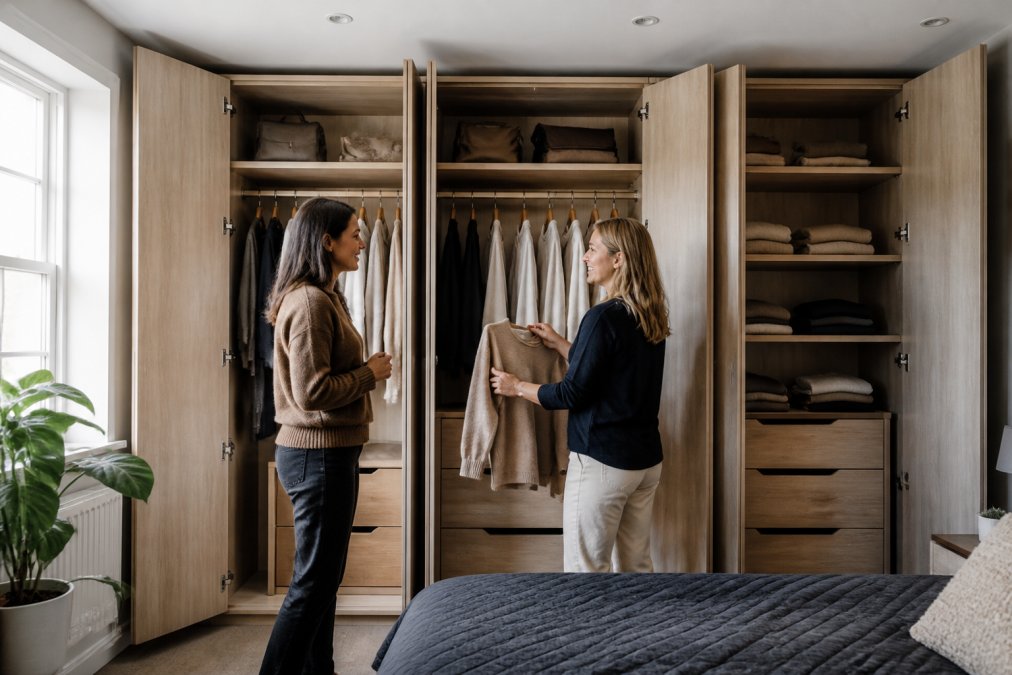
The gains come from three places most buyers overlook:
- Height. Standard units stop short of the ceiling. Fitted storage uses that dead zone for seasonal items and suitcases.
- Depth. Bespoke interiors can be built to the depth your room allows, not the depth a retailer stocks.
- Corners. Alcove storage turns a useless recess into a full-height cupboard.
Wardrobe Internal Layout Configurations That Actually Work
A good internal layout is planned around what you actually own, not a generic template. The most common mistake is over-ordering hanging space and under-ordering drawers, leaving folded clothes stacked on top of the rail.
Planning Your Hanging, Shelving and Drawer Zones
Start with an inventory. Count long-hang items (coats, dresses), short-hang items (shirts, trousers) and folded items separately. Then allocate zones:
- Full-height hanging for coats and long dresses, usually 1.5m or more
- Double hanging for shirts and trousers, two rails stacked
- Shelving for folded knitwear, bags and boxes
- Drawer units for underwear, socks and accessories
- A top shelf for occasional-use items
The Impact on Property Value and Long-Term Investment
Most guides answer this with a shrug and a sentence about kerb appeal. That is not useful if you're deciding whether to spend on fitted joinery or put the money towards a new kitchen. So let's separate what is measurable from what is folklore.
What Fitted Wardrobes Do and Don't Do at Valuation
A wardrobe is not a fixture in the way a boiler or bathroom is, and it will not appear as a separate line on a surveyor's valuation. Surveyors value the property, not the furniture, and a lender's mortgage valuation will not reward you for a well-organised interior. Investing in bespoke storage remains a personal choice rather than a financial strategy, much like the broader debate surrounding the long-term utility of high end furniture.
- Listing photography. A bedroom with built-in storage photographs as a complete room. A bedroom with a gap and a standalone unit photographs as a room with a problem.
- Viewing objections. Awkward layouts, a chimney breast, an L-shaped room, a narrow box room, give buyers a reason to hesitate. Fitted storage removes that reason before it forms.
- Comparable positioning. Two similar homes on the same street will be priced against each other. The one where the main bedroom clearly works is easier to justify at the upper end of the range.
A Realistic Way to Judge Your Own Return
Rather than reaching for a percentage nobody can substantiate, run the calculation on your own circumstances. Three variables do the work:
- How long you will stay. The shorter the stay, the harder it is for any home improvement to pay back. Under two years, treat the spend as a lifestyle cost, not an investment.
- How bad the storage problem is. In a period property with irregular walls, fitted storage solves something a buyer would otherwise have to solve themselves. In a modern rectangular bedroom with a built-in double already in place, it solves very little.
- How the local market reads the room count. In areas where three-bedroom homes compete on the quality of the third bedroom, a properly fitted box room or loft room can shift how the property is perceived. In areas where buyers are focused on plot size or parking, storage is a footnote.
The Long-Term Investment Case in Plain Terms
If you want a single measure, use cost per year of use rather than a resale percentage. A fitted run serving a household for a decade works every day; a cheaper unit that sags, jams or gets replaced in year three does not. That comparison holds up, and most articles skip it.
Custom 2 Door Sliding Wardrobe Doors →
Maintenance, Longevity and Environmental Considerations
This is the section most guides skip, and it decides whether the spend was worth it five years later. A wardrobe is a mechanical object as much as a piece of furniture, and the parts that fail are predictable.
What Actually Fails, and When
In a fitted wardrobe, the structure rarely gives out first. The moving parts do. In order of how often they cause problems:
- Sliding door runners. The single most common failure point. Cheap nylon rollers on a thin track flatten, then the door drops, then it drags. Quality bottom-running track with adjustable rollers, cleaned once or twice a year, is the difference between a door that glides for fifteen years and one that jumps within three.
- Hinges on hinged doors. Soft-close hinges are a wear item. Most will need adjusting at some point and replacing eventually. They are inexpensive and accessible, which is why hinged doors are often the lower-maintenance choice in a room where the doors are opened constantly.
- Drawer runners. Loaded drawers on light-duty runners sag and stick. Full-extension runners rated for the load they carry last far longer.
- Panel edges. This is where flat-pack and bespoke diverge most sharply. Board that is cut and edged properly resists moisture and knocks at the corners. Board with a raw or taped edge swells and chips, and once a corner goes, it keeps going.
Bespoke vs Flat-Pack Over Ten Years
The honest comparison is not 'bespoke never breaks'. It is that bespoke units are built from components that can be adjusted, replaced and re-aligned, while flat-pack units are often built to be assembled once. A fitted run can have a worn runner swapped and a door re-hung. A flat-pack carcass that has swollen at the base or lost its cam fixings usually cannot be saved.
Maintenance You Can Actually Do
The routine is short. Wipe sliding tracks and vacuum grit out of the channel a couple of times a year. Check door alignment annually and adjust the rollers if a door catches. Tighten hinge screws if a door drops. Clean glass and mirror panels with a soft cloth and a non-ammonia cleaner. That is the whole list, no repainting, no re-oiling, no tightening of sagging joints, because there are no joints to sag.
Environmental Impact: The Honest Picture
The sustainability argument for made to measure is not that the materials are greener. It is that the unit is used for longer and fits the room it was made for, so it is less likely to be replaced or discarded. Off-the-shelf furniture that does not quite fit is a common route to premature replacement.
Two practical points worth raising with a supplier:
- Board sourcing. Ask whether the board is FSC-certified and where it is manufactured. Certified board is widely available and is a reasonable baseline expectation, not a premium extra.
- End-of-life. Ask whether the unit can be dismantled and the components separated for recycling. Fitted wardrobes that are screwed together rather than glued are far easier to take apart and reuse or recycle later.
Conclusion: Making the Right Choice for Your Home
The question isn't whether made to measure wardrobes are worth it in the abstract, it's whether they're worth it in your room. Awkward dimensions, a long-term stay and a genuine shortage of storage all point the same way. A perfectly rectangular room with space for a standard unit points the other way.
Frequently Asked Questions
What are the main benefits of choosing made to measure wardrobes?
Made to measure wardrobes are built to your room's exact dimensions, so they use every centimetre of space, including awkward alcoves and corners. You choose the internal layout, finishes and door style, which means better organisation and a cohesive look. Unlike flat-pack options, they are fixed in place and typically built from more durable materials, offering a longer lifespan and a higher-quality finish that can add to your home's appeal.
How do bespoke wardrobes increase the value of a property?
Estate agents often highlight fitted storage as a selling point because it signals a well-designed, move-in-ready home. Built-in wardrobes can make a bedroom feel larger and more functional, which appeals to buyers. While no single feature guarantees a higher sale price, a well-executed fitted wardrobe contributes to the overall perceived value and can help your property stand out in a competitive market, especially in rooms with awkward layouts.
Are made to measure wardrobes more durable than flat-pack alternatives?
Generally, yes. Made to measure wardrobes from reputable suppliers use thicker boards, quality hinges and robust tracking systems. For example, DoorsDirect offers a 10-year guarantee on its products, backed by a three-stage quality check. Flat-pack furniture often uses thinner panels and basic fittings, which can loosen over time. The fixed installation of bespoke units also reduces stress on joints, contributing to a longer service life.
What interior storage options are available for custom wardrobes?
You can mix and match hanging rails (single or double), adjustable shelves, drawer units, shoe racks and pull-out trays. For awkward spaces, shelves can be cut to fit around obstacles. DoorsDirect, for instance, supplies made-to-measure shelves up to 600mm wide and a shoe rack that can be cut to the millimetre. This flexibility lets you create a layout that matches exactly how you store your clothes and accessories.
Leave a comment